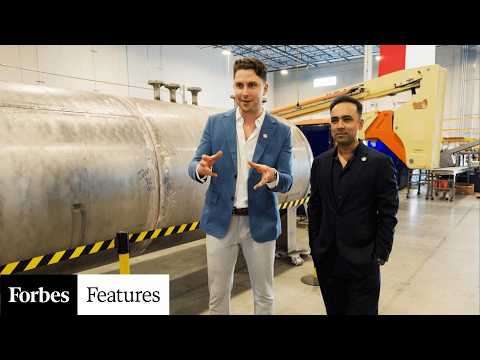
The Startup Mass-Manufacturing Nuclear Energy To Save The AI Grid
AI Summary
The burgeoning AI industry faces a significant bottleneck: power. Hyperscale companies like Google, Microsoft, and Amazon are investing heavily in data centers, but the existing electrical grid cannot meet the escalating demand. This demand is projected to be 100 gigawatts in the US alone within the next five years, a growth comparable to building 100 new cities. This surge is impacting everyday consumers through increased electricity bills and the cost of hardware.
Alo atomic, co-founded by Matt Lozac and Yaser Arafat, proposes a nuclear renaissance as the solution. They aim to revolutionize nuclear energy by overcoming past challenges of slow deployment and high costs associated with large, single-use reactors. Their approach focuses on mass-producing smaller, modular nuclear reactors, termed XMRs (extreme manufactured reactors). These reactors are designed to be 90% factory-manufactured, inherently safe, and deployable within 18-24 months, with a target of less than six months.
The company's name, "Alo," meaning light in Bengali, reflects its mission to bring hope, light, and energy to the future. Both founders have personal motivations rooted in energy scarcity and environmental concerns. Lozac was driven by his childhood asthma, exacerbated by coal-fired power plants, and witnessed the positive impact of the coal-to-nuclear transition in Ontario. Arafat grew up in Bangladesh, experiencing daily brownouts and studying by candlelight, which fueled his desire to solve energy abundance issues for developing nations.
Alo's innovative approach has attracted significant venture capital, raising hundreds of millions of dollars in just two and a half years, surpassing the early funding of SpaceX and Tesla. This influx of capital is supported by a shift in US government policy, with executive orders aimed at reforming nuclear reactor testing and streamlining authorization processes. The urgency is underscored by a government mandate to achieve criticality for two to three nuclear reactors by July 4th, 2026.
Arafat, with decades of experience in designing large-scale reactors, recognized the need to treat nuclear reactors like tech hardware rather than massive construction projects. Alo's strategy involves vertical integration and mass manufacturing, akin to Henry Ford's automotive assembly line. Their pilot factory in Austin is designed to produce modules that can be efficiently assembled on-site. A key innovation is the Alo X, a 20-foot tall, 10-foot diameter reactor that can fit on a truck and power 10,000 homes for three years without refueling.
This miniaturization and rapid production are enabled by using sodium as a coolant, eliminating the need for water and allowing deployment anywhere. Unlike traditional pressurized water reactors, Alo's XMRs are designed to be meltdown-proof, relying on physics, such as gravity for control rod insertion, to ensure safety. The company is de-risking the nuclear, non-nuclear, and economic aspects of their technology.
Alo's factory production aims to achieve cost-effectiveness, targeting three cents per kilowatt-hour, significantly undercutting natural gas. Their goal is to scale production from tens to thousands of reactors annually. While large-scale plants will still be necessary, XMRs can provide cost-effective power to industrial users like data centers, alleviating the burden on consumers for grid expansion. The company's ultimate vision is to deploy this technology globally, helping developing nations overcome energy poverty, a mission deeply personal to Arafat.