THE YOUNG BOY WHO TURN IDEAS INTO REALITY. HOW DID HE DO IT…
Audio Summary
AI Summary
In the village of Igbala, where the Ozen River flowed, lived a quiet boy named Dare, considered unremarkable by his community. At 12, Dare was small for his age and possessed a unique habit of observing things with intense focus—the fire, the river, the blacksmith's hands—as if deciphering a hidden language. His parents, Balagan, a farmer, and Sod, a basket weaver, worried about their only surviving child, holding him at a slight distance, fearful of further loss.
Dare spent his afternoons after school watching Ogi, the finest blacksmith in Igbala, work at his forge. Ogi, a short, wide man with forearms like tree roots, noticed Dare's consistent presence. After three weeks, Ogi engaged the boy, asking what he observed. Dare replied, "The way you hold the hammer, you change your grip between strikes. Nobody else does that." Surprised, Ogi learned Dare had only watched him but had noticed a difference from traditional smithing diagrams, which Dare had seen in school library books. Impressed, Ogi invited Dare into the forge, instructing him not to touch anything.
For two weeks, Dare sat and watched, his questions revealing a mind already deeply engaged with the craft. He asked about the optimal temperature range for shaping metal, seeking not basic information but confirmation for his internal deductions. At the end of the second week, Ogi handed Dare a small finishing hammer. Dare, remembering Ogi's unique grip—the slight forward cant of the wrist, the loose thumb—struck the iron. The sound was "right," a clean contact, not perfect, but indicative of innate understanding. Ogi watched, seeing not a beginner's anxiety but the focused calm of someone performing a task they had already mastered internally.
That evening, Ogi visited Balagan, Dare's father, to convey his observations. Ogi declared that Dare possessed a rare gift, stating, "What I saw today I have not seen in 30 years of this work." Balagan, a man who loved his son fiercely but expressed it as caution, was hesitant. He worried about the hard life of a blacksmith, the uncertain money, and the lack of formal recognition. Ogi countered, explaining that Dare was not simply learning a trade out of necessity but was "built for it from the inside," a distinction Ogi had only seen in three other individuals, two of whom achieved renown beyond the district. Balagan, after much thought about his son's quiet nature, his disengaged school reports, and the children he had lost, agreed to let Dare learn from Ogi for six months, with a promise to revisit the decision.
The subsequent six months were transformative for Dare. He found everything in the forge felt "right"—the tools, the rhythm, the fire's language. He learned with focused intensity, practicing hundreds of strikes, asking "why" before "how," and extracting lessons from his mistakes. By the third month, he was making simple items under Ogi's supervision; by the fourth, independently. In the fifth month, Dare began to imbue his functional pieces with beauty, a quality Ogi had not taught him. A set of wall hooks Dare made for the headmaster, with their refined taper, drew admiration and prompted the headmaster to inquire about the maker. The village, cautiously, began to revise its assessment of Dare.
In the sixth month, a pivotal event occurred. The Oba of Igbala, a man of traditional sensibility and local pride, needed a significant exhibit for the regional heritage festival: an original throne representing Igbala's metalwork tradition. The Oba first approached Ogi, who, unexpectedly, proposed that his apprentice, Dare, design the throne, with Ogi overseeing the execution. Trusting Ogi, the Oba agreed, asking to see Dare's drawings.
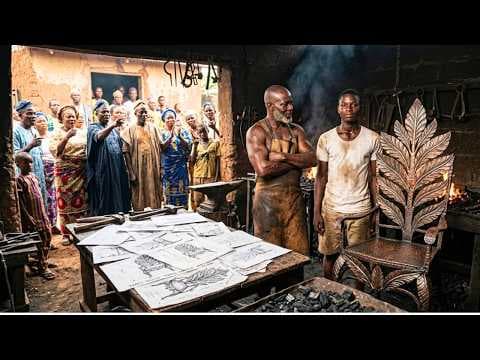
Dare, unaware of the commission's full scope, was asked by Ogi to draw "a seat of authority" that spoke of the village, its craft, and tradition. Dare spent three days, producing not one but seven detailed drawings, each annotated with notes on material, joinery, and light. The throne design deviated from the expected. It was low and wide, traditional in style, but featured a back panel of interlocking iron leaves—not generic, but the specific leaves of the iron tree found along the Ozen River, rendered with meticulous precision. At its base, a geometric pattern, inspired by his mother's basket weaving, connected the village's domestic and industrial crafts.
Ogi, deeply moved by the drawings, confirmed that Dare had conceived them entirely from his mind and the essence of the village. Work began, and Ogi recognized that he was witnessing a rare phenomenon: the convergence of accumulated skill and innate sensibility in one person. He guided Dare, correcting technique when necessary but mostly stepping back, allowing Dare's vision to unfold. The iron leaves were particularly challenging, each requiring individual shaping and slight variations to mimic nature's imperfection. Dare spent 11 days crafting 43 leaves. Balagan, observing his son's dedication, felt a profound and new sense of pride.
The throne was completed three weeks before the festival. Standing in the forge doorway, master and apprentice admired their creation. The iron leaves caught the light, creating a shifting complexity, while the geometric base rooted the piece. It was extraordinary. The Oba, upon seeing it, stood in silent contemplation for a long time before turning to Dare, then 12, and nodding slowly, acknowledging the self-evident genius before him.
At the regional heritage festival, Igbala's throne became the center of attention. Positioned under carefully placed lamps, it drew a sustained audience. A woman from the state cultural board, Mrs. Ady, repeatedly inquired about the maker. Impressed by Dare's honest and unpretentious answers, she noted his design and process. The festival jury, meeting informally, awarded Igbala's throne the prize for traditional craft—a historic win for a village of Igbala's size.
News of the victory preceded their return, and the village erupted in celebration. Dare, riding in the Oba's car, felt a profound sense of belonging, "precisely where he was supposed to be, doing precisely what he was supposed to do, seen by precisely the people who needed to see him." His mother, embracing him, expressed a mixture of knowing and hoping for his future.
Dare continued his apprenticeship, using a state board bursary for materials. Mrs. Ady secured a secondary school scholarship for him. He studied in the district capital during the week and returned every weekend to the forge, eager to test his ideas against iron and fire. Ogi, with true grace, began to learn from his student, as Dare's precision and hunger pushed the craft's boundaries. They worked in easy silence, their combined experience and instinct creating a quality neither could achieve alone.
Commissions followed, slowly at first, then more rapidly. A cultural magazine published photographs of the throne, generating inquiries about the young maker. Balagan, though still farming, found his worry transformed from a formless dread to a specific, manageable concern. On Dare's 17th birthday, Balagan stood at the forge gate, finally understanding the pull of the craft, the music of hammer on anvil, and the deep satisfaction his son found there. He felt a release, a certainty that Dare would be alright.
Inside the forge, Dare worked alone on a small, unasked-for gift for his mother: decorative clasps for her basket weaving frame, translating her lifelong pattern into iron. As he finished, holding the perfectly shaped, clean-surfaced iron in the lamplight, he felt a profound sense of purpose. At 17, with his whole life ahead, Dare stood on the cusp of everything he could become, a master in the making, precisely where he was meant to be.