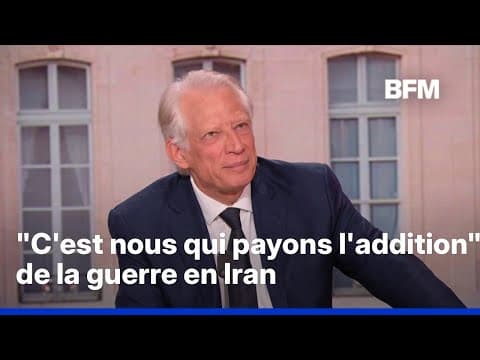
Iran, Donald Trump, racisme en France: entretien avec Dominique de Villepin, ancien Premier ministre
Audio Summary
AI Summary
The discussion begins with an analysis of the rescue of an American pilot in Iran, highlighting the formidable professionalism and courage of the pilots involved in a difficult operation. The American administration is seen as taking significant risks, operating in a "grey area" where events could escalate quickly, especially given Donald Trump's strong rhetoric. The speaker notes that the United States does not hold the initiative in this conflict, despite its superior power, due to the resilience of the Iranian regime and its ability to operate effectively on its own hostile terrain. This means Americans face a high risk of capture in any operation.
The current situation suggests that Donald Trump's control over the situation is limited, despite his claims of controlling Iranian airspace. The Iranian regime is resistant to American arguments, and the use of force and violence does not intimidate a regime focused on its survival. The speaker emphasizes that in asymmetrical power dynamics, the initiative often lies with those who can use limited means with determination, rather than solely with the strongest power.
Regarding the war's objectives, specifically regime change and preventing Iran from acquiring nuclear weapons, the speaker questions the justification for the conflict. They argue that if the goal was truly to disable the nuclear program, other solutions, such as the agreement signed by Barack Obama that Trump later scrapped, were available. The current approach of attempting to destroy the program from the air is deemed ineffective, as the knowledge and personnel exist to rebuild it. The stated war aims, therefore, have not been fulfilled and are unlikely to be achieved by force.
A new era is emerging, revealing the true nature of American power: destruction. The ultimatums given by the US demonstrate their capacity for "unlimited fire" aimed at destroying living conditions in Iran. The speaker believes that destroying the daily lives of Iranians has become a war aim, moving beyond previously stated objectives. This "negative power" is held by the Americans in their asymmetrical relationship with Iran.
A second crucial aspect of this situation is the "dehumanization" of the Iranian people. The discourse largely ignores the human cost of the conflict, focusing instead on abstract "terrorist" targets. This dehumanization, combined with the destructive power and perceived imbalance in leadership, paints a picture of a war driven by questionable sanity, particularly concerning Donald Trump's leadership style and rhetoric. The speaker suggests that three-quarters of humanity view the conduct of this war as lacking rationality.
The speaker extends this critique to Israeli Prime Minister Benjamin Netanyahu, whose administration prioritizes Israel's security "by all means," including unlimited force and destruction in various regions. However, the speaker argues that this approach will not lead to greater security because security ultimately depends on political conditions, which Netanyahu seems unwilling to address. His refusal to consider a Palestinian state or compromise with Iran is seen as leading to an "unlimited war," potentially betraying Israel's ideals. The recent law to reinstate the death penalty for Palestinians is cited as evidence of a "logic of apartheid."
The speaker observes both Trump and Netanyahu as leaders operating without limits, albeit for different reasons. Regarding France's role, the speaker laments the lack of strong opposition from European leaders. They believe France should assert its opposition to the war more forcefully, as Europeans are the ones who will ultimately pay the price for the conflict's consequences, including migration, terrorism, and proliferation risks. The speaker advocates for Europe to demonstrate its own power dynamic within NATO, focusing on a European pillar and accelerating efforts to take over, especially given the risk of the US abandoning Ukraine.
Addressing concerns about potential economic repercussions if Europe confronts Trump, the speaker dismisses this, stating the goal is to warn him of the consequences, not to confront him. They recall Jacques Chirac's warning to George Bush in 2003, which was ignored, leading to chaos. The speaker believes hope lies with the American people and the global economy, as well as with democratic principles. They stress the importance of humane policies and realistic global leadership, noting that three-quarters of the planet await European leadership.
The discussion then shifts to domestic issues, specifically rising fuel prices in France. The speaker advocates for a "responsible" approach, focusing on protecting the most vulnerable. This includes targeted aid, such as fuel vouchers for those in rural areas below a certain income threshold who depend on their cars for work. They also propose a policy of "capping" fuel prices, where the state intervenes when prices exceed a certain level (e.g., 2.50) and recoups losses when prices fall. Additionally, the speaker calls for a tax on the "super-profits" of oil companies and distributors, emphasizing fairness and transparency. They also stress the need to accelerate decarbonization efforts, contrary to recent trends.
Finally, the conversation addresses the issue of racism in France, particularly against elected officials. The speaker affirms the reality of racism, describing it as "implicit" or a "halo of racism," operating through "dog whistle" language that divides people. They express concern about the radicalization of the political landscape, with the far-right advocating for "native-born French people" and Jean-Luc Mélenchon's "New France" discourse, both of which risk further dividing the French. The speaker calls for unity, a humanist France, and adherence to republican principles, warning against their "weaponization." They reject the idea of being an heir to Macronism, arguing that Emmanuel Macron failed to deliver on his promise of unity. The speaker emphasizes the need for the French people to unite to address threats to national sovereignty.
Regarding a potential presidential candidacy, the speaker states "the time will come" but avoids a direct answer, noting that the French are not currently focused on presidential elections. They highlight their movement, Humanist France, as the leading youth movement in France, with a large number of activists, indicating a coming "fight for the common good." This fight is for a France threatened with extinction and for French people who feel dispossessed and are losing pride in their nation.
On the divisive issue of the veil for young girls, the speaker refers to existing rules established with Jacques Chirac in 2004, which are clear for schools and public services. They question whether the state should interfere in family life and public spaces concerning minors, as this would lead to a "logic of control" and force. Instead, they advocate for education and the sharing of values to encourage peaceful coexistence, rejecting policies of prohibition and escalation often pursued by the far-right. They conclude that a law to ban the veil for young girls would be too complicated and would lead France away from its current republican principles.