Why Who You Are Affects How You Think
Audio Summary
AI Summary
Tattoos represent more than just art; they often reflect life changes, beliefs, and personal expression. Shona, also known as Skeleton Velvet, a tattoo artist at Black Serum in San Francisco, notes that her role involves a degree of "life counseling" as she helps clients make decisions about artwork they will live with. Tattoos allow individuals to control their appearance, a form of body modification that contrasts with unchangeable birth characteristics. The process can be a significant commitment, involving hours of pain and time for impactful results.
Shona also specializes in cover-ups, acknowledging that identity evolves, and what seemed fitting at 19 might not resonate at 29. Even older individuals may embrace tattoos, as exemplified by Shona's grandmother, who got her first tattoo, a sand dollar, in her 70s, matching Shona and her sister. This illustrates how personal presentation and ideas about tattoos can change over a lifetime.
Christian Wheeler, a professor of marketing at Stanford Graduate School of Business, highlights that tattoos, whether consciously or not, communicate aspects of one's identity, which is dynamic. He points out that opinions held today often differ from those held decades ago, a natural process of growth. This concept of evolving beliefs, opinions, and identity is crucial for understanding polarized politics.
Wheeler's research focuses on "identity relevance," a concept referring to how central certain opinions or attitudes are to an individual's self-definition. For instance, one's attitude towards a microwave is likely less identity-relevant than one's stance on abortion or immigration. His work reveals that when people view attitudes towards political policies or issues as identity-relevant, their attitudes become more extreme, leading them to prefer politicians with more extreme positions on those issues. This extremity can manifest as stronger positive or negative stances, or a preference for unprecedented action over limited action.
The drive for clarity and distinctiveness in identity contributes to this extremism. Identities function most effectively when they are clear and differentiated from others. In a political context, if an issue becomes identity-relevant, the desire for clarity and distinctiveness can push individuals towards more extreme positions, as greater extremity creates more differentiation from the "other side." This clarity can create an "allure toward a more extreme position." Previous research by Wheeler has shown that when people desire self-clarity, they prefer polarizing products, and in the political domain, they adopt attitudinal positions that distinguish them from opposing parties.
A common suggested remedy for political polarization is to "listen to the other side." However, Wheeler's paper suggests a nuance. While prior research indicates that people generally like those who are receptive and open-minded, viewing them as trustworthy and intelligent, this doesn't always hold true in political discourse. The study found that if an individual, who shares your opinion on an issue (e.g., gun control), expresses a willingness to listen to counter-attitudinal opinions, your perception of them depends heavily on the "messenger" of those counter-attitudinal opinions. If the source of information is unknown, receptiveness is viewed positively. However, if the information comes from "the other side," receptiveness is viewed negatively. This implies that the identity of the messenger is critical in how open-mindedness is perceived, creating an alarming implication for bridge-building efforts.
Wheeler defines identity as the multitude of characteristics people use to answer "Who am I?" This can include familial roles (son, mother), professions (professor, doctor), chosen groups, or unchosen characteristics like nationality or religious affiliation. While identity can seem "slippery," there's often consistency in the characteristics people list. He suggests that encouraging people to think about their full array of identities, rather than just one (e.g., "I'm a Democrat"), can help them view issues through different lenses, recognizing that their perspective as a professor, son, or American might differ from their perspective as a Democrat or Republican.
To reduce political polarization, Wheeler proposes two main approaches. From one's own side, it's crucial to recognize that "we're more than our opinions." Opinions can change and evolve, which is a form of growth, and not all opinions need to be defended as if they are core to one's self. From the other side, it's important to view people beyond their group memberships. While many are aware of the negative effects of racial or gender stereotyping, they may readily stereotype political opponents. The goal is to "individuate" people by learning information about them unrelated to politics, such as their hobbies or family life, which humanizes them and moves them away from simple categorical labels. This is especially effective if the individuating information is not prototypical of their group (e.g., a Democrat who enjoys hunting, or a Republican who is vegan).
The increasing self-categorization on social media and geographical segregation (e.g., rural-urban divide) exacerbate the problem by limiting incidental contact with those holding differing beliefs. To break this cycle, Wheeler advocates for more interactions and for seeing people as individuals rather than categories. When engaging in discussions, it's important to resist the instinct to defend one's viewpoint and attack others. Instead, adopt an approach of "listening to understand" the other person's perspective and the experiences that shaped it. Acknowledging what the other person has said and using hedging language ("sometimes," "some people") can de-escalate tension and find common ground, shifting the dynamic from opposition to a shared pursuit of understanding.
In organizational settings, these principles can be applied through active listening, discouraging labeling and stereotyping, and detaching identity from opinions. Leaders can model this behavior and even systematically encourage individuals to adopt positions from the "other side" to foster broader understanding, similar to methods like Edward de Bono's Six Thinking Hats. Individuation in an organization means recognizing that an individual might disagree with their group on certain points, making them less of an "interchangeable member" and more open to their specific viewpoint.
Wheeler emphasizes that many political issues have multiple valid value structures. For example, the abortion debate can be viewed through the lens of individual rights or the sanctity of human life. Both are reasonable perspectives. Recognizing these different lenses allows one to understand how a reasonable person might hold an opposing viewpoint, even if one doesn't come to agree with it. Leaders who model this understanding can positively impact organizational culture.
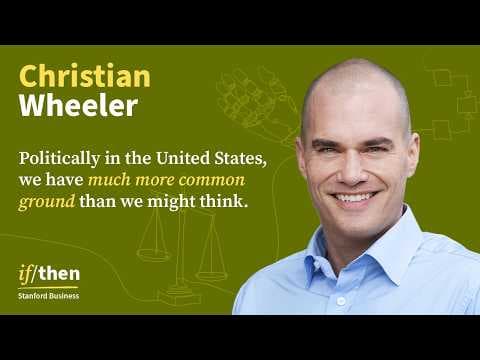
Ultimately, despite perceived political divides, there is often more common ground than people realize, with shared desires for prosperity, education, and infrastructure. It's the "team-oriented thinking" that obscures this common ground, which is often much larger than the areas of disagreement.