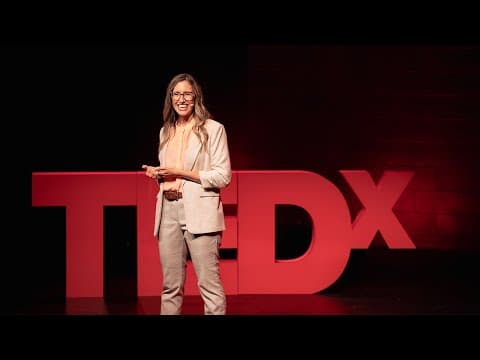
How much do you trust? | Emanuela Brusadelli | TEDxWollongong
Audio Summary
AI Summary
The speaker, a clinical psychologist from Milan, Italy, shares her personal experience of moving to Wollongong, Australia, and the challenges of adapting to a new environment. She highlights the importance of trust in navigating new situations, whether it's a new gym, meeting new people, or even caring for pets. Trust, she explains, is fundamental for human connection, feeling safe in relationships, and seeking help when needed. As a psychologist and a new mother, she realized the necessity of trusting professionals in vulnerable situations.
In psychology, one way to understand trust is through "epistemic trust," which is the ability to believe in knowledge from others. This ability develops early in life as we learn from caregivers who provide us with a framework for perceiving the world, others, and ourselves. These early experiences can shape our trust, influencing decisions about friends and partners. The speaker emphasizes that trust is both a trainable ability, like a muscle, and a deeply rooted lens through which we view the world, carried with us everywhere.
Research at the University of Wollongong explores the dynamics of trust between psychologists and clients, and how mistrust can hinder seeking support, while trust aids in reporting symptoms. However, simply asking people to trust is not effective, especially for those who fall into "Team MadMax." These individuals maintain distance as a self-protective and survival strategy, which can be dangerous if it prevents them from seeking help.
Conversely, "Team Little Red Riding Hood" has the opposite problem, tending to believe everything others say. This can be equally dangerous, as they may ignore obvious red flags due to a desire to bond or belong. Both teams developed their trust patterns early in life, but the speaker acknowledges that life experiences can alter these patterns, leading some to gain trust while others lose it for valid reasons.
Understanding which "lens" one uses to see the world and identifying with either Team MadMax or Team Little Red Riding Hood can boost resilience and self-understanding. This awareness can facilitate conversations about trust and encourage seeking help. Trust serves as a critical indicator for interpersonal relationships, personal well-being, and community well-being. The goal is to achieve the "right amount of trust"—not too much, not too little—to connect with others while also protecting oneself. The speaker concludes by noting that it’s never too late to reassess one's trust patterns and embrace trust as a valuable tool in life's journey.