L’étrange carte des plus grandes éruptions volcaniques de tous les temps.
AI Summary
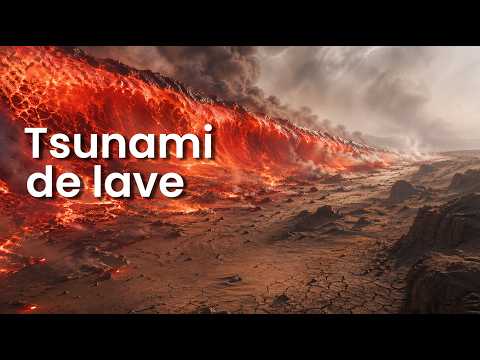
This episode delves into the planet's most colossal volcanic eruptions over the last 250 million years, events of unparalleled duration, scale, and violence compared to anything witnessed in modern times. Although millions of years of erosion have obscured some traces, the monumental lava flows, known as "traps," still cover a significant portion of Earth's surface, making up nearly 10% of emerged land. These areas, marked in red on the global map, consist of several kilometers of dried lava.
The scale of these ancient eruptions is extraordinary. To illustrate, the Laki eruption in Iceland in the late 18th century, one of the most violent in recent millennia, expelled 15 cubic kilometers of lava, causing a 20% mortality rate in Iceland and a temporary global temperature drop. In stark contrast, the eruptions discussed in this episode released hundreds of thousands, sometimes even millions, of cubic kilometers of lava. This immense scale stems from their unique nature: they were formed by mantle plumes rising from deep within the Earth, fracturing the crust over hundreds of kilometers. Through these fissures, colossal amounts of highly fluid magma erupted, forming vast networks of lava fountains that spread across areas comparable to entire countries, rather than building conventional volcanoes. These intermittent eruptions, lasting hundreds of thousands of years, covered continents and even ocean floors with kilometers-thick layers of lava.
Before diving into specific examples, an interlude introduces "mammou.ai," an AI platform that centralizes various AI models, including text generators like Chat GPT, Mistral, and Gemini, image creators like Nanobanana and Stable Diffusion, and research tools like Perplexity. It also offers lighter, faster open-source models for daily use. Mammou.ai aims to simplify access to AI tools for a monthly subscription.
The journey into these ancient eruptions begins with the Siberian Traps, formed at the end of the Permian period when a mantle plume breached the Earth's crust in the Northern Hemisphere. For nearly 4 million years, fractures opened intermittently, releasing fluid lava flows that spread across vast areas, temporarily transforming landscapes into seas of molten rock. During peak activity, the magma discharge could be dozens of times greater than the combined annual output of all currently active volcanoes. These eruptions, ending 248 million years ago, left behind a lava-covered surface comparable to Europe and a poisoned, asphyxiated planet. The massive release of toxic chemicals and greenhouse gases like CO2 and methane drastically increased global temperatures, while ocean oxygen levels plummeted, leading to acid rain and a planetary-scale biological collapse. The Siberian Traps are responsible for the largest mass extinction in Earth's history, wiping out an estimated 96% of marine species and 70% of terrestrial species.
Approximately 50 million years later, another colossal continental volcanic event occurred at the end of the Triassic period, around 201 million years ago. A rising mantle plume beneath the supercontinent Pangea attempted to open a new ocean. Under immense extensional forces, Pangea's crust fractured over thousands of kilometers, creating an embryonic rift. Ultra-fluid basaltic lava flowed to the surface, filling the landscape, while intrusive lavas deep within the crust cooked organic-rich sediments, turning deep rocks into giant greenhouse gas distilleries. This intense volcanism weakened ecosystems, disrupted the climate, and acidified oceans, leading to the disappearance of about 20% of marine species and a significant portion of large terrestrial vertebrates. Although Pangea resisted the ocean's opening, the volcanism left a weakened crust that would later facilitate the birth of the Atlantic Ocean. Today, fragmented vestiges of these "dantesque" volcanic episodes, known as traps, are found on three different continents on either side of the Atlantic.
Moving back 183 million years to the Early Jurassic, the Karoo-Ferrar eruptions began to tear apart the southern part of Pangea, then called Gondwana. A new magmatic intrusion exploited this weakness in the crust, leading to eruptions that, in just 500,000 years, spewed out nearly 2.5 million cubic kilometers of lava through two massive fissures stretching over 6,000 kilometers. These flows, far exceeding the output of all current volcanoes, smoothed and filled reliefs over 3 million square kilometers, covering vast areas that would become parts of South Africa, Antarctica, South America, India, and Australia. The Karoo-Ferrar eruptions triggered the Toarcian extinction event, during which colossal volumes of CO2 and sulfur dioxide drastically altered ocean chemistry, causing dissolved oxygen levels to collapse, while atmospheric CO2 levels doubled. Global ocean temperatures rose by 3 to 7 degrees Celsius. These eruptions wiped out nearly a quarter of marine species and further fragmented Gondwana's southern crust. However, this crisis, like previous ones, also fostered new life forms, as vacant ecological niches favored the diversification of dinosaurs.
48 million years later, at the end of the Early Cretaceous, as Gondwana continued to fragment, lava flows formed the Paraná and Etendeka Traps between Africa and South America, where the South Atlantic rift was emerging. Over 3 million years, 1.5 million cubic kilometers of lava spread across an area twice the size of France. Identical rocks from this volcanic apocalypse are still found today in southern Brazil and northwestern Namibia.
Next, the episode discusses the largest discovered volcanic event on Earth, the Ontong Java Plateau, a submarine volcanic monster northeast of New Guinea. Formed 120 million years ago in the Early Cretaceous, an extremely powerful mantle plume pierced the oceanic crust, depositing 40 million cubic kilometers of magma on the seafloor—a volume nearly 10 times greater than the Siberian Traps. This required continuous magmatic outpouring for almost 3 million years, equivalent to the Laki eruption's output non-stop. Originally, the Ontong Java Plateau was likely as vast as Alaska and partially emerged, but the accumulating lava layers eventually collapsed under their own weight, causing the oceanic crust to buckle. Seismic data reveals this plateau consists of 26 kilometers of dried lava layers, five times thicker than the underlying oceanic crust. This immense mass has prevented its rapid recycling by plate tectonics, making it difficult for the moving plates to drag it to subduction zones. Despite emitting 10 times more lava than the Siberian Traps, the Ontong Java formation is not linked to a major mass extinction. While it locally disrupted ocean currents and acidified water, the extended eruption period, the fact that lavas did not burn through organic-rich sediments, and the absorption of gases by water significantly mitigated its global impact.
53 million years later, a part of western India, having detached from Africa and moving towards Asia, experienced colossal magmatic upwellings. In just 2 million years, 1.5 million cubic kilometers of lava erupted onto the surface of the future subcontinent, forming the Deccan Traps. These basaltic plateaus, several kilometers thick in places, now cover nearly 500,000 square kilometers of western India. However, erosion over 65 million years has reduced its original footprint, estimated to be over 1.5 million square kilometers. The peak of these eruptions coincided with the Chicxulub meteorite impact, which ended the reign of dinosaurs, already weakened by the Deccan's volcanic emissions. Although the magma source weakened 65 million years ago, the hotspot's activity continued at a reduced rate, giving rise to the Mascarene islands, including Rodrigues, Mauritius, and Réunion, over millions of years.
Just 5 million years after the Deccan eruptions ceased, a magmatic bubble exploited the fragmentation of the supercontinent Laurasia and the opening of the North Atlantic Ocean. This created a fissure system thousands of kilometers long, stretching from southern Greenland to Scotland and northern Scandinavia. Torrents of magma erupted intermittently for nearly 5 million years, forming basaltic plateaus hundreds of kilometers long and hundreds of meters thick. Parts of these ancient formations are visible today in western Scotland. Similar to Ontong Java, the impact of these eruptions was lessened because most of the lava flowed into the ocean. These eruptions are unique because, unlike most deep mantle plume events that are relatively short-lived, the magma upwellings here never fully stopped. Over tens of millions of years, significant volumes of lava continued to rise, concentrating in the same area and eventually forming Iceland. The active hotspot beneath Iceland is believed to be an inherited vein from these initial lava upwellings 60 million years ago, a vein that never truly closed.
Another region on Earth that experienced mantle magma upwelling and has never fully ceased activity is the Horn of Africa. The impressive Ethiopian Traps in the Abyssinian highlands consist of dried lava flows up to 2,500 meters thick, formed 30 million years ago when Saudi Arabia began separating from Africa. Over 500,000 years, repeated erratic eruptions buried landscapes under 500,000 cubic kilometers of basaltic lava. Each major flow phase could spew as much lava as all currently active volcanoes combined over several millennia. The location of these flows coincides with the nascent Red Sea and the East African Rift, which provided pathways for the underlying magma. 30 million years later, this region remains one of the most tectonically active on the planet, with volcanism slowly shaping a future ocean. In the Afar Depression, where the African, Somalian, and Arabian plates are tearing apart, the thinning continental crust has fostered the emergence of classic volcanoes aligned along East Africa's fault lines.
Fortunately, magmatic eruptions of this magnitude are relatively rare, occurring on average once every 10 to 20 million years. The most recent examples, which formed the Columbia River Basalt Group in the northwestern United States, began 17 million years ago and ended 6 million years ago. While the volumes of lava (covering nearly 200,000 square kilometers) were about 10 times smaller than the Deccan Traps, they were still immense compared to any modern eruption. During peak activity, dozens of times the volume of the Laki eruption would pour out of a single set of open fissures, inundating hundreds of kilometers. Since this system became extinct 6 million years ago, no major lava flows have erupted on Earth's surface. However, the planet will inevitably experience such events again. While the precise location of the next large-scale breakthrough is unpredictable, regions with thinned and weakened crust, such as Iceland and the Horn of Africa, are more susceptible to being submerged by future lava flows.