Gadolinium (new) - Periodic Table of Videos
Audio Summary
AI Summary
The video explores the element gadolinium, its history, properties, and applications, particularly in medical imaging. The discussion begins with a demonstration of injecting a gadolinium contrast agent into a tomato, highlighting how it creates bright spots in an MRI scan, mimicking its use in human medical diagnostics.
Gadolinium, a rare earth element, has a history dating back to the 18th century. It was discovered in a mineral found in a quarry near Stockholm by Swedish scientist Johan Gadolin, whose name it honors. Gadolin's initial publication was in Swedish and later in German, using an old Gothic script that made it difficult to read. Interestingly, Gadolin himself expressed that new elements were becoming too numerous, a sentiment starkly contrasting with modern scientists' excitement at discovering new elements. The definitive proof of gadolinium as a new element came from Swiss chemist Jean-Charles Galissard de Marignac, who identified a specific spectral line in a flame. The presenters note that while they attempted to replicate this using a Bunsen burner and spectroscope, their efforts were "slightly amateur" compared to the precision achieved in the 19th century. The actual metal was isolated much later, in 1935, by French chemist Félix Trombe.
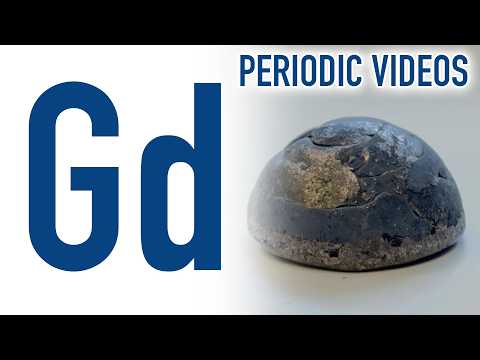
Nowadays, gadolinium is readily isolated, primarily for its magnetic properties. The presenters showcase a lump of gadolinium metal, with technician Neil filing it. They then dissolve gadolinium in hydrochloric acid, producing hydrogen gas and gadolinium trichloride. Standard chemical tests are performed with various potassium compounds. The key to gadolinium's utility lies in its electronic structure. As a lanthanide, it sits in the middle of the rare earth series and, in its 3+ ionic state, possesses seven unpaired electrons, making it highly magnetic. This magnetic property allows the metal to be attracted to a magnet, a demonstration Neil enjoys.
This strong magnetic property is crucial for Magnetic Resonance Imaging (MRI). In an MRI scanner, the body's water molecules are analyzed based on their magnetic spectrum. Different organs have varying water content, which MRI can distinguish. Gadolinium-based contrast agents are fundamental to MRI, significantly enhancing the signal from hydrogen atoms in water molecules. When gadolinium interacts with water in the body, it causes a brightening of the image in the MRI scan, creating distinct bright spots that aid in diagnosing conditions like cancer, multiple sclerosis, and injuries.
However, gadolinium salts themselves are toxic. To mitigate this, gadolinium ions are complexed with "ligands"—molecules that essentially wrap around and coordinate the gadolinium, forming a cage-like structure. This encapsulation preserves the magnetic effect while preventing the gadolinium ions from interacting with biological tissues and causing toxicity. These contrast agents are designed with multi-dentate ligands, often with eight binding sites, to securely hold the gadolinium.
Since injecting patients for demonstration purposes is not feasible, the presenters opted for an experiment with a tomato. They explain that a tomato, like humans, is largely composed of water and shares some genetic similarities. The chosen contrast agent for the tomato injection was gadolinium DTPA, where DTPA is an acronym for the complexing ligand, also known as Magnevist, the first clinical contrast agent. The injection was performed slowly into the tomato to prevent leakage.
The experiment involved scanning the tomato before and after the injection using an MRI machine. The pre-injection scan showed a uniform image of the tomato's structure, including its compartments and seeds. After the injection of the gadolinium contrast agent, the post-injection scan revealed distinct bright regions within the tomato. These bright spots, indicating where the gadolinium had accumulated, demonstrate the principle of MRI contrast enhancement. The presenters emphasize that this visually represents what happens in a clinical MRI scan, where gadolinium pooling leads to image brightening, providing clearer contrast for diagnosis. They note a significant difference between the sides of the tomato, with one side showing more brightening due to gadolinium accumulation.
The video also touches upon the visual aspect of gadolinium, mentioning Neil's interest in burning metals. Gadolinium burns very easily, producing an intense, bright white light, though its potential use in fireworks would likely be prohibitively expensive. Finally, the presenters mention an extended interview with Dr. Pete Harvey and encourage viewers to support their work through a "periodic table of patrons." They also briefly mention a unique experiment involving injecting bread with an arsenic compound.