What Tesla and SpaceX Teach Founders About Building Hardware | a16z
AI Summary
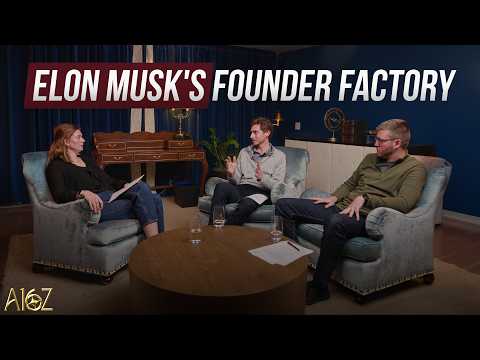
The discussion features Chandler Lugjitsa, CEO of Galedai (missile propulsion), and Turner Caldwell, CEO of Mariana Minerals (critical mineral supply chains), sharing insights from their tenures at SpaceX and Tesla, respectively. Both emphasize that the "Elon Musk school of thought" extends beyond anecdotal tales of all-nighters and impossible deadlines, focusing instead on repeatable practices that transform how complex hardware is built and shipped.
Chandler, new to the missile industry, identified a critical shortage, high costs, and slow production rates. His background in liquid propulsion from SpaceX and UCLA led him to believe these issues could be addressed by applying similar technologies. Turner, after a decade at Tesla, focused on the battery supply chain, particularly minerals and metals. He observed that established players in this industry were often stagnant and lacking in technological advancement.
A key takeaway from both is the importance of **flat organizations** and **democratized access to information**. Chandler highlights that flat structures are crucial for rapid information flow, allowing junior engineers to directly engage with senior leadership and other teams without hierarchical bottlenecks. Turner elaborates that while flat organizations can be chaotic if implemented poorly, their core purpose is to facilitate collaboration and swift decision-making. He stresses the need for leaders within these flat structures to possess **high conviction** and make decisions rapidly, thereby increasing development velocity and production cycles. This rapid decision-making, even with incomplete information, is vital, as often the correctness of a decision is only revealed through iteration.
Turner also emphasizes the challenge of coordinating large, complex operations like refineries and mines, especially with a shrinking talent pool. He advocates for leveraging **autonomy, automotive advancements, and humanoid robots** to address these operational challenges.
Regarding technical problem-solving, both acknowledge the difficulty of tackling first-of-a-kind technical challenges. However, they identify that the greater hurdle often lies in **aligning large groups of people** towards these goals. Turner stresses the importance of democratizing information access to prevent data silos that form in teams exceeding 30-50 people. Mariana Minerals has embedded this into their core operating systems, making everything web-app hosted with generally open internal access to core engineering information, integrated into a data frame that provides context for decisions. This approach is vital for large-scale capital projects (EPC) where data silos between engineering, procurement, and construction teams are common. They are building a new operating system to track decision history and leverage LLMs for data navigation.
Chandler focuses on the concept of **critical path**, defining it as the schedule-driving tasks essential for unlocking the next phase of a project. He notes that in early-stage companies like Galedai, this often involves constant "firefighting." To manage this without slowing down subsequent steps, he advocates for **"swat teams"** that can independently tackle parallel tasks, preventing all resources from being consumed by the immediate critical path. This avoids the "second-grade soccer" effect where everyone swarms a single issue, neglecting other vital areas. He acknowledges that for very early-stage companies with small teams, managing a single critical path is more straightforward, but the principle of preventing resource diversion remains crucial for growth.
In terms of practical processes, Chandler champions **high-signal, low-noise email updates**, particularly concerning critical path items. These updates, driven by an "extreme owner," not only inform the team but also serve as a crucial mechanism for the individual driving the task to document progress and identify areas for improvement. Turner introduces the concept of a **"shift pass down"** equivalent for R&D and manufacturing processes. Initially manual, this process of documenting what was done, what was supposed to be done, and why, can be partially automated by aggregating data into a central backbone, allowing humans to review and add commentary rather than starting from scratch. This creates a **"drum beat"** for the company, providing structure and cadence without stifling flexibility for urgent decisions. These drum beats can be company-wide "sprints" for major milestones, acknowledging that unlike software with daily releases, hardware projects have longer cycles (12-18 months). This cadence also allows for celebrating intermediate wins, serving as a reward function and calibration for the team.
Setting **milestones** is approached with aggressive ambition, often referred to as "Elon time." Chandler explains that the purpose of these aggressive targets is not necessarily to achieve them precisely as set, but to force deliberate thinking about what is truly critical and what cannot be done within the timeframe. This process identifies actual critical paths and generates a prioritized list of tasks, including those that might need to be eliminated. Turner agrees, emphasizing that aggressive milestones help weed out what is truly blocking progress.
To avoid **team burnout** despite intense work cultures, both point to **mission alignment** as the primary driver. When individuals are deeply connected to a compelling mission (e.g., making life multiplanetary at SpaceX), long hours and demanding deadlines feel less like pain and more like purposeful effort. Turner notes the challenge of instilling this passion in defense work. He also identifies **churn**—caused by erratic decisions, politics, and data hoarding—as a significant contributor to burnout. When the pathway is clear, decisions are transparent, and priorities are well-defined, people are motivated to work hard. Aggressive goals, if achievable, can be motivating, but setting targets with no technical path can be demoralizing.
When discussing principles that **didn't translate directly**, Chandler notes that **parallel pathing** a lot of things, which is resource-intensive but effective at SpaceX due to its vast resources, is not feasible for smaller, early-stage companies like Galedai. Turner, having witnessed Tesla's growth, suggests it's less about unlearning principles and more about **massaging their implementation** to address issues like churn and burnout, especially as a company scales and requires more structure.
The concept of **"design for manufacturing"** is central. Chandler explains that on Starship, rapid iteration (V1 to V3) was enabled by a production focus, questioning every requirement to simplify designs. He gives an example of a seemingly minor component (a snorkel) that presented a potential issue with valves, but by quickly dedicating resources to prove its viability, they accelerated production and enabled broader use across different vehicle components. Turner applies this to refineries and mining, emphasizing **tack time analysis**—breaking down all discrete steps for building something—and treating analytical labs and construction tasks as manufacturing processes. He highlights the lack of quantified, short-interval control in traditional construction and the need for a software backbone to automate data capture and enable real-time progress monitoring, similar to manufacturing dashboards.
Regarding **vertical integration**, both agree it must be **strategic**, not idealistic. Chandler believes in-housing assemblies that bottleneck the supply chain, like large weldments, to achieve production goals (e.g., 10,000 missiles per year). Turner frames the decision around a single question: **"Does the company exist or not?"** If a critical part, technology, or cost factor necessitates in-house production for the company's survival, then vertical integration is justified. Saving a small percentage on a non-critical component is not a sufficient reason. He uses Mariana Minerals as an example: to exist as a software company operating mineral infrastructure, they had to integrate both functions. He also notes that vertical integration expands supply chain interactions, as upstream suppliers have their own supply chains.
On **hiring exceptional talent**, both emphasize the rigorous **technical evaluation** process at Tesla and SpaceX. This involves multiple interviews and technical tests to ensure candidates are autonomous and capable. While this lengthens the hiring process, it effectively filters for motivated individuals. They strive to replicate this rigor, though it's challenging without the same brand recognition. Turner notes that the internship program at Tesla and SpaceX acts as a crucial, extended trial period, allowing them to identify and retain top talent. Chandler is implementing a similar internship program at Galedai, focusing on passion and relevant project experience.
For **young engineers considering starting a company**, Turner advises gaining experience by seeing projects through from **messy beginning to deployment multiple times** within high-talent-density environments. This builds credibility and an intuitive understanding of execution cycles, enabling setting realistic targets. Chandler echoes this, emphasizing being a **"sponge"** and surrounding oneself with the best people to learn from them. He adds that while there's no perfect time to start, building a strong **technical foundation** before tackling fundraising and company-building aspects is crucial. He advises leveraging networks for perspective and learning what "good" looks like in terms of exceptional teams and execution.