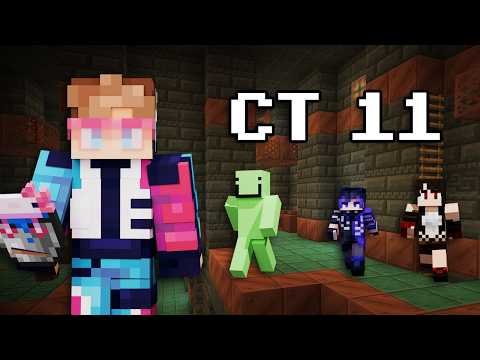
Minecraft tournaments are back
Audio Summary
AI Summary
The video opens with a group of friends expressing nervousness and excitement as they prepare to play a series of mini-games, noting the loud sounds and new people on the team. They are playing on a stage and admire their Overwatch skins. They quickly encounter a game called "Mace Mania" where they are on one heart and face fighters. Despite their efforts, they are quickly eliminated, with one player noting they felt hit from nowhere. They earn only one vote from this game.
Next, they are introduced to "Madness," a brand-new game. The instructor, Funip, explains that they will race to the end of a train station in three rounds, navigating randomly selected levels. They are given four inventory items: jump boost, slowfall, water speed, and shrink, which are effects activated by right-clicking. They can only have two effects active simultaneously, and activating a third disables the first. They go through a practice station to learn the mechanics. One player finds having two effects confusing and notes that slowfall significantly reduces speed. They also realize the importance of abusing two effects at once.
In the first round of Madness, they perform well, with all players finishing in the top half. One player, Silver, finishes 23rd, and another, who got first, earns 194 points. They discuss strategies for managing effects, with one player preferring to manually deactivate them to avoid confusion.
The second round of Madness begins immediately. They strategize about using jump boost and slowfall to navigate copper jump pads and slab obstacles. One player has a terrible start, avoiding slowfall, while another botches everything. Despite initial struggles, one player, "SK," manages to get sixth place after being in 31st at the start, and another finishes 11th. They attribute their success to being "so good at this." They reflect on their mistakes, particularly regarding the combination of jump boost and slowfall, which often led to hitting walls and falling.
The third round of Madness presents a new challenge with a single line of obstacles. They discuss the dangers of slowfall if not used perfectly. One player makes a mistake at the start but manages to recover. They navigate water sections and various obstacles, with one player expressing frustration with slowfall. Despite some struggles, they maintain a strong team performance, with their team finishing first by a significant margin of 300 points. They are confident they could be the first team overall.
The next game is a voting game, and they decide to move away from the "layer." It appears to be a bridge-crossing game where the first player to pick a safe path gets voting points. They try to send one player forward to secure points. One player gets three votes. They realize making it to the end of the bridge in general awards votes.
They then move on to "Gold Rush," a dungeon-crawling game where the goal is to bank as much gold as possible within 12 minutes. They must clear dungeons, break mob spawners, and complete side rooms to collect gold and "key scraps." Banking at least four key scraps increases their final score multiplier by 5%, and five scraps by 7%. Dying results in losing half of their gold and all key scraps, and they won't respawn until the team moves to the next dungeon. If all team members die, all gold collected in that dungeon is voided.
They start the first dungeon, noting its darkness and the importance of killing mobs and breaking spawners. They encounter rooms requiring one, two, or three players. They split up to complete side rooms and collect key scraps. One player uses a crossbow and suggests splitting up in case of "dumb mechanic things." They successfully complete several side rooms, including a three-player button puzzle and a parkour section. They manage to collect four key scraps and find the exit.
In the second dungeon of Gold Rush, they find a library-themed room. They focus on killing mobs and breaking spawners. They complete a two-player arrow puzzle and a one-player room. They discuss the importance of finding all key scraps for the multiplier. They manage to find five key scraps and bank their gold.
The third dungeon presents new challenges, including more puzzles and obstacles. They continue to work together, completing multi-player rooms and collecting key scraps. They face a building puzzle where they have to copy a 5x5 pattern. They successfully complete it, securing five key scraps again. They decide to exit early due to time constraints, having collected a good amount of gold.
After Gold Rush, they move to a gambling game where they bet on different colored horses. They strategically choose black, with most of the team betting on it. The race is chaotic, with horses having a "freeway" and comeback mechanics. Brown initially takes a lead but is overtaken. Black manages to secure second place, earning them some votes.
The next game is "Blitz," a PvP game where players collect materials and fight opponents. The map has secret metals and crystals that give points, with diamonds offering extra. Damage and kills are doubled in the early moments. They decide to prioritize collecting materials, especially diamonds, and avoid early fights, assuming other teams are better at PvP. They hold high ground and try to avoid engagements. They get into a fight with a three-player team, securing some points. They continue to collect diamonds and engage in skirmishes, but ultimately find themselves in challenging positions.
They discuss strategies for Blitz, considering whether to prioritize diamond spawns or rotate to other team's diamonds. They emphasize avoiding raw poke fights and saving arrows for strategic engagements. They encounter several teams, engaging in some fights and trying to secure diamonds. They realize the importance of team coordination and avoiding being caught out. Despite their efforts, they struggle in PvP encounters.
The next game is "Rainbow," a fast-paced game where players must stand on blocks of a specific color, with other blocks disappearing. They find it challenging due to fast reaction times and potential lag. One player struggles to make jumps, attributing it to ping. They earn only one vote from this game.
They then play "Flow State," a movement-based game with four types: parkour, trident, elytra, and obstacles. Parkour and elytra are difficulty-based, while trident and obstacles are time-trial-based. They have 14 minutes to complete all four and cannot switch once started. They receive a 20-point bonus for completing all four. They decide to do parkour first, then trident, obstacles, and finally elytra.
In parkour, they attempt medium and expert difficulties, finding some levels challenging. They eventually switch to hard and easy for some levels to conserve time. They complete parkour and move on to trident. They aim for S-tier ranks in time trials.
They continue with obstacles and elytra, finding some expert levels surprisingly easy, while others are incredibly difficult. They struggle with certain jumps and gaps, expressing frustration. They manage to complete most of the challenges, though some players reset to improve their times or switch to easier difficulties.
After Flow State, they play "Bullseye," a game where they shoot arrows at a target over a wall, with only one shot per round. They struggle with accuracy, with many shots falling short or going too far. One player, "SK," performs well, hitting targets.
They then vote for "Walking Soccer," a game played in the Wardens Arena. The goal is to shoot golems into a goal using a bow. A ball spawns in the center, and the closest player picks it up, gaining a bow and temporary invulnerability. If the arrow hits someone, they receive the bow. The arrow shoots at a shorter speed than vanilla.
They strategize, with one player playing defense and others rushing for the ball. They learn to self-pass and use the ceiling to their advantage. They score several goals, showcasing good teamwork and passing. They realize that scoring goals pushes their spawn back, giving the opposing team an advantage at the start of the next play. They continue to score, with one player getting a hat-trick. They find success in passing the ball through a small hole in the defense. They maintain a strong lead in scoring.
In later rounds of soccer, they continue to coordinate, using boosts and strategic passes. They face challenges with opponents blocking shots and punching them off the ball. They experience some frustration with the mechanics, particularly the "pick up cool down" and the perceived randomness of hitting opponents. Despite some setbacks, they maintain a competitive performance, often tying or winning rounds. They finish with a 3-3 record in rounds.
The next game is "Find the Button," where they have to find as many stone buttons as possible scattered across a map. They quickly start searching, with buttons disappearing once found. One player, "Evbo," excels at finding buttons. They check various areas, including under stairs, and accumulate a good number of buttons.
They then vote for "Chunk Lock," a capture-point game where they capture zones to earn currency and can buy items like "stock tokens" and respawn tokens. The price of a stock increases at the end of each round. They decide to stick together and capture zones. One player gets disconnected and has to buy a respawn token. They focus on capturing gold zones and buying stocks. They encounter other teams, leading to skirmishes. They learn that early fights are not necessarily bad, and they need to be more alert to avoid being snuck up on.
They continue to capture zones, prioritizing teamwork and avoiding being separated. They face aggressive opponents and adapt their strategies, sometimes running away and sometimes engaging in fights. One player manages to stay alive and resupply the team. They realize the importance of capping zones quickly and using absorption. They engage in more fights, trying to pinch opponents and secure kills for points. They discuss the effectiveness of damage points versus zone capture.
They continue to struggle with the PvP aspects of the game, feeling outmatched in individual fights. They try different strategies, including focusing solely on land coverage or hard fighting for zones. They find the game mechanics to be somewhat random and lacking clarity, particularly regarding zone point calculation and combat interactions. They win some zone fights but still lose overall rounds, often due to opponents having more land coverage or better timing on zone snapshots.
The final game is "Golf," where they must move an armor stand from a starting platform to a hole by hitting it with a golf club. Only the golf club holder can hit it, and the club transfers to the next player in a set order after each hit. They have 14 minutes and can respawn the armor stand if it falls. They learn that sprinting into the armor stand makes it go farther and that wall shots are effective.
They start the game, with one player, "SK," having the golf club first. They learn to line up shots, use walls for angles, and communicate to guide the armor stand. They make good progress through the initial levels, understanding the mechanics of hitting it across gaps and around corners. They experience some setbacks with misjudged shots and the armor stand falling.
As they progress, the levels become more complex, requiring precise wall shots, diagonal hits, and coordination to position players on pressure plates. They encounter a "tiny" armor stand, making shots more challenging. They adapt their strategy, focusing on safe shots and setting up teammates. They manage to catch up despite a slow start, with their later rooms being completed quickly.
In the final challenge, "The Inferno," players participate in four duels: Dropper (flame bow and TNT to create a path), Parkour (race to a goal), The Ribbon (crossbow duel, five hits to lose), and The Gauntlet (sword duel). The first team to win three duels wins. If there's a tie, a tiebreaker game is played. They watch other teams duel.
In the Dropper duel, one player from the purple team struggles with making jumps. In the Parkour duel, "Infumi" from their team initially struggles but then makes a comeback, only to lose on a fence obstacle. In the Crossbow duel, "Ghostify" from their team is defeated. The final duel is a sword fight, and "Floives," a top player, is surprisingly defeated, which the team finds both shocking and satisfying. They reflect on the increasing multiplier for later games, which makes PvP games more impactful, and lament that their team often struggles in these types of games despite excelling in others. They express a desire for more diverse game types beyond PvP.