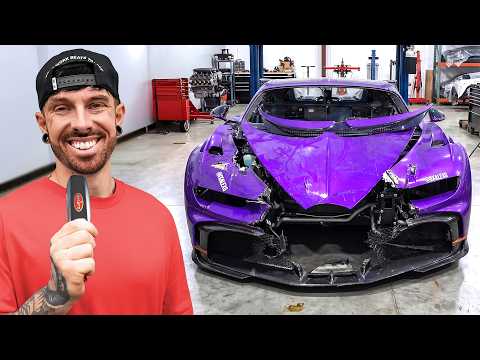
ATTEMPTING TO START THE WRECKED BUGATTI CHIRON PUR SPORT
AI Summary
This summary details the complex process of reconnecting the front and rear halves of a Bugatti Chiron Pur Sport following a significant crash. Despite Bugatti’s refusal to sell parts or provide technical support—claiming such a repair is impossible outside of their specialized facilities—the team successfully navigated the mechanical and structural challenges of the rebuild.
### The Engine Mount Dilemma
The primary obstacle to rejoining the car was a broken gearbox and engine mounting. The team considered two options: CNC machining a new part from a solid aluminum block or repairing the original casting. They ultimately chose to repair the original mount to ensure the three crank position sensors remained perfectly aligned. If these sensors are off by even a few millimeters, the W16 engine might fail to start or run poorly under boost.
A specialist named Bob performed the repair using TIG welding with 4047 and 4043 aluminum rods. To improve upon the factory design, Bob added custom aluminum infills to the casting’s structural ridges. This modification made the mount stronger than the original, which the team suspected was designed by Bugatti to break during an impact to protect the engine.
### Mechanical Reassembly and "Volkswagen" Parts
With the mount repaired, the team began the intricate process of dress-up. They reinstalled the electronic wastegates, which are critical for regulating boost pressure. During the reinstallation of the starter motor, the team confirmed a surprising detail: the Bugatti Chiron uses the exact same starter motor part number as a 1.9 TDI Volkswagen Passat.
The flywheel was then torqued into place, a process requiring extreme precision to avoid vibrations and ensure the crank sensors could read the flywheel teeth correctly. Reconnecting the massive gearbox to the engine involved managing a vast array of electrical connectors, oil lines, and solenoids. Because Bugatti provides no official service data, the team had to filter and reuse the original gearbox oil, as the specific grade and fill procedures were unknown.
### Improvisation and the "Marriage"
The team encountered a squashed coolant pipe that could not be replaced through official channels. They improvised a fix using a rigid rubber fuel hose and heavy-duty clamps, ensuring it would not collapse again once the car was joined.
The "marriage"—the process of bolting the rear subframe to the front carbon monocoque—is typically done at the factory with million-dollar machinery. The team achieved this using heavy-duty bin wheels to align the sections. The two halves are held together by only 14 titanium nuts and bolts.
A significant setback occurred when the narrator snapped one of the vital titanium bolts while attempting to torque it to 70 Nm. They realized that titanium is highly brittle; it is designed to snap in a high-speed accident so the engine can separate from the cabin for safety. Fortunately, they were able to extract the broken thread and source a replacement titanium M8 bolt online for a fraction of the expected cost.
### Exhaust and Straight-Piping
The team decided to upgrade the car with a custom Valvetronic exhaust system. To maximize airflow and sound, they performed a "straight-pipe" modification by manually removing the secondary catalytic converters. They noted that since there are no sensors after the secondary cats, the car’s ECU would not detect the modification or enter "limp mode." This process also allowed them to recover the precious metals found inside the converters.
### Final Integration and Startup
The final steps involved a massive amount of "plumbing" and electrical work. This included:
* Connecting the prop shaft and differential.
* Routing fuel lines from the monocoque tank to the engine.
* Installing the transmission ECU under the driver’s seat.
* Bleeding the brakes to ensure the car could be safely put into gear.
* Installing the $40,000 special lithium-ion battery.
The team also installed the interior carpet and the accelerator pedal, which they noted was surprisingly made of simple plastic rather than high-end aluminum.
### Results and Conclusions
Upon turning the key, the Bugatti fired up immediately. The new exhaust provided a deeper, louder tone, though the team noted that the four turbochargers naturally muffle much of the engine's sound, preventing it from sounding like a naturally aspirated supercar.
A minor fuel leak occurred during the initial start when a line popped off, but it was quickly repaired. Most importantly, the car successfully engaged its gears, proving that the structural and electronic connection between the two halves was functional. While the reassembly was a success, the team expressed lingering concerns about the health of the water pump seals and turbos, as the car had been driven without coolant by its previous owner before the repair began. The project stands as a successful defiance of the manufacturer’s claim that the car could not be repaired in a standard garage.