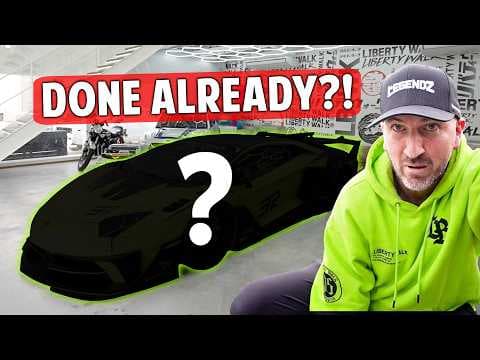
Liberty Walk Gave Me Their $3M Black Listed Ferrari F40!
Audio Summary
AI Summary
The video documents a visit to Liberty Walk in Japan, founded by Kato, a man whose vision for car customization went against traditional rules. Liberty Walk is known for its distinctive style of cutting apart million-dollar cars, riveting wide-body kits, exposing hardware, and achieving slammed fitment. This approach, which most people would be hesitant to apply to expensive vehicles, is driven by Kato's appreciation for presence and nostalgia over perfection.
The hosts, who have a history with Liberty Walk, having built the first wide-body BMW M3 in Canada over ten years ago, followed by a Ferrari 458 and 488, are now meeting Kato, the originator of the movement. Kato's generosity is immediately evident as he hands them the keys to a Ferrari F40 for a test drive.
The tour begins at Liberty Walk headquarters, where various custom cars are showcased. One notable vehicle is a Murcielago with a unique wide-body kit, featuring distinct fog lights and a gated manual transmission, suggesting it's a pre-LP model. The hosts express their admiration for the kit, which they've never seen before.
Kato, the founder, owner, and CEO, provides a private tour of his personal car collection and shares insights into the company's origins, including never-before-seen photos of his first garage. The tour highlights a Huracan Liberty Walk wide-body with a camouflage design, and an iconic pose often associated with Kato.
The collection includes cars from his youth, such as an RX3, Fairlady Z, and Kenmery, which he now owns. The inspiration for the exposed rivet style of wide fenders, which became a signature of Liberty Walk, originated from old racing cars like the Kenmery and Hakosuka GTRs, which had slightly wider fenders. Kato took this concept further, creating even wider and bigger "full works" fenders, drawing from styles like Savannah and Celica works. These fenders, originally modified for racing, were adapted for street use, giving rise to the BOSOZOKU style.
Liberty Walk was founded 35 years ago when Kato was 25. Initially, it was not a wide-body company but a car dealership. With limited funds, Kato started by buying and reselling inexpensive used cars like BMWs and Mini Coopers. Over time, he expanded into customizing more expensive cars, realizing that many enthusiasts couldn't afford them. This led him to the idea of making body kits, allowing average people to customize their own vehicles.
At 40, Kato decided to pursue his dream of sharing Japanese styling with the world. Despite not speaking English and lacking overseas connections, he sought help from an English-speaking person at a cabaret club. This led to his first appearance at the SEMA show. His first car at SEMA was a Murcielago with air suspension, not a full wide-body, which he displayed for two years, marking his entry into the US market.
Kato's preference for Ferraris is revealed, though his work on Lamborghinis began in memory of a friend who passed away and wished to see him customize Lamborghinis. He explains that Ferrari has blacklisted him for his modifications, but he views this as a challenge and an opportunity to be recognized as a legitimate Ferrari custom builder.
The tour continues, showcasing a manual Ferrari 430 with wide-body over-fenders and special wheels. Kato's preference for manual transmissions over "E-gear" highlights his roots as a classic car enthusiast. He believes old cars possess character that new, overly perfect cars lack. He sees his modifications not as devaluing precious cars but as improving them, making them cooler and more appealing to contemporary audiences.
Kato's philosophy, "Liberty Walk," encourages people to "do what you want to do" as long as it doesn't negatively affect others. This ethos challenges the Japanese societal norm of not sticking out. He aims to showcase traditional Japanese car culture, applying it to various cars—European, American, and Japanese—to make them "even cooler." He emphasizes that he's selling a lifestyle and culture, not just body kits.
The hosts express interest in building an R33 GTR, and Kato happens to have one. They inquire about purchasing it, but the specific R33 with 10,000 km is already sold. Another R33 with 100,000 km is available for around $40,000-$45,000, which they consider, planning to rebuild the engine anyway.
Kato's personal collection also includes a V-spec R32 GTR with only 10,000 km, which he considers his baby and loves more than an F40. This car, a second-generation Nissan Skyline, features an L3.1L engine, modified from the original L28. Its loud, Zoku-sha style exhaust and stripped-down interior exemplify the "save money on your build" philosophy, where removing parts and simplifying the interior is seen as a cost-effective way to achieve a cool aesthetic.
The car's unique license plate, curved upwards, and an emblem resembling the Nazi SS mark are addressed. The emblem, known as the "Black Emperor" mark, is clarified as having no connection to the Nazi SS, despite its visual similarity. This is a static, non-air suspension car, hard as a rock, with custom switch panels and carbon Kevlar elements.
The F40 arrives, and Kato offers the keys, encouraging them to drive it to Tokyo and to "scrape it, bump it, break it" without worry, as it was built for that purpose. The hosts are thrilled, with one agreeing to start smoking if he gets to drive the F40. The F40 is described as one of the most iconic in the world, a Liberty Walk wide-body F40 in Japan.
The driving experience is unique. The F40's seating position is unusual, with feet cocked to the right. The clutch is described as touchy, but the car is easier to drive once rolling. Kato's F40 has been tuned for the turbo to kick in immediately, unlike the stock version where it engages at 5,000 RPMs. The car has 33,000 kilometers, indicating it's been regularly driven.
The hosts are amazed by the F40, comparing its driving feel to an NSX, despite the lack of power steering and the F40's much higher value. The experience solidifies their understanding of why the F40 is so special. The limited space for feet, especially for larger drivers, forces one of the hosts to drive barefoot.
The tour continues to other Liberty Walk buildings, including a café designed with an American jet fighter theme, reflecting Kato's love for US culture. The café serves American-style food like spaghetti and hamburgers.
Kato's vision extends beyond car customization to creating a culture for kids. He calls it "Kidzania," an amusement park-like area where children can engage with cars and the lifestyle he's created. He's observed kids in various countries who lack resources but are passionate about cars, and he aims to give them hope and happiness through Liberty Walk Kids, offering gifts rather than selling merchandise. He sees collaborations as a way to bring cultures together.
The visit concludes with the hosts reflecting on Kato's journey and philosophy. They emphasize that his success stemmed from going "all in" on a crazy idea, defying conventional rules, and creating something much bigger than himself. The F40 driving experience, particularly its high value and unique modifications, leaves a lasting impression.