World’s #1 Mentalist: How To Read Minds, Influence Anyone, and Never Fear Rejection
AI Summary
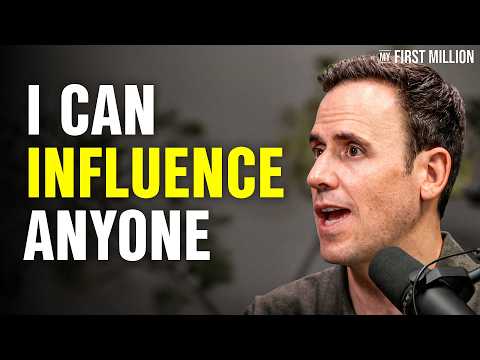
The speaker, a mentalist, emphasizes that the ability to convince and win people over is the most crucial skill in life, describing it as a "cheat code" that 90% of people lack. He explains his profession as a "magician of the mind," distinct from traditional magic as it involves no props. Instead of physical tricks, he influences thoughts and deduces information, making it appear as if he can read minds, though he clarifies he possesses no supernatural powers. His methods involve influencing and extracting information through various techniques, which he considers an elevated form of magic.
He illustrates his abilities with an example where he asks a participant to imagine a birthday party with a specific number of guests and to picture one person they would hug. He then accurately guesses details about this person, including their birth month and exact birthday, and even their name. He notes that the participant's internal thoughts about attending that person's party provided subtle cues. He states that he can't read minds but influences people to reveal information, making it seem like he does.
The mentalist started his career as a magician at 13, getting a restaurant gig at 14. He quickly learned to overcome the fear of rejection, which was his biggest hurdle. To manage the emotional impact of rejection, he developed a cognitive dissociation, separating himself, "O's Pearlman," from "O's the magician." This allowed him to view rejections impersonally, attributing them to the tricks needing improvement rather than personal failing. He believes this ability to overcome the fear of rejection and failure is critical for success, contrasting it with people who "keep one foot out" when pursuing goals.
He compares his approach to concepts from "The Game," a book on social dynamics, acknowledging that techniques like setting time constraints and approaching from a specific angle are derived from that world. He is obsessed with understanding why certain people are remembered after an event and how "naturals" exude confidence without formal training. He aims to teach how to develop this natural confidence and overcome inner dialogue that hinders potential. The underlying skills he uses—walking into a room, being remembered, engaging with people, and creating deeper bonds—are, in his view, universally applicable "cheat codes" for success in any field, from business to teaching or parenting.
He admits that his skills could be used for financial crimes, likening his profession to an "honest con man." Unlike psychics who might sell false promises, he openly states that his performances are based on learned, repeatable skills, not supernatural abilities. He believes that while his specific "tricks" are hyper-focused and don't generalize to everyday lie detection, the underlying principles of influence and observation are powerful.
He recounts an experience in real estate where he uses emotional manipulation to create a "feeding frenzy" among potential buyers. By underpricing properties, he generates high interest and leverages the competitive instinct, even if there are no other offers, leading to profitable sales. This strategy relies on understanding human behavior and emotional investment.
The mentalist reveals a past experience of shoplifting as a teenager, using his sleight-of-hand skills, which eventually led to his arrest and a few days in jail. This experience was transformative, leading him to stop stealing. He also shares that despite his reckless behavior in college, he maintained excellent grades, highlighting a disconnect between academic success and personal struggles.
He discusses his process for developing new material, akin to a comedian refining jokes. He often performs new tricks for the first time on TV, reverse-engineering them by starting with the desired ending and working backward. This allows him to save his polished material for paid performances.
Another participant shares his personal journey of setting a financial goal of $20 million by age 30, inspired by a desire to overcome childhood poverty. He used a structured approach, breaking down the large goal into monthly and quarterly targets, which he calls the "ABC" method (A to B, B to C), focusing only on the next immediate step. This methodical approach helped him sell his company at 31, achieving his goal. He relates this to ultra-running, where the focus is on reaching the next small milestone rather than the daunting total distance.
The mentalist acknowledges a personal challenge: a "fatalistic pursuit" of the next big thing, which prevents him from fully enjoying current successes. He strives to appreciate present achievements, recognizing that he is doing things he once thought impossible.
He shares an anecdote about performing for Jeff Bezos in a room filled with powerful CEOs. He challenged Bezos to ask a question no one else would know the answer to, and then accurately guessed the answer to Bezos's obscure question about a third-grade fight. This moment validated his craft, which he defines as reverse-engineering the human mind to amaze and, to some extent, deceive intelligent people.
He concludes by performing another trick, asking the participant to imagine spinning a globe and pointing to a dream travel destination. He deduces the participant's initial thought of Paris and then a subsequent pivot to Jackson Hole, Wyoming, demonstrating his ability to pick up on subtle mental shifts.