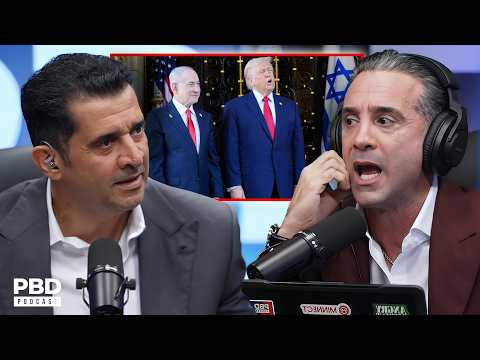
"The Only Man In The Arena" - Trump vs Iran: What REALLY Happened Behind Closed Doors
Audio Summary
AI Summary
The discussion revolves around a New York Times article titled "How Trump Took the US to War with Iran," detailing a critical meeting at the White House on February 11th. Israeli Prime Minister Benjamin Netanyahu and his intelligence chief presented a plan to President Trump and his advisors for military action against Iran. Netanyahu's team outlined four main objectives: the decapitation of the Ayatollah, crippling Iran's power projection capabilities, fostering a popular uprising within Iran, and ultimately achieving regime change with a secular leader.
During the meeting, Netanyahu's team presented a video montage of potential secular leaders, including Reza Pahlavi, who lives in Bethesda, Maryland, which immediately raised questions about the plan's realism. They also claimed that Iran's ballistic missile program could be destroyed in weeks, the regime would be too weak to choke off the Strait of Hormuz, and any Iranian retaliation against US interests would be minimal. Furthermore, Mossad intelligence suggested that street protests in Iran, aided by Israeli spy agencies, would reignite, and Kurdish fighters from Iraq would open a ground front in the northwest, accelerating the regime's collapse.
However, US intelligence officials, including then-CIA Director Gina Haspel and others, assessed the Israeli pitch. They found objectives three and four (popular uprising and regime change) to be "detached from reality" and "farcical." Marco Rubio reportedly called the plan "BS." General Joseph Dunford, Chairman of the Joint Chiefs of Staff, offered a blunt assessment, stating that in his expertise, Israelis tend to "oversell and their plans do not always are well-developed." He added that "they know they need us and that's why they are hard selling."
Despite these internal warnings from his key advisors, the President ultimately made the decision to proceed. The speakers question why Trump would disregard the consensus of his top intelligence and military brass, who deemed half of the proposed objectives unachievable. They highlight that while objectives one and two (killing the Ayatollah and bombing Iran's capabilities) were considered feasible, the crucial elements of popular uprising and regime change were dismissed as unrealistic by US officials. The fact that a popular uprising did not occur, and Kurdish fighters did not provide the anticipated ground support, reinforces the advisors' initial skepticism.
The conversation then broadens to discuss decision-making processes, particularly in high-stakes situations. One participant argues that the process, where external parties like Netanyahu present their case, followed by internal deliberation and ultimately the President's decision, is how such matters should ideally unfold. They appreciate that Trump engages with leaders like Putin, Xi, and Netanyahu, knowing they prioritize their own nations' interests. The analogy of making personal decisions after gathering input from various friends, each with their own biases, is used to illustrate this point.
However, a counterargument is raised about the potential for undue influence when the President's own advisors are dismissed. The concern is that if the President is listening to an "Israel first" voice over his own intelligence and military experts, it could lead to flawed decisions. The floating objectives of the Iran policy, shifting from eliminating nuclear threats to ballistic missiles, drones, regime change, and freeing the Iranian people, are cited as a legitimate criticism, indicating a lack of clear, consistent goals unlike the Venezuela situation, where the objective was clear despite debates over methods.
The discussion emphasizes that the President, as the "man in the arena," bears the ultimate responsibility and pressure for these decisions. While external criticism is inevitable and necessary for a healthy democracy, it's acknowledged that critics often lack the full scope of information available to the President. The point is made that leaders must be prepared for criticism and not be surprised by it, as 100% support is rarely achievable.
The conversation concludes with a personal anecdote about the podcast's own decision to delve into politics despite initial warnings about losing subscribers. This is used to illustrate the idea of tuning out noise and making difficult decisions. The host then shares a recent experience with online bots and hateful comments on a family photo, highlighting the pervasive nature of disinformation and negativity online. He announces that all backlogged merchandise orders have been fulfilled and introduces a new limited edition "America 250" hat, celebrating 250 years of bold decisions, available on vtmerch.com.