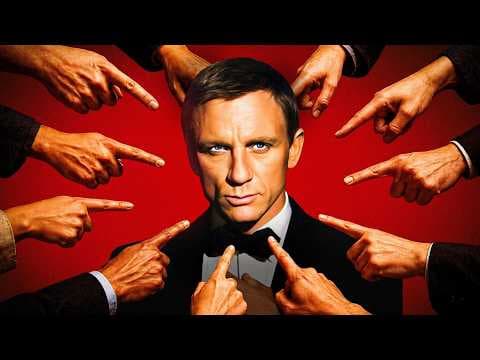
Le meilleur James Bond de l’histoire (Daniel Craig)
Audio Summary
AI Summary
Imagine being a 35-year-old struggling comedian in London, with dreams of being an actor. One day, you receive a call offering you a role that will change everything—a role that has existed for 60 years, played by six actors before you. This isn't just a role; it's a legacy: James Bond, the most famous name in cinema. Accepting it means your name will be etched in history, with no turning back. This actor, who said yes, became one of the planet's most famous people in weeks, abandoning his previous anonymous life, a choice that caused him heartbreak. This role proved that a single part can transform a career, a life, and even the way cinema is made. Of all who played the spy, he is considered the most magnified, emotive, blonde, and stylish. Yet, it's almost sad that once he played this role, he wanted out. His dream was to act, not to dedicate 15 years of his life to a franchise. He regretted his past life, seeing this decision as potentially the worst he ever made.
James Bond's legend isn't just due to the films; it has a rich backstory. In 1939, a 31-year-old English marine officer and former journalist, Ian Fleming, predicted a new conflict in Poland. He had witnessed the horrors of war firsthand: Nazis, double agent missions, firearms, and death. After the war, he married but found a new hobby: writing. He wrote extensively about espionage, a subject he knew intimately. He created a character: stubborn, a gambler, driving big cars, a drinker, and a womanizer—the spy he wished he had been ten years prior. He introduced a Russian adversary and his associate, Le Chiffre. This project eventually found an editor and was published in 1953 as "Casino Royale," signed by Ian Fleming.
The original name for the character was "James Secretan." However, when "Casino Royale" was reprinted, Ian Fleming was asked to change the name, as it was considered too surprising. Struggling to find a new name, Fleming, a keen bird watcher, was reading "Birds of the West Indies" and saw the author's name: James Bond. He immediately called his editor, declaring he had found the name. The book was a success, selling 5,000 copies in its first month and over 50,000 within a year—an enormous figure for the time. Fleming, who initially only wanted to secure his retirement, became a celebrated author.
From 1953 until his death in 1964, Fleming wrote a new James Bond book every year. He even contemplated killing off James Bond to regain his freedom, but unknowingly, he was fighting a curse that would follow Bond throughout his life: the character was impossible to kill. The announcement of Bond's death in future books was not well received by publishers, who saw the immense profitability of the franchise.
In the 1950s, the demand for books soared, and everyone wanted a piece of the pie, including television. On October 21, 1954, "Casino Royale" was adapted into a TV film. While most associate James Bond with actors like Sean Connery, Pierce Brosnan, Roger Moore, Timothy Dalton, or George Lazenby, the first screen Bond was actually Barry Nelson. The refusal to kill off James Bond was likely due to his growing popularity.
Meanwhile, in the 1990s, our struggling actor, who enjoyed a quiet life of theatre and pub visits, began to gain recognition for his talent. He was offered more stage roles, and eventually, film opportunities. He didn't care about fame; he just wanted to act. He accepted a supporting role in a historical film with Cate Blanchett. A seemingly unremarkable scene in this film, where he walks down a corridor, caught the eye of Barbara Broccoli, a young producer.
Barbara Broccoli was no ordinary producer. Her father, Albert Broccoli, along with his associate Harry Saltzman, founded EON Productions in 1961 and acquired the rights to James Bond from Ian Fleming. They brought James Bond to life on screen, starting with Sean Connery, who became the epitome of the ultimate leading man. "Goldfinger" was the first film in history to gross over $100 million, equivalent to $937 million today. After Connery, Roger Moore took over, starring in seven films over 12 years. James Bond became synonymous with masculine sex appeal and a global phenomenon.
For 40 years, EON, under the guidance of Albert Broccoli and Harry Saltzman, built the most powerful franchise of all time. However, by 2002, despite Bond's enduring popularity, there was a sense that audiences might desire something new. That year, two spy films were released: Pierce Brosnan's final James Bond film, "Die Another Day," and "The Bourne Identity" starring Matt Damon. The contrast was stark, suggesting a shift in audience preferences.
Ian Fleming had considered ending James Bond in his books, and now, the film franchise faced a similar crossroads. Albert Broccoli was no longer alive, and his daughter, Barbara, was at the helm of EON. Having grown up immersed in the James Bond world, she was determined to do great things. During Pierce Brosnan's era (1995-2002), he expressed a desire to move on after his third film. Barbara faced a dilemma: either reinvent the character with Brosnan or find a new James Bond. She announced that the next James Bond would be different, more human, and the future of the saga would depend on the actor.
Many actors auditioned for the role, including Ewan McGregor, Michael Fassbender, and Henry Cavill, who was initially the director's first choice. However, our struggling actor, the one from the beginning, never even considered auditioning for such an iconic role.
One evening, Barbara Broccoli was watching "Layer Cake," a Matthew Vaughn film about a London cocaine dealer. She recognized the lead actor, a very blonde, blue-eyed Englishman, from that brief corridor scene in the historical film years ago. His performance in "Layer Cake"—physical, violent, yet emotional—struck her. She realized he was the one she needed. His name was Daniel Craig. She declared to her team the next day that she had found their new James Bond.
Daniel Craig was unaware of this. When he received the call from Barbara, he was initially apprehensive. A few weeks later, a major event was organized in London. On a military ship in the middle of the Thames, the new James Bond was unmasked: Daniel Craig. The public's reaction was overwhelmingly negative. He didn't fit the traditional image of Bond. Critics questioned how he could replace Pierce Brosnan with his "plastic Russian artist" look, his blonde hair, and his appearance in a life vest. Websites like "CraigNotBond.com" and "BlondNotBond.com" emerged, filled with articles arguing that a blonde, muscular actor with a "professional boxer's face," accustomed to playing villains, could not embody the tall, dark, handsome, and elegant secret agent.
Despite the backlash, the controversy generated significant buzz for the upcoming film. Daniel Craig began an intense physical transformation, shedding his previous lifestyle of cigarettes, alcohol, and unhealthy eating. His coach pushed him to become "balèze" (strong), a new requirement for this more physical Bond.
Barbara Broccoli decided to restart the franchise by adapting Ian Fleming's first book, "Casino Royale," which had only been adapted once before in the 1960s. The story focused on Bond's first mission, a poker game, and a woman he would love. This approach finally piqued Daniel Craig's interest.
Filming for "Casino Royale" began in November 2005 in the Bahamas. Anticipation for the film was immense, and a persistent photographer even spent the night in the sand near the set to capture the first images of Daniel Craig, hoping to prove he was a bad choice. However, when the sun rose, the photographer zoomed in and saw Daniel Craig emerging from the water in swimming trunks, looking magnificent. This single shot, an unintentional homage to Ursula Andress's iconic scene in "Dr. No," instantly silenced critics and transformed hate into hype. The world realized that a blonde Bond could work.
When "Casino Royale" was released in 2006, it was a critical and commercial success, grossing over $600 million. It received 8 BAFTA nominations and won a Saturn Award for Best Film, a first for James Bond. The premiere was historic, attended by the Queen of England. The audience, initially skeptical, erupted in applause after the intense opening sequence and the integration of the "gun barrel" into the film's narrative, marking Bond's first kills and his journey to becoming 007.
In that moment, Daniel Craig, overwhelmed by years of pressure and criticism, understood something profound: he was no longer the actor he had been before James Bond. He had delivered one of his best performances, though he never intended to dedicate his life to the role. The intense public scrutiny continued after "Casino Royale," making it impossible for him to live a normal life. His privacy was invaded, and his relationships were scrutinized by the press.
Despite the challenges, Craig embraced the role. In 2007, he returned for "Quantum of Solace." However, the production was chaotic due to a writers' strike. The script was incomplete, and the director, Marc Forster, and Daniel Craig had to write scenes daily. The film, though financially successful (grossing $600 million), was not as well-received as "Casino Royale." Craig also sustained numerous injuries throughout his Bond tenure, including two teeth broken on "Casino Royale," a dislocated shoulder, a cut finger on "Quantum of Solace," a broken leg on "Spectre," and an ankle injury on "No Time to Die."
In 2012, his career reached another peak with "Skyfall." This film delved into Bond's past, his childhood, his parents, and his relationship with M. It introduced new versions of classic characters like Q and Moneypenny, brought back the Aston Martin DB5, and featured a compelling villain played by Javier Bardem. "Skyfall" was a masterpiece, grossing over $1 billion and, for many, standing alongside "Casino Royale" as Daniel Craig's best Bond film.
The role of James Bond came with immense pressure, not just during filming but also in his daily life. His clothing, cars, and sponsor obligations were all dictated by the franchise. He became a fashion icon, with anything he wore instantly selling out. This constant scrutiny made him understand Ian Fleming's desire to kill off James Bond for a tranquil life. After "Spectre," he famously declared he would rather slash his wrists than do another Bond film, despite the ever-increasing paychecks (from $3 million for "Casino Royale" to $30 million for "Spectre").
After a break, Daniel Craig returned for one final mission: "No Time To Die." Phoebe Waller-Bridge was brought in to co-write the script. While not reaching the critical heights of "Skyfall" or "Casino Royale," "No Time To Die" was arguably the most important film in the saga. For the first time in 60 years, James Bond was portrayed as human, vulnerable, and tired, seeking a normal life. The film explored his relationship with a daughter, a first for the character, and concluded his arc with Vesper Lynd, allowing him to finally choose his own destiny. The ending, though sad, was seen as the only possible way for the character to achieve closure.
Over 15 years and five films, Daniel Craig transformed James Bond. He took a role that everyone doubted he could play and left an indelible mark on its history. Before Bond, he was a young man joining the National Youth Theatre, an actor who loved the stage. Even after Bond, he continued to pursue diverse acting roles, including a challenging performance as a homosexual man in 1950s Mexico. Leaving the role was heartbreaking for him, as he left behind a part of his life that confirmed him as a colossal actor. For James Bond fans, there is only one thing to say: Thank you, Daniel Craig.