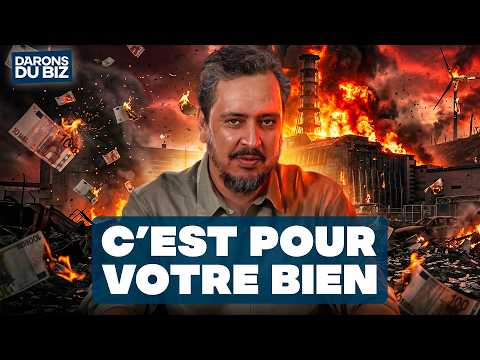
La grande arnaque verte - avec Aldo Sterone
Audio Summary
AI Summary
This transcript presents a critical perspective on modern political ecology, particularly its focus on climate change, arguing it is more of a religion and an economic racket than a science. The speakers contend that the scientific consensus on climate change is manufactured and influenced by financial interests, leading to policies that harm the middle class and benefit global powers like China.
A central argument is that natural climate cycles have always existed and that current changes are not necessarily an anomaly requiring drastic societal upheaval. They cite Earth's orbital variations, solar activity, and longer-term geological cycles as drivers of climate change throughout history, pointing to past glaciations and periods of warmth. The idea that human activity is the sole or primary cause of current warming is challenged, with a distinction drawn between climate change and pollution. While acknowledging pollution is a problem, they argue that climate policies don't necessarily address it and can even exacerbate it by shifting production to less regulated regions.
The speakers are highly skeptical of proposed solutions, such as electric vehicles and renewable energy sources like wind turbines. Wind turbines are described as a "complete scam," primarily a way to secure subsidies and being sold by China with programmed obsolescence. The ban on internal combustion engines by 2035 is viewed as an economic gift to China. Electric cars are dismissed as not being the most effective way to save the planet. Nuclear energy is also brought up, with a statement that it's the most dangerous energy source, though this is immediately countered by the claim that France could stop emitting CO2 tomorrow without affecting global climate.
The concept of "scientific consensus" is heavily criticized, drawing parallels to historical instances where scientific consensus was later proven wrong, such as the promotion of cigarettes by doctors in the past. They allege that research funding, including for bodies like the IPCC, is often opaque and influenced by powerful interests, leading to biased results. The disappearance of billions in climate funding is highlighted as evidence of potential corruption or mismanagement.
The speakers argue that climate policies are being used to impose "punitive ecology" and extract wealth from the middle class. Measures like low-emission zones are seen as effectively banning poorer individuals from cities. The carbon tax is claimed to be paid by the people, not multinational corporations. The DPE (Diagnostic de Performance Énergétique) for housing is criticized for potentially removing millions of homes from the market and worsening the housing crisis.
A significant portion of the discussion revolves around the perceived hypocrisy of climate advocates who often travel by private jet while preaching environmentalism. They also criticize the use of climate change as a justification for increasing state control and limiting individual freedoms. Examples include the idea of "15-minute cities" and electronic fencing to restrict movement, reminiscent of a feudal system. The UK's introduction of mileage charges for electric vehicles is cited as an example of the state changing the rules of the game after people have invested in the "green" option.
The narrative suggests a deliberate strategy to dismantle European industries, particularly the automotive sector, in favor of China. The rapid rise of Chinese electric vehicle manufacturers like BYD is presented as evidence, with European cars being portrayed as inferior in quality and price-performance compared to their Chinese counterparts. This is framed as a strategic move by China, which paradoxically continues to build coal plants while pushing green technologies in Europe.
The speakers also touch upon the broader geopolitical implications, contrasting the pragmatic, business-oriented approach of the US (focused on AI and energy independence) with what they perceive as Europe's ideological and self-destructive embrace of climate policies. They suggest that Europe is becoming a "slave civilization" to more pragmatic global powers.
The discussion extends to the nature of the state, which they view as an entity serving the interests of dominant classes rather than the general population. The example of nuclear energy in France is used to illustrate how political ecology, influenced by external pressures (like Germany), has led to the destruction of a clean energy source, hindering national sovereignty and energy independence. They argue that wind and solar energy are unreliable and primarily serve as a mechanism for transferring taxpayer money to wealthy investors through guaranteed subsidies.
The transcript concludes with a bleak outlook for Europe, suggesting it is on a path of irreversible decline due to its adherence to what they see as flawed and self-serving ecological ideologies. The speakers advocate for individual responsibility, critical thinking, and, for some, expatriation as the only viable solutions to protect oneself and one's family from what they perceive as an impending economic and societal collapse driven by "eco-politics." They emphasize that true ecology, focused on resourcefulness and avoiding waste, existed before the current climate discourse and is being undermined by the very policies claiming to protect the planet.