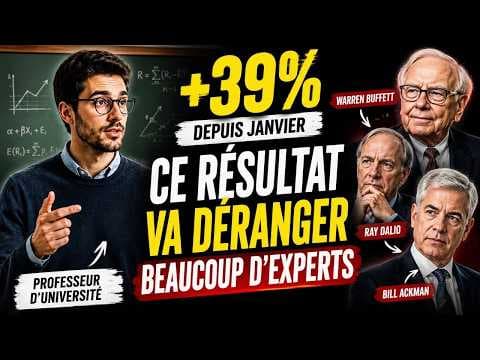
Ce professeur d’université réalise +39%… et ça risque de déranger beaucoup d’experts !!!
Audio Summary
AI Summary
The speaker begins by recounting a 2009 research study conducted with Philippe Bernard, focusing on the results of a trading competition organized by ZoneBourse. The study analyzed data from 505 active traders who participated for over five months, as many abandoned the competition or lost their entire capital within shorter periods. The findings were stark: only 39 traders, or 7.72%, achieved a positive performance, defined as anything above 0%. These positive results were often marginal, with minimal gains. Furthermore, a significant portion of participants, 42%, lost their initial capital of at least €1000 at least once, leading the speaker to liken the experience to gambling. The high brokerage fees of that era, around €9 per transaction up to €7500, were identified as a major impediment, requiring a minimum gain of €18 just to break even on a buy-sell transaction. The speaker warns that even with modern brokers advertising zero fees, hidden costs or less favorable execution prices exist, emphasizing the principle that "when it's free, you are the product." The prospect of a €10,000 prize in the competition, despite a €1000 initial stake, was seen as an incentive that fostered a gambler's mindset with a low probability of success.
The speaker then contrasts these findings with a more recent experiment involving his students and real money, conducted in 2026. This experiment involved a survey with 324 anonymous responses, providing a statistically significant sample. The question posed to students was about their performance since the beginning of the year. The speaker shares his own portfolio's performance as a benchmark, which stood at 30% by May 15th. The survey results revealed a dramatic difference: 17% of students achieved 27% or higher performance, and 36% between 20% and 27%. Crucially, only 1% of students reported a negative performance, a stark contrast to the 92.3% negative performance in the ZoneBourse competition. This statistic challenges the common narrative, often perpetuated by Forex advertisers, that 90% of traders lose money. The speaker highlights that 99% of his students showed positive performance, with nearly 80% achieving over 15% growth.
The speaker acknowledges the skepticism such results might generate, particularly the idea that amateur traders could outperform seasoned professionals, including those with advanced mathematical and financial expertise. He then introduces William Igon, a respected figure in finance whom he contrasts with his own quantitative, momentum-based approach. Igon, described as a "Warren Buffett of France," focuses on value investing, seeking undervalued qualitative stocks and playing for a return to fundamental value. The speaker clarifies that his own strategy is purely momentum-driven and quantitative, and that while he respects fundamental analysis, it's not his primary method, especially in the current expensive market. He notes that Igon, managing significant assets and client funds, cannot time the market and must remain invested, a stance the speaker disagrees with, citing Warren Buffett's ability to hold cash and wait for opportunities. The speaker explains that the market since 2009 has been a momentum market, driven by liquidity injections and quantitative easing, which distorts fundamentals. He believes that while momentum is currently dominant, value investing will eventually become relevant again.
Comparing performances, the speaker reveals that William Igon's performance year-to-date was 5%. Famous hedge funds like Citadel and Millennium also showed modest returns in the first quarter, with Citadel at 2.4% and Millennium at 3.6%. He then introduces "Maxime," a university professor and researcher, not a finance professional, who joined his institution in 2025. Maxime's year-to-date performance was an astounding 38.98%, significantly outperforming the Nasdaq and, importantly, professionals like William Igon and major hedge funds. This example is presented to counter the dominant discourse that individuals have no chance in the markets. The speaker reiterates the ZoneBourse competition's dismal results (7% positive performance) due to high fees and a gambling mentality, contrasting it with the nearly 99% positive performance among his students.
The speaker addresses the common argument that comparing individual investors to multi-billion dollar hedge funds is invalid. He argues that the question is precise: can individuals beat professionals? He dismisses the notion that technical analysis is merely "drawing," as proclaimed by some with prestigious academic backgrounds, by pointing to the actual performance results. He emphasizes that his approach, based on a scientific anomaly (momentum) and extensive back-testing since 1995, is not based on luck. He presents the "Alpha Zen" portfolio's performance, which since 2007 has yielded 25% annually with a maximum drawdown of 22-23%. From 2020 to early 2026, it achieved 31% annual returns with a 22% drawdown. Crucially, during the "lost decade" of 2000-2010, when the Nasdaq saw no growth, the Alpha Zen portfolio returned 17.39%. Over 30 years, it has "annihilated" the Nasdaq with an average annual performance of 25%. This data, available on the Alpha Zen page, is presented as evidence of a solid, data-driven strategy, not a hastily conceived idea.
The speaker anticipates further objections, such as the argument that if momentum trading were so easy, everyone would do it, or that it might stop working if widely adopted. He counters that as long as highly educated individuals dismiss technical analysis as "drawing," there is ample room for such strategies. He also dismisses the idea that he would keep a successful strategy secret, comparing it to doctors or lawyers sharing their knowledge. He argues that in highly liquid markets, sharing a strategy doesn't diminish its effectiveness, especially when only a small fraction of people actually implement it with the necessary discipline. He points out that even if thousands followed his approach, it would still be a small drop in the ocean, and many professionals, like William Igon, do not use momentum, creating opportunities.
The speaker then delves into the psychological aspect, emphasizing the importance of mindset. He acknowledges that the Alpha Zen program is not easy and that many students experience doubt, panic, and even unsubscribe during difficult times, such as during wartime. He stresses that consistent application and a strong mindset are crucial for success. He criticizes the prevailing narrative that it's impossible to beat the market, attributing it to either incompetence or vested interests whose business models rely on preventing individuals from achieving market success. He contrasts his own motivation, which is the success of his students and scientific validation, with the potential financial interests of others. He highlights that his students, often intelligent and serious individuals, have achieved remarkable results.
He presents numerous testimonials from students, including Gael (over 56% performance in one year), Boris, Oda (24% year-to-date), Baptiste (36% performance), and Dasa (34.78% performance, outperforming the Nasdaq). Christophe, a bus driver, achieved 14.79% performance in less than four months with a small capital. These testimonials, shared freely on LinkedIn, showcase a diverse range of individuals achieving exceptional results. The speaker admits that Alpha Zen is in a launch phase and requires significant work, but he believes it offers immense value by opening minds to the possibility of individuals beating professionals. He contrasts this with "doom and gloom" economic videos that attract views but offer little value.
The speaker addresses common arguments encountered in the Q&A section of his program. To the question, "If it were so easy, everyone would do it," he responds that discipline and action are key, likening it to weight loss where knowledge alone is insufficient. He emphasizes that Alpha Zen provides action through a real portfolio and coaching, where he demonstrates his own trades and accepts losses, fostering a sense of shared endeavor. He firmly states that no one can guarantee performance, and anyone who does is a charlatan. Instead, he guarantees that inaction leads to wealth erosion through inflation, and investing without a method leads to emotional decision-making and losses, as evidenced by the ZoneBourse competition's low success rate.
He highlights the advantages of individual investors, such as agility and access to momentum strategies. He presents a scenario where investing only 25% of a portfolio in Alpha Zen could yield the same performance as a 100% ETF investment over the long term, based on historical data. He reiterates that risk is inherent in all investments. He concludes by expressing pride in Alpha Zen's impact, having transformed many from passive investors into "personal hedge funds." He acknowledges the significant effort involved and the emotional toll, particularly during traumatic events like war, which led him to consider stopping the program. However, positive feedback and the desire to continue creating intelligent investors keep him motivated. He believes Alpha Zen has created a new form of investment and a generation of discerning investors, offering significant value beyond mere financial returns. He encourages viewers to like the video, leave comments, and ask questions.