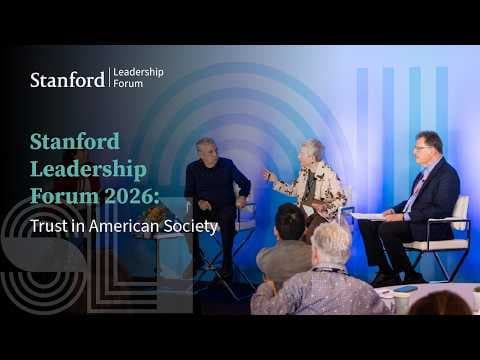
Stanford Leadership Forum 2026: Trust in American Society
Audio Summary
AI Summary
This panel discussion focuses on the decline of trust in American society, its various dimensions, and potential solutions. Historically, trust has been a "superpower" for America, linked to better health, happiness, economic prosperity, democratic institutions, and resilience. However, trust has significantly declined: in the 1970s, about half of Americans trusted others, a figure that has fallen to about a third today. Alarmingly, only 17% trust the government to "do the right thing." This erosion extends to institutions like the news, courts, communities, and leaders. The panel aims to understand this crisis and explore remedies.
Tom Friedman argues that Americans can no longer agree on basic facts, a situation not accidental. He uses the metaphor of "mangroves" – filtering institutions that hold society together – which have been lost. These include shame, elite responsibility, civility, and local newspapers. Shame, for example, once prevented public figures from seeking office after scandals. Elite responsibility, such as that expected from a Supreme Court justice, has diminished. Civility, once a standard, has eroded to the point where public discourse is often vulgar. Local newspapers, which once provided a filtered and contextualized view of local and national politics, have largely disappeared, replaced by unfiltered information directly from partisan media. Friedman believes these filtering institutions have been "uprooted," and their restoration requires intentional effort and a diversity of "species" or perspectives.
Friedman dates this erosion largely to 2007, with the advent of Facebook and social media. He argues that social media disintermediated people from each other and fostered anonymity, allowing individuals to say anything without an editor. He criticizes the conflation of editing with censorship, which he believes has contributed to a "trust destroying engine" where reputations can be ruined and lies spread with zero accountability. He personally avoids social media platforms like Twitter, Facebook, Instagram, and TikTok, viewing them as detrimental to trust.
Margaret Levi acknowledges the role of social media but suggests that the erosion of social infrastructure predates it, pointing to events like the Vietnam War, Watergate, and the decline of labor unions and PTAs. She also emphasizes that distrust is not always negative, particularly concerning government. A certain degree of skepticism can be healthy in a democracy. Levi's work focuses on what makes institutions "worthy of trust." Key elements include promise-keeping by elected officials, competent and fair delivery of services, and accountability for those who break laws or free-ride. She stresses that government commitments should be to the common good, transcending partisan boundaries. Levi finds it challenging to identify current US institutions that are consistently getting this right, noting a widespread undermining of trust. She cites Denmark as an international example of a country with institutional arrangements that foster trustworthy government and high citizen trust, particularly in areas like environmental policy and social welfare.
Larry Diamond, drawing on his studies of democracies worldwide, notes that declining public trust is an early warning sign of democratic collapse. He echoes Levi's point about the potential for "too much trust," referencing the high trust in government during the Eisenhower era, which subsequently fell after events like Vietnam and Watergate. He cites the philosopher Sidney Hook, who argued that democracy requires a scrutinizing and skeptical orientation toward government, not blind faith or hostile rejection. Diamond also points out that while US trust levels appear low, comparative data suggests that European parliamentary systems with proportional representation and coalition governments (like Denmark, Norway, Sweden, and Germany) often have significantly higher trust in government than majoritarian systems like the US. He highlights the dire situation in Latin America, where trust in political institutions is extremely low, with higher trust only in non-political institutions like the church, police, and military. This chronic distrust, often fueled by corruption and poor performance, leads to dissatisfaction with democracy and a desire for "strong men" leaders who claim to be above political "muck." He sees South Africa, where satisfaction with democracy has plummeted, as an example of a democracy in serious trouble due to declining trust.
The panel discusses the "canary in the coal mine" for democratic decline. Diamond reiterates that social media's business model, which drives algorithms towards toxic and polarizing information, is overwhelming societal "mangroves." He also emphasizes the critical role of local media, noting the disappearance of local newspapers. He mentions a recent initiative by Reed Hoffman to restore trust in institutions through a state-level online information network called CalMatters, which aims to increase transparency and accountability in state government. This initiative, by systematically reporting on government actions, could provide more context and balance to information, moving away from cynicism.
Friedman acknowledges that society has shifted from "too little information to too much," making the challenge now "what to believe." He suggests that "digital civics" – teaching people how to read, triangulate, and verify information online – should be a fundamental part of education. He sees his role as a journalist as a "translator from English to English," simplifying complex subjects so people can understand them and "fear less," especially in an age where making people "stupid and angry" has become an industry.
Levi argues that beyond social media and information problems, democratic institutions themselves need repair. They are 250 years old and haven't evolved sufficiently. She emphasizes the need for new forms of deliberation and engagement where people's voices are heard, respected, and responded to. She also highlights the loss of "intermediate organizations" (like local newspapers, religious institutions, and unions) that once helped translate information and reinforce social norms. She suggests that capitalism and democracy need a "refresh and a rethink" beyond the current "old form."
Friedman brings up the "skyboxification" of public goods, where once collective experiences like watching sports are now increasingly behind paywalls, contributing to societal fracturing.
The panel discusses how the crisis of trust plays out differently across various communities. Levi points out that different groups in the US, such as southern white men, Black Americans, and religious groups, feel "dissed and disrespected" or that promises have not been kept, leading to distrust of government and each other.
Diamond stresses the need to address polarization. He praises Tom Friedman's reporting on how trust emerged in Minneapolis after a crisis, highlighting the power of social roots of organization and connectedness. Friedman explains that Minneapolis's response was emergent but rooted in a "winter people" culture of mutual aid and pre-existing community organizations. He also mentions the recent events in Hungary, where a grassroots movement challenged the populist leader Viktor Orbán, driven by concerns about corruption and the state of social services, rather than just democracy. This suggests that addressing tangible issues like corruption and economic well-being can be a powerful driver for change and trust.
Diamond highlights the potential of deliberative democracy, specifically "deliberative polling," to reduce affective polarization. By bringing diverse groups of people together under "good conditions" – objective information, fairly stated pro and con arguments, and an ethic of mutual respect – people can dramatically reduce emotional contempt for opposing viewpoints. He suggests that scaling up such deliberation in communities and schools, or online, could reduce polarization and increase informed engagement.
For future leaders, Tom Friedman advises to "be a good listener." He learned that listening not only helps one understand but also conveys respect, which is crucial for effective communication and building trust. Margaret Levi offers the example of Australia in the 1980s, where Prime Minister Bob Hawke rebuilt trust in the tax system by holding a constitutional convention with diverse groups. Though the system didn't change drastically, public confidence was restored because people felt they had participated and been heard. Larry Diamond advises future leaders to "be a bridge" – to step outside their comfort zones and connect with broader information flows and social networks, bridging political and social differences.
The panel also touches on economic inequality as a factor in distrust, noting that countries with higher trust often have more equitable wealth distribution and a commitment to the collective good. The potential impact of AI on jobs and the further erosion or rebuilding of truth is also briefly mentioned, with concerns about AI's inherent trustworthiness but also its potential for positive applications in addressing misinformation and fostering connection.
In conclusion, while the challenges are sobering, the panelists express optimism that trust can be rebuilt through intentional efforts to restore filtering institutions, promote listening and mutual respect, reform democratic institutions, address economic inequality, and leverage deliberative processes.