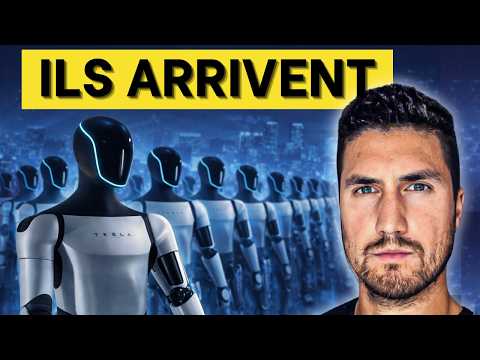
5 investissements pour GAGNER ($) dans l’ère de l’IA et des robots
AI Summary
In this video, Paul addresses a common modern anxiety: the fear that robots and artificial intelligence will inevitably replace human jobs and cause us to lose control over our destiny as a species. Rather than succumbing to panic, Paul argues that we are facing an unavoidable revolution. He estimates that by 2050, there will be at least one billion humanoid robots globally. He points to the imminent arrival of autonomous robot taxis as a prime example of how the world is changing; soon, a car will no longer be a mere expense but an asset capable of generating income. This shift will likely eliminate traditional roles like taxi and Uber drivers, but Paul insists that history rewards those who take action and position themselves with the "wind at their backs" rather than those who live in fear.
To navigate this transition, Paul suggests focusing on three primary human resources: time, energy, and money. He views the current state of AI and robotics as being similar to the early days of Bitcoin in 2013—a massive opportunity for those who understand the trend. He advises viewers to ignore the extremes of "doomsday" media and the intense pressure to learn everything about AI immediately. Instead, he suggests a balanced approach of adaptation. He notes that while people often imagine a "Terminator" style apocalypse or a society of total leisure, the reality will likely be somewhere in the middle, and we have roughly 15 to 20 years before robots reach a level of mass production that could truly shift societal control.
Paul draws a historical parallel to the agricultural revolution. At one time, 80% of humans worked in agriculture, but mechanization and tractors changed that. Humans adapted and moved into other fields. He believes AI will follow a similar path. The first major shift we will see involves autonomous driving. Within months, software updates could turn millions of Teslas into autonomous vehicles. This creates a new economy where an individual could own a fleet of ten cars that perform automated transport services, generating passive cash flow.
This leads to a broader reflection on governance. Paul observes that governments are often too slow to regulate—noting it took fifteen years to classify Bitcoin. Consequently, he predicts that large corporations like Tesla will gain immense power, essentially acting like sovereign nations. In this new model, a corporation "taxes" its robot workers by taking a percentage of the revenue they generate, such as a fee on every autonomous taxi ride. This creates a completely new economic structure where robots serve as the primary workforce for corporate "states."
To succeed in this environment, Paul outlines five specific strategies:
**1. Investing Capital in Growth Sectors:** For those with savings, Paul recommends investing in the "best" companies within the fields of humanoid robotics, autonomous vehicles, battery technology, and drones. He emphasizes that this is just the beginning of a long-term trend. He specifically mentions looking for companies preparing for their Initial Public Offerings (IPOs) in the robotics sector, as these represent early-stage opportunities for significant profit.
**2. The "Pick and Shovel" Strategy:** Referring to the 1800s gold rush, Paul explains that while few miners found gold, the people selling the tools—picks and shovels—consistently made money. In the AI era, the "picks and shovels" are data centers, energy providers, and manufacturers of robot components and batteries. Investing in the infrastructure that powers AI is often safer and more lucrative than betting on a single AI application.
**3. Utility Businesses:** If you have the capital, Paul suggests moving beyond stocks and actually purchasing physical assets like autonomous vehicle fleets or humanoid robots. These can be leased out as a utility business. As humanoid robots become more advanced and capable of performing diverse tasks, owning the hardware that performs the labor will become a highly profitable business model.
**4. Becoming Indispensable through AI Mastery:** For those without large amounts of capital, Paul suggests using time and energy to become an expert in AI tools. This doesn't necessarily mean becoming a computer scientist, but rather learning how to integrate tools like ChatGPT, Claude, or Grok into business processes. He introduces the concept of "vibe coding," where one can write software using spoken language while the AI handles the technical logic. He emphasizes that the best teacher for AI is the AI itself; by spending a small monthly subscription fee, anyone can access world-class training in automation.
**5. Branding and Human Connection:** Paul argues that as AI-generated content, fake news, and "AI influencers" flood social media, human trust and brand image will become more valuable than ever. People will still seek out brands they recognize and trust—like Google—because they represent reliability. Developing a personal or corporate brand is a safeguard against automation. Furthermore, he highlights that certain human elements, like leadership, tonal nuance, and community, are difficult for AI to replicate. Humans still prefer watching other humans compete in sports or play chess, suggesting that the "human touch" will remain a premium commodity.
Finally, Paul highlights "Focus" as the ultimate weapon for 2026 and beyond. In a world of constant digital distraction, the ability to work deeply for several hours on a single task is becoming rare. He shares his personal experience as a high-level triathlete, noting that he succeeded because he focused exclusively on one sport for ten years. He warns against trying to run eight businesses at once, as specialization leads to mastery. In an age of "empty" AI content and "soft brains" caused by notifications, the person who can focus on one thing and become a champion in that niche will be the one who prospers. By strategically using time, energy, and money, Paul concludes that anyone can turn the AI revolution into a source of success.