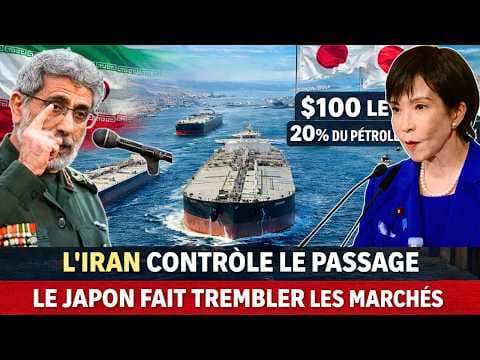
Le Japon avertit le monde et l'Iran double ses revenus — Washington panique
Audio Summary
AI Summary
The speaker anticipates Japan taking action in response to global events, citing the existing relationship between the US and Japan, which includes 45,000 US soldiers stationed in Japan and significant US spending. While the US doesn't *need* anything from Japan or others, intervention is deemed appropriate, especially since Japan reportedly obtains over 90% of its oil via the D3 Dormouse. This situation is no longer theoretical but is unfolding within a critical choke point of the global economy. The involvement of three distinct powers—the US, Iran, and Japan—in this strategic equation signals a shift in the global balance.
At the heart of this equation is the D3 Dormouse, a small maritime corridor that is immense in its consequences. Approximately one-fifth of the world's oil, around 20 million barrels daily, transits through this passage between the Persian Gulf and the rest of the world. This narrow strait is crucial for the energy stability of the global economy. Iran's evolving posture in this region is gradually altering the regional balance of power. By consolidating its presence and strengthening its surveillance and maritime projection capabilities around the D3, Tehran is not merely protecting its exports but gaining influence over the energy flow of several Gulf monarchies, including Saudi Arabia, the United Arab Emirates, Qatar, and Kuwait. This changes the strategic logic of the Middle East, as Iran's ability to impact this maritime passage indirectly influences the energy exports of countries historically aligned with the Western bloc. The issue thus extends beyond the Washington-Tehran rivalry to the very architecture of the global oil market.
The United States faces a complex strategic dilemma. Officially, its rhetoric remains tough with sanctions, diplomatic pressure, and repeated warnings. However, economic reality imposes pragmatic limits, as a sudden contraction in global oil supply would immediately cause price surges, leading to inflation, financial market tensions, pressure on central banks, and economic slowdown. Even with high energy production, the US is not immune. Washington must maintain a firm stance against Iran while avoiding major disruptions to global oil flow; geopolitical confrontation cannot reach the point of economic rupture. Tehran seems to grasp this contradiction, which strengthens its strategic position, as controlling or influencing a vital energy corridor provides indirect leverage over international financial balances.
This dynamic extends beyond the Middle East to Asia, with Japan being particularly concerned. Despite having one of the world's most industrialized economies, Japan has a major structural weakness: energy dependence. Much of its oil and liquefied natural gas comes from the Persian Gulf and transits through the D3 Dormouse. Any tension in this region almost immediately impacts Japan's energy security. As markets price in this risk, the yen is often the first casualty. The yen recently approached historical lows against the dollar, a level that has previously forced Japanese authorities to intervene. Tokyo faces a delicate position because traditional tools to defend a currency, like raising interest rates, are difficult to use. Japan's public debt already significantly exceeds 230% of its GDP, a colossal level for an advanced economy. Sharply increasing key interest rates would instantly escalate the cost of servicing this debt, potentially straining bond markets, causing investors to question the stability of Japanese bonds, and paradoxically worsening pressure on the yen. This is described as a financial trap where monetary policy becomes almost unusable.
In such a scenario, Tokyo's options are limited. A critical question arises: what if the Middle East energy crisis escalates into a global financial crisis? Tokyo might be compelled to use a discreet but potentially explosive lever for international markets: utilizing part of its financial reserves to stabilize its currency and economy. Japan holds one of the largest foreign positions in US debt, with hundreds of billions of dollars invested in US Treasury bonds. If pressure on the yen becomes too strong, energy import costs continue to rise, and budgetary margins shrink, selling some of these assets to support the Japanese currency could emerge as an option. Such a decision would have immediate global repercussions. As Washington needs to finance a growing volume of public debt, a massive influx of additional bonds onto the markets could abruptly alter the supply-demand balance. Analysts project an increase of about $250 billion in new Treasury bond issuances compared to the previous year. If Japan sells US Treasury bonds, it could lower their prices, increase yields, raise the cost of US debt, and trigger a financial spiral.
Paradoxically, Iran benefits from the new energy tensions despite sanctions. Before the recent escalation, Iranian oil was often sold at a significant discount (18 to 24 dollars below market price) to compensate buyers for legal and political risks. Now, this gap has reportedly narrowed to about 7 dollars, bringing Iranian oil closer to international prices. In some cases, including transport costs, Asian refineries pay almost the same price for Iranian oil as for other Gulf oils. This is partly due to the changing energy demand in Asia, where countries like China and India have infrastructure capable of processing heavier Iranian crude, allowing demand to be redirected rather than disappear. Some analyses indicate that India recently bought an Iranian cargo for the first time in several years, signaling that trade channels continue to adapt despite sanctions. If global prices remain high, potentially exceeding 100 dollars per barrel, Iran's energy revenues could increase significantly. This reflects a broader trend: in a more multipolar world, traditional pressure instruments are less effective. Meanwhile, trade between emerging economies, particularly within BRICS, continues to grow, sometimes using alternative payment systems to the dollar.
Japan remains a sensitive point in the system. With approximately 470 million barrels of strategic reserves, each release of oil reduces its safety margin and heightens market attention. A chain of dependency is evident: the D3 Dormouse influences oil flows, which influence global inflation, which influences monetary policies, which in turn affect bond markets and currencies. In this interconnected system, a regional energy crisis can quickly become a global financial shock. Two trajectories are possible. The first is a gradual de-escalation with diplomatic appeasement in the Middle East, rebalancing oil markets, and currency stabilization—the preferred scenario for central banks and international financial institutions. The second, more complex trajectory involves prolonged tension in the Persian Gulf, persistently high energy prices, persistent inflation, and increasing pressure on currencies like the yen. In this case, Tokyo might aggressively use its financial tools, including its reserves in US debt. This raises the ultimate strategic question: if energy security becomes the primary driver of global economic decisions, will traditional financial alliances remain as solid? And in a world where energy, currencies, and maritime routes are the true instruments of power, which power will truly control the economic balance of the 21st century?