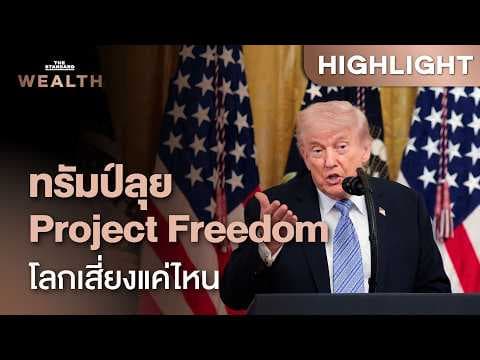
ทรัมป์ประกาศ ‘Project Freedom’ เติมทหาร 1.5 หมื่นนายในฮอร์มุซ น่ากังวลแค่ไหน | THE STANDARD WEALTH
Audio Summary
AI Summary
The current global situation, marked by Project Freedom, an Iranian attack on the UAE, and potential US and Israeli retaliation, is creating significant tension. Professor Dr. Somchai Pakkawiwattanakanak, an independent academic specializing in toxicology and politics, assessed the risks and implications.
Donald Trump's announcement of Project Freedom and the increased military presence, encompassing air, land, and sea forces, signals a complex and volatile environment. While the US claims to merely be guiding boats through the Strait of Hormuz, clashes are occurring. A crucial development was Iran's attack on a major UAE port. This port is vital for the UAE, which has been avoiding the sensitive Houthi Strait area for East-West passage. Despite a ceasefire agreement, both parties are struggling to find a resolution, each believing they hold the upper hand and unwilling to compromise.
The US appears to be leveraging its position to pressure Iran economically, limiting its income generation. However, Iran believes it still possesses strategic options, such as disrupting oil flow through the Red Sea channel, which is critical for Saudi Arabia and the UAE. An attack on this channel could severely impact oil supplies, potentially removing another 10 million barrels from circulation and causing a total deficit of 20 million barrels. This delicate balance means both sides feel they have an advantage, yet neither has fully opened the door to a definitive resolution. Iran has proposed a ceasefire and the lifting of sanctions, but the US remains focused on the issue of uranium, creating a wide gap in negotiations.
The professor anticipates that Iran may not adhere to the ceasefire due to the UAE attack, potentially leading to retaliation from the US or Israel and an escalation of violence. He notes that Iran's leadership includes hawkish factions unwilling to concede. Iran believes its control over the global economy, particularly oil flow, gives it leverage. The approaching US election also weakens Trump's position, making him hesitant to launch a full-scale attack on Iran due to the risk of further disrupting oil supplies, which could affect Saudi Arabia.
Oil prices are a significant concern. In a stable scenario, with the East-West oil flow unaffected, prices might settle around $80 per barrel. However, prolonged conflict could push prices to $100, and a severe disruption could see them reach $120 per barrel. The professor believes a full-blown dispute is unlikely, as both sides recognize the need for compromise, despite their posturing. He suggests that any escalation would be contained to limited areas, as both sides have already sustained significant losses and further pain would outweigh any gains.
Economically, the situation presents a challenging outlook. While a global economic expansion of 3% (Scenario 1) is possible, the current climate suggests a more conservative growth rate of 2.5-2.7% (Scenario 2), bordering on recession. For countries like Thailand, this could mean a growth rate of 1.2-1.6%. The impact on energy prices, supply chains, and transportation could be severe, potentially surpassing the crises of 1973 and 1979, as it now encompasses both oil and gas, affecting all businesses, including agriculture and tourism.
The Thai government has implemented short-term measures, such as "Thai people helping Thai people" projects and fuel subsidies totaling approximately 100.5 billion baht, which are deemed sufficient for now. These measures are expected to stimulate economic recovery by 0.35-0.4%. However, the long-term effectiveness depends on the duration of the conflict. The government is also focusing on developing competitiveness through BOI investment, which has seen record highs, and facilitating technology transfer in areas like Cloud and Data Centers. This aims to build structural resilience beyond short-term fixes.
For the general public and businesses, preparation for a prolonged crisis is crucial. This involves assessing business models, ensuring liquidity, and identifying areas for improvement. The crisis presents an opportunity to develop intangible added value, such as enhanced competitiveness, which will become valuable assets once the economic turmoil subsides. The professor emphasizes preparing for the worst-case scenario to ensure readiness.
In conclusion, the situation is complex and likely to persist, with both sides asserting their dominance while seeking a way out. The economic repercussions, particularly concerning energy prices and global growth, are significant. Governments and businesses must prioritize both short-term relief and long-term structural adjustments to navigate this uncertain period.