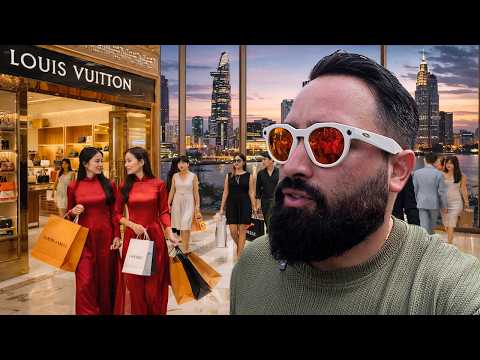
What is LUXURY SHOPPING Like in VIETNAM? 🇻🇳
Audio Summary
AI Summary
This video explores the luxury side of Vietnam, specifically Ho Chi Minh City, contrasting it with the commonly portrayed budget-friendly aspects. The host aims to showcase high-end shopping, luxury accommodations, and the country's reputation for high-quality gold.
The journey begins at the Rex Hotel, a historic five-star establishment in District 1. Built in 1925 as an automobile garage, it became a hotel in 1975 and is one of Vietnam's oldest five-star properties. Located above a shopping mall, it houses luxury brands like Christian Louboutin, Rolex, Burberry, and Chanel. The area around the hotel also features high-end stores such as Cartier, Bulgari, and Louis Vuitton, as well as the Saigon Center, which offers more affordable options like Uniqlo and New Balance. The host highlights that while Vietnam is known for being budget-friendly, there's a significant market for luxury goods and experiences.
The host checks into the Rex Hotel, noting its "old money" ambiance and historical significance. Despite its age, it offers modern amenities like flat-screen TVs, minibars, Wi-Fi, luxurious bathrooms, a fitness center, swimming pool, and a rooftop bar overlooking a famous walking street. The room, which typically costs $300 a night, was secured for $120 on a Tuesday, demonstrating price fluctuations. The host expresses appreciation for experiencing a piece of history at this price.
Before diving into shopping, the host briefly mentions using Vietnam Escape Tours for travel arrangements, praising their professional guides, tailor-made excursions, and excellent service, including airport transfers with comfortable vehicles.
The first shopping stop is the Christian Louboutin store, where the host is surprised to find sales, with items up to 40% off. He tries on several pairs, considering white slip-ons to complement his black pair. Although he likes the white ones, they don't fit perfectly, and he ultimately decides against the slip-on style, preferring something he would wear more often.
Next, the host explores the luxury boulevard, showcasing stores like Cartier, Chopard, Van Cleef, and Fendi. He notes the surprising presence of such high-end brands, challenging the common perception of Vietnam as solely a budget destination. He then visits the Louis Vuitton store, where he learns about customization options for trunks, including specific designs related to Vietnam. He looks at wallets and shoes but decides against a purchase, having recently bought sandals for his companion in Bangkok at a 50% discount.
The main objective for the day is to purchase gold, as Vietnam is known for its high-quality gold at good prices. The host visits a gold shop, admiring the various designs in 18, 22, and 24 karat gold. He expresses interest in an 18-karat Cuban link chain, aiming for a longer length than his current necklace to achieve a layered look. After some negotiation, he settles on a custom-length chain, estimated to be around 11 grams and costing approximately $1,488. The shop offers a 3% discount for cash payments, but the host opts to pay with a card. The gold is described as having a low "making charge" due to lower labor costs in Vietnam compared to other countries.
The chain is promised to be ready in 15 minutes, highlighting the efficiency of the local gold market. After the purchase, which totals $1,537, the host immediately takes the necklace to another shop next door to have it tested. The test confirms it is 18 karat gold, specifically 74.4% gold and 25.6% other materials. This verification process reassures the host about the quality of his purchase.
The host concludes by expressing his satisfaction with the gold purchase, noting that it's a good investment piece and significantly more affordable than similar items in the US, where 14-karat gold is often more expensive. He reflects on his changed travel experiences in Vietnam, now able to afford luxury items and experiences, a stark contrast to his first trip.