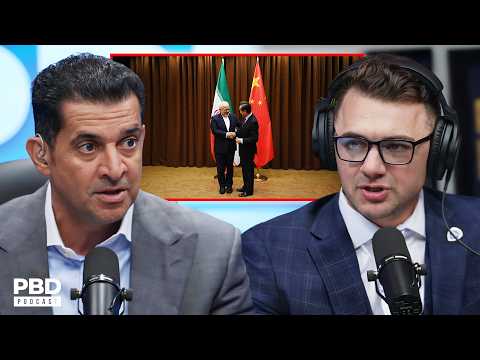
“Send Your Kids To DIE” - Iran State Media EXPOSES Brutal War Propaganda
Audio Summary
AI Summary
The speaker discusses the contrasting narratives and cultures in China and Iran, particularly regarding state media and its influence. In China, state media declared that the US funded and dropped a bioweapon, a narrative unquestioned by the populace due to cultural norms. Similarly, in Iran, state media encourages parents to send their children to war, portraying it as a heroic act that will turn them into "men." This highlights a culture where the government is willing to sacrifice its own people.
The conversation then shifts to the potential for civil war in Iran, with the speaker asserting that the government would readily kill its citizens. If a decisive action is not taken against the IRGC (Islamic Revolutionary Guard Corps) in Iran, it will embolden them, leading to future conflicts potentially far more devastating than 9/11. The speaker believes that the IRGC is currently confident and will not cease their actions.
Regarding the extent of intervention, the speaker suggests that a complete removal of the Iranian regime would lead to short-term political losses for Republicans in the US, potentially benefiting figures like AOC or Gavin Newsom in future elections. However, the true "win" would be a long-term one, 20 years down the line, rather than in the immediate 6-12 months. The speaker criticizes current presidential actions if they are solely focused on midterms, arguing that this approach neglects long-term American security and protection.
The historical context of Iran is brought up, noting that under Muhammad Reza Pahlavi, Iran was peaceful and allied with many nations, with no significant issues in the Middle East. Citizens did not wear hijabs, and the country resembled a Western nation, even attracting Hollywood figures for vacations. This contrasts sharply with the current situation, where the conflict is not merely economic but theological for the extremists within Iran.
The speaker emphasizes that while conflict has always existed in the region, the current adversary in Iran is different. While 80% of Iranians desire an end to the current regime and the IRGC, the extremist 20% are driving the conflict. The speaker notes that Gulf States like the UAE and even Turkey are seeking better relationships with the West, highlighting Iran as a distinct and more challenging entity. If Iran continues to strengthen, the issue will persist for decades.
The speaker expresses skepticism about short-term victories, believing that any meaningful win would only manifest in 10-20 years. The influence of media noise and bot accounts is also discussed, where negative comments are often traced back to recently created accounts, suggesting coordinated efforts.
A major concern is that if a ceasefire occurs, Iran will claim victory over the US and Israel, further solidifying the extreme narrative among its people. This would lead to a doubling down on their extremism. The discussion also touches upon Iran's significant leverage over the global oil market. They don't need to physically drop bombs in the Strait of Hormuz; merely threatening to do so can disrupt global oil supplies.
Iran's strategic thinking is highlighted by their demand for a dollar per barrel of oil passing through the Strait of Hormuz, payable in crypto, not euros or US dollars. This is a deliberate move to prevent asset seizure or freezing, demonstrating a step-ahead approach. The speaker acknowledges the strategic brilliance of this move, despite its disruptive implications for the existing financial system. The speaker concludes by stressing the need to respect the cunning and creative nature of such an enemy.