How to Pay Off a 30-Year Mortgage in 7 Years (Without Being Rich)
Audio Summary
AI Summary
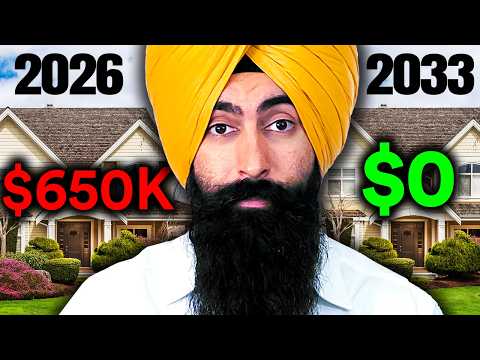
This video outlines how to pay off a 30-year mortgage in as little as seven years, even without a windfall. While it requires hard work and sacrifice, there are strategies to accelerate the process without significant financial strain.
When you purchase a house, the standard 30-year fixed-rate mortgage at 7% interest can result in paying significantly more than the home's initial cost. For example, a $437,000 house with a $350,000 financed amount will incur an additional $488,000 in interest over 30 years, totaling over $900,000. The initial monthly payment of $2,329 is heavily frontloaded with interest. In the first year, over $24,000 goes to interest, while only about $3,500 contributes to the principal, meaning 87% of each payment initially goes to the bank. It takes until year 21 for more than half of your monthly payment to start building equity. This highlights the importance and power of paying extra towards your mortgage, especially early on, as every additional dollar paid directly reduces the principal and saves future interest.
Many people believe they lack extra funds for mortgage payments, but there are "tricks" to help pay down the mortgage faster without feeling a significant financial impact.
Here are three key strategies to pay off your mortgage faster:
**1. Make 13 Mortgage Payments a Year Instead of 12:**
This is the baseline strategy and can be implemented in two ways:
* **Bi-weekly Payments:** Divide your monthly mortgage payment ($2,329 in the example) by two ($1,164.50) and pay this amount every two weeks. Since there are 52 weeks in a year, you will make 26 half-payments, which equates to 13 full monthly payments annually. This method can save you five years on your mortgage and over $90,000 in interest.
* **Adding a Small Amount to Monthly Payments:** If your bank doesn't allow bi-weekly payments, divide your monthly payment by 12 (e.g., $2,329 / 12 = $194.08) and add this amount to your regular monthly payment. So, instead of $2,329, you would pay $2,523.08 each month. This effectively results in 13 full payments per year, also saving five years on your mortgage and over $90,000 in interest.
Crucially, when making these additional payments, ensure the extra money is applied directly to the principal balance, not towards the next month's payment. Applying it to the principal reduces the amount of debt on which interest is charged, thereby saving you money and building equity faster.
**2. Aggressively Apply Extra Money to Your Mortgage:**
For those aiming to pay off their mortgage in four to seven years, aggressive payments are necessary. Any extra money you receive—from tax refunds, bonuses, raises, or even side hustles—should be directed towards your mortgage principal. Every additional dollar paid reduces the interest you owe and shortens the loan term.
* An extra $200 a month can save six years on your mortgage and approximately $108,000 in interest.
* An extra $500 a month (about $16 a day) can save 12 years and roughly $200,000 in interest.
* An aggressive extra $2,500 a month can save 23 years and a substantial $375,000 in interest.
Even small, consistent extra payments can lead to significant savings over time, allowing you to achieve financial freedom sooner and use the saved money for travel, retirement, or other goals. This requires discipline to consistently find and apply extra funds.
**3. Mortgage Recasting:**
This powerful, lesser-known concept involves making a large lump sum payment towards your mortgage principal and then having the bank "recast" your loan. Unlike a mortgage refinance, which creates an entirely new loan, recasting keeps your existing loan, interest rate, and term.
Here's how it works: If you receive a bonus, inheritance, or tax break (e.g., $5,000, $10,000, or more) and apply it directly to your mortgage, your principal balance decreases. However, your monthly payment typically remains the same. With mortgage recasting, after making a lump sum payment (usually a minimum of $5,000 to $10,000, depending on the bank), the bank will recalculate your monthly payment based on the new, lower principal balance.
For instance, if your mortgage drops from $350,000 to $330,000, your original monthly payment of $2,329 might be recalculated to, say, $2,200. If you then choose to continue paying the original $2,329 each month, the extra $129 ($2,329 - $2,200) automatically goes directly to the principal balance without you feeling like you're paying "extra" money. This accelerates principal reduction and interest savings.
Mortgage recasting usually involves a fee, but it's significantly cheaper than a mortgage refinance (hundreds of dollars versus thousands). Not all banks offer it, so it's essential to check with your specific lender. The key benefit is maintaining your existing interest rate and loan terms while lowering your monthly payment, allowing more of your payment to build equity.
In summary, to pay off a 30-year mortgage much faster, you must be more aggressive than simply following the bank's standard payment schedule. Early payments are crucial because they directly reduce the principal, saving substantial interest over the loan's life. By making 13 payments a year, aggressively applying extra funds, and utilizing mortgage recasting for lump sum payments, you can significantly shorten your mortgage term and save hundreds of thousands of dollars in interest, achieving financial freedom years sooner.