Neoclouds: How Failed Companies Became AI’s Biggest Winners
Audio Summary
AI Summary
The current AI boom raises concerns about a potential dot-com bubble repeat, with hundreds of billions flowing into AI infrastructure without clear returns. Historical IPOs are at record highs, and startups raise billions with zero revenue. Nvidia, a key player, is investing heavily in AI companies, potentially creating a circular financing loop where its investments lead to sales of its chips. For example, Nvidia has committed over $40 billion in equity to AI-related companies in the first four months of this year, including $2 billion in Nibbius, equity in Core Weave, a partnership with Iron, up to $30 billion to OpenAI, and a $150 million deposit to Cruso Locked in Metal. UBS estimates the OpenAI deal alone could account for up to 13% of Nvidia's projected 2026 revenue. This raises questions about how much of Nvidia’s record revenue is independent demand versus money looping through the system.
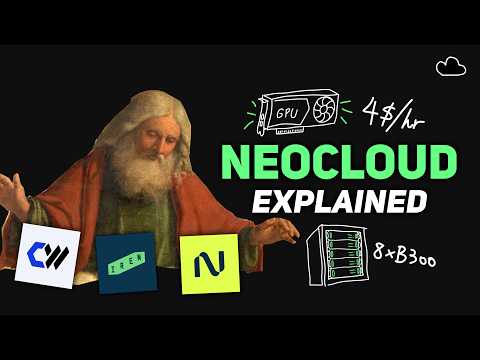
Understanding "Neoclouds" is crucial to this boom. Neoclouds are new-generation cloud providers specializing in AI compute, specifically GPU rental. Unlike hyperscalers (AWS, Azure, Google Cloud) that offer hundreds of cloud products, Neoclouds provide bare-metal GPUs running on Kubernetes, with no databases, identity management, or analytic tools.
Neoclouds emerged due to a specific problem: the explosive demand for Nvidia H100s after ChatGPT launched in late 2022. Hyperscalers, despite massive investments, couldn't keep up with demand for data centers, grid power approvals, or GPU deliveries. Their existing cloud businesses also slowed them down. Neoclouds, unburdened by legacy infrastructure, moved faster, taking massive, concentrated risks on Nvidia hardware. They could secure 5-7 year customer contracts and deliver clusters of tens of thousands of GPUs in months, not years.
Another reason for Neocloud preference is cost. An H100 GPU on AWS costs around $4 per hour, while on a Neocloud, it can be closer to $2 per hour—nearly 50% cheaper. This price gap exists because hyperscalers bundle GPUs with their entire cloud ecosystem, while Neoclouds offer just the raw GPU and connectivity, appealing to AI labs that don't need additional services.
The Neocloud business model is appealing to investors due to its predictable and capital-intensive cash flow. For instance, an 8-GPU H100 server costing around $300,000 (including GPUs, chassis, networking, data center buildout) could be rented out at $2.50 per GPU hour on a 5-year contract. This generates approximately $150,000 in annual revenue (accounting for 15% downtime), leading to $750,000 in lifetime revenue. The server can pay for itself in roughly two years, with years 3-5 generating pure profit. Tens of billions of dollars have been poured into this category in less than two years, funding players like Core Weave, Nibbius, and Iron.
These three major Neocloud players, while seemingly similar, operate with distinct strategies:
**Core Weave:** The largest, IPO'd in March 2025, with $3.5 gigawatts of contracted power and over $99 billion in revenue backlog by early 2026. Core Weave is the epitome of a Neocloud, selling raw compute to only four or five mega-customers like Microsoft (67% of 2025 revenue), OpenAI, Meta, and Anthropic. They do not build developer-facing products because their customers are AI platforms with their own developer surfaces and software stacks. Core Weave focuses on enterprise sales and multi-year contracts, with no room for software R&D due to $14 billion in debt and $30-35 billion in capital expenditure planned for 2026. Their strategy is an extremely focused bet on raw compute.
**Nibbius:** In contrast to Core Weave's few mega-customers, Nibbius serves a few big customers and thousands of smaller ones, including AI native startups, mid-market companies, and inference workloads. These smaller companies often lack in-house engineers to optimize GPUs, requiring a software layer. Nibbius acquired IEN AI, an MIT inference efficiency startup, for $643 million in May 2026 to invest in software. While raw GPU rental offers 30-50% gross margins, an inference and platform layer can boost margins to 60-80%. Nibbius aims to become the "AWS of AI" by building higher-level services on top of raw compute, similar to how AWS evolved beyond EC2 and S3 to become highly valuable.
**Iron:** The most interesting of the three, Iron doesn't compete in the same way. Many Neoclouds, including Iron, are pivots from other businesses. Core Weave started as an Ethereum mining company, and Nibbius emerged from a Yandex divestiture. Iron was founded in 2018 as a Bitcoin mining company called Iris Energy. While other miners chased cheap hardware, Iron systematically built one of North America's largest power portfolios. By 2026, Iron owns and controls roughly 3 gigawatts of grid-connected power capacity, primarily in Texas and British Columbia, making it a valuable asset in the AI cloud computing sector.
The biggest bottleneck for the AI industry in 2026 is no longer GPUs, data, or money, but electricity. Iron's 3 gigawatts of owned power capacity, mostly from renewable sources, gives it a significant advantage, especially with wholesale electricity prices in its Texas site averaging $27-34 per megawatt-hour, significantly cheaper than the US average of $40 or more.
However, Iron faces a major flaw: possessing power doesn't automatically translate into running a successful AI cloud business. In Q1 2026, Iron reported $145 million in revenue, but only $33 million came from AI cloud services; the rest was still from Bitcoin mining. Core Weave's AI revenue in that quarter was 63 times Iron's, and Nibbius's was 12 times greater despite having 10 times less power. Iron's entire AI business currently relies on a single $97 billion Microsoft contract signed in late 2025. SemiAnalysis gave Iron a "not recommended" rating for its cloud compute due to its lack of experience. Iron is sitting on a valuable resource but is struggling to monetize it effectively.
The power bottleneck is a critical issue for Neoclouds, with new grid connections taking up to seven years in major US markets. Neoclouds must either acquire existing pre-secured power sites (like Core Weave) or build in less crowded grids (like Texas or the Nordics).
A second, potentially more concerning problem is the Nvidia chip life cycle. Nvidia releases new, more powerful, and power-efficient chips every 12-18 months (e.g., H100s, B200s, Reuben chips). This rapid obsolescence means existing GPU racks constantly depreciate and incur a significant opportunity cost by wasting limited power capacity on less efficient hardware. Core Weave depreciates GPUs over six years, but their useful life might be closer to three. This challenges the profitability model, as chips might not fully pay back their cost before customers demand upgrades.
Despite these challenges, a major shift in the AI landscape offers a bullish case for Neoclouds: inference compute surpassed training compute in early 2026. For years, GPU demand was driven by training frontier models by a few labs and massive contracts. Inference, however, involves actual end-users paying for models to perform real work (e.g., chat queries, automation). Inference is globally distributed, requires low latency, and generates recurring revenue. This shift means GPU demand is no longer just speculative training spend but driven by actual customers and products. For example, Anthropic's ARR grew from $1 billion in late 2024 to $44 billion by May 2026. OpenAI is clearing over $20 billion, and Google's monthly token processing grew 50-fold in 12 months due to agents and coding assistants.
This inference economy suggests that the circular financing structure, where Nvidia invests in Neoclouds that then buy Nvidia chips, might be justified by compounding inference revenue.
Further confirmation of the Neocloud model's viability comes from Elon Musk. Despite his commitment to vertical integration, building XAI's massive Colossus training facility in Memphis, he eventually repurposed Colossus 1's compute capacity. When Grok demand slowed and Colossus 2 came online, SpaceXAI signed a deal to rent out Colossus 1's entire capacity to Anthropic for $1.25 billion per month until May 2029. This "Neocloud move" demonstrates a willingness to sell excess internal compute to even competitors at a significant premium. Colossus 1, costing around $10 billion to build, will pay back its investment in just eight months through this rental, generating pure profit for the remaining 28 months. This highlights the immense demand for inference compute, even repurposing a non-Neocloud facility into one.
In conclusion, while concerns about a bubble and challenges like power bottlenecks and chip obsolescence exist, the rise of the inference economy and strategic pivots by major players suggest that the Neocloud model might be here to stay.