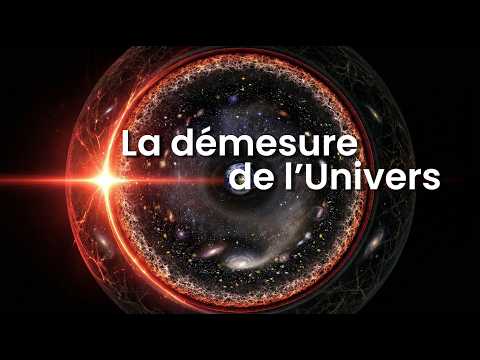
Jusqu’où va l’Univers ? Un voyage vers l’infini étape par étape
AI Summary
This video aims to convey the immense scale of the universe, starting with a discussion of Opera, the video's sponsor. Opera's latest browser version offers features like tab organization into "islands" based on type, allowing users to reduce or expand them with a click and categorize them by theme or project using color codes. Users can also drag tabs down to divide their screen into four sections, useful for comparing sources or documents. The browser's theme and window appearance are fully customizable, allowing users to choose background colors and create a personalized work environment. Opera also enables users to transform videos into floating modules that can be moved across windows, which is convenient for multitasking. Additionally, Opera provides a built-in VPN, allowing users to change their geolocation to another continent with a single click. These and other features are available for free via a link in the description.
The journey into the universe's immensity begins by acknowledging its incomprehensible size. Distances to other celestial bodies are often converted into light-years. Light travels at approximately 300,000 km per second in the vacuum of space. To visualize this speed, in the time it takes to blink, light covers a distance equivalent to the Earth's circumference. In just over a second, light travels from Earth to the Moon, covering about 384,000 km. If one were to travel this distance by car at 130 km/h, it would take four months non-stop. A standard airliner would take 18 days, while Apollo mission modules, traveling at an average of 5,300 km/h, took nearly four days. The space between Earth and the Moon is vast enough to contain all the planets of our solar system or 30 Earths.
Despite the Moon's distance, it pales in comparison to the distance to the Sun, which is approximately 400 times further away. Traveling at the speed of Apollo modules, it would take three years to reach the Sun. An airliner would take 19 years, and a non-stop car journey at 130 km/h would take about 130 years, meaning one would likely die of old age before arriving.
The Sun, though immense compared to Earth, is tiny relative to some other stars. Arcturus, a red giant, is about 25 times wider, while Rigel, a blue giant, is 78 times wider. Rigel, in turn, is a dwarf compared to Antares, a red hypergiant nearly 900 times larger than our Sun. If placed at the center of our solar system, Antares would engulf the orbits of Mercury, Venus, and Earth. Antares itself is almost half the size of UY Scuti, one of the largest known stars. If UY Scuti were at the solar system's center, Jupiter, despite being 778 million km from our Sun, would be inside the star. Yet, UY Scuti is still dwarfed by the sheer scale of our solar system.
To grasp the solar system's vastness, consider the Voyager 1 probe, the furthest man-made object from Earth. Launched in 1977, Voyager 1 travels at about 62,000 km/h. After 48 years, it has traveled 160 times faster than a Formula 1 car but is only six times Neptune's distance from the Sun. In 2012, it crossed the heliosphere's boundary, the solar wind's influence bubble, and has since been in interstellar space. Today, 25 billion km from our star, Voyager 1 has not even covered one light-day since its launch. It will reach this distance by February 2027. More significantly, Voyager 1 is still very far from exiting the solar system. It is estimated to take nearly 2,500 years to reach the Oort Cloud, a gigantic sphere of debris surrounding the Sun, and 25,000 years to exit it and pass the solar system's gravitational boundary. At that point, the probe will have only covered a quarter of the distance to the nearest star, Proxima Centauri. If Voyager 1 were headed towards Proxima Centauri, it would take nearly 100,000 years to cover the 4 light-years separating us.
The vastness of space becomes even clearer when considering the solar system's size. An image representing the orbits of the four inner planets and Jupiter, with the Sun scaled smaller than an atom, illustrates this. Expanding to include the gas giants' orbits and the dwarf planet Sedna, whose highly eccentric orbit takes about 11,500 Earth years to complete one revolution, its furthest point is nearly 1,000 times the Earth-Sun distance. Yet, Sedna's orbit is tiny compared to the Oort Cloud.
Following a single photon from the Sun helps visualize these scales. It takes just over 3 minutes to reach Mercury's orbit, 6 minutes for Venus, and 8 minutes 20 seconds to cover the 150 million km to Earth's orbit. 12 minutes 30 seconds after departure, it reaches Mars' orbit. Another half-hour gets it to Jupiter, and 1 hour 20 minutes after leaving the Sun, it passes Saturn's orbit. 2 hours 40 minutes after leaving the Sun, it reaches Uranus, and nearly 2 hours later, it crosses Neptune's orbit, entering the Kuiper Belt, a disk of hundreds of millions of comets and asteroids, where it will travel for 3.5 hours. After that, two more weeks of travel through space are needed for the photon to reach the inner edge of the Oort Cloud, where it will spend nearly a full year traveling at the universe's maximum speed before exiting and finally passing the Sun's gravitational boundary, which defines the solar system's true limits. Then, nearly three more years of travel are needed for the photon to reach Proxima Centauri, the closest star to the Sun, which is not even visible to the naked eye.
The immense distances mean apparent luminosities fade dramatically as light disperses in space. Only the most powerful stars are visible from great distances. Proxima Centauri, a small red dwarf ten times larger than Earth and only 4.2 light-years away (literally next door on a cosmic scale), is invisible to the naked eye and was only discovered by telescope in 1915. This light dilution affects not just small red stars. An observer 50 light-years away with human-like vision would not even see our Sun. Of the 6,000 stars visible to the naked eye on clear, moonless nights, only 133 are within 50 light-years. Telescopes reveal 1,800 more, all smaller and dimmer than our Sun.
The vastness becomes overwhelming when one realizes that almost all stars visible to the naked eye fit within a small sphere, about 1,000 light-years in diameter, centered on Earth. This sphere is a tiny fraction of our galaxy, the Milky Way, a vast collection of gas, dust, and stars, nearly 100,000 light-years wide and 1,500 light-years thick. Images of our galaxy are digital representations, reconstructions from data gathered from within, as we are 25,000 light-years from the center in a spiral arm. To get a full picture of the Milky Way, Voyager 1 would need about 550 million years to reach a sufficiently distant point. Despite this, our eyes and telescopes offer a splendid view of the estimated 300 billion stars and planetary systems in our galaxy, visible as a milky band across the sky.
The Milky Way is immense. If all its constituents were reduced 70 billion times, our Sun would be a 2 cm sphere, Earth a pinhead 2 meters away, Jupiter a lentil 8 meters further, and Neptune a grain of semolina 67 meters from the tiny Sun. Voyager 1 would be an atom 280 meters away. Proxima Centauri, the nearest star, would be 580 km from our reduced Sun, and the galactic center 3.7 million km away, ten times the Earth-Moon distance in reality. If the Sun were reduced to a lentil, the Milky Way would still span twice the Earth-Moon distance. If the Sun were a white blood cell, the galaxy would be as vast as Europe.
150 years ago, the Milky Way was the only known galaxy. Today, we struggle to count them. In 2003, the Hubble Space Telescope focused on a tiny, dark patch of sky, equivalent to a pinhead held at arm's length. After a million seconds of exposure, it produced an extraordinary image: a few bright points were nearby stars, but everything else was galaxies—nearly 10,000 were identified in this single shot. This photo is a minuscule fraction of the sky; it would take 23 million such photos to cover the entire celestial sphere. The observable universe is estimated to contain about 2 trillion galaxies.
Andromeda, one of the closest galaxies, is twice as large and contains three times more stars than the Milky Way. If slightly brighter, it would appear five times wider than the full Moon in our sky. Andromeda is 2.5 million light-years away, meaning the light we see today left its stars when Homo Habilis walked Africa, over 2.2 million years before Homo sapiens appeared. Despite this distance, Andromeda is "next door" on a cosmic scale, yet it will likely remain inaccessible. Voyager 1 would take 56 billion years to reach it, nearly four times the universe's age. Thus, "close neighbor" in the universe implies vast distances.
Andromeda and the Milky Way are part of our Local Group, a collection of about 50 gravitationally bound galaxies. This Local Group is part of our Local Group, a structure 10 million light-years in diameter containing over a thousand galaxies. This, in turn, is a subset of the colossal Virgo Supercluster, an estimated 150 million light-years in diameter, containing about a hundred different clusters. The Virgo Supercluster is itself contained within even larger structures, with millions of such structures estimated in the universe. Everywhere we look into deep space, superclusters of galaxies form a cosmic web spanning tens of billions of light-years, containing an estimated 2 trillion galaxies.
All this is only the observable universe—the portion whose light has had time to reach us since the universe began—likely a tiny fraction of the total universe. The visual horizon of the known universe is currently 45 billion light-years away. Billions more superclusters probably exist beyond our sight, meaning the observable universe, already incredibly difficult to grasp, might be ridiculously small compared to the entire universe. It's even possible the universe is infinite, its dimensions beyond human imagination.
To further grasp the scale of the observable universe, imagine reducing its dimensions so that our galaxy, 100,000 light-years wide, fits into a 1-meter diameter. In this miniaturized universe, the Milky Way is a luminous disk 1 cm thick, fitting between outstretched arms. The Sun is a microscopic dust grain two-thirds of the way to the edge. Almost all naked-eye stars are within a 1 cm wide region around this grain. 25 meters away, in the cosmic gloom, lies the Andromeda galaxy, 2 meters wide. Bound by gravity with about 50 smaller galaxies, the Milky Way and Andromeda form our Local Group, a coherent structure spanning about 100 meters at this scale. In the distance, the Virgo Supercluster, with nearly 10,000 galaxies, stretches over 1 km. Thousands of such superclusters fill the view in all directions, up to the observable universe's limits, which are nearly 460 km from our 1-meter luminous disk—a distance roughly equivalent to Paris to Bordeaux. In short, space is vast.
To conclude, imagine the distance to the edge of the observable universe contained in a series of books filled with black. If the Sun were reduced to a 2 cm sphere on the cover of a 250-page book series: Mercury would be on page 4, Venus on page 8, Earth on page 10, Mars on page 16, Jupiter on page 55, Saturn on page 100, Uranus on page 200, and Neptune, the last gas giant, would be lost in the black immensity of page 75 of the second book. Voyager 1 would be at the beginning of volume 7, and the solar system's outer limits would appear around the 3,600th book. The nearest star to the Sun would be around the 11,000th book. To contain the distance to the Andromeda galaxy's edges, 6.5 billion books would be needed, requiring storage space 300 times larger than the world's biggest library. If one were to extend this thought experiment to the limits of the observable universe, it would require covering an area the size of France with 12-story buildings, all filled to the brim with books almost entirely black with ink representing the void of space, only occasionally disturbed by rare stars.
If this still doesn't convey the universe's insane size and leaves one feeling small, consider that you are, in fact, a giant—much larger than you think. While the Sun is immense compared to Earth, you are proportionally almost 10 times larger to a water molecule than the Sun is to you. This is perhaps the most astonishing part: in the infinitely small, the proportional distances between matter's constituents are even more staggering than those in the vastness of space. The orders of magnitude separating a proton's size from the smallest suspected unit, the Planck length, are the same as those separating a human's size from our galaxy, or a pollen grain from a light-year. The Planck length is so tiny that, proportionally, we are 10,000 times closer in size to the largest thing we can observe (the observable universe) than to the smallest thing whose existence is hypothesized. This is truly enormous. To delve deeper into this dizzying immensity, the speaker recently released "Voyage dans l'Infiniment Grand," a comic book exploring the universe's vastness, available at bookstores.