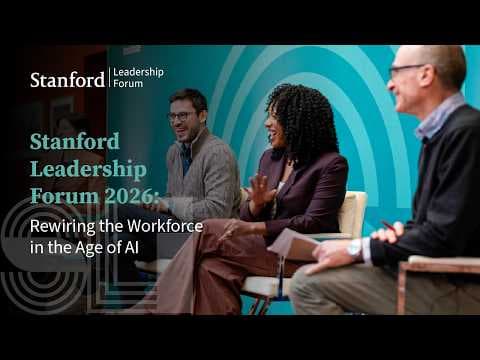
Stanford Leadership Forum 2026: Rewiring the Workforce in the Age of AI
Audio Summary
AI Summary
The panel discussion, moderated by Paul Leuer, professor of economics at Stanford GSB, explored the ongoing transformation driven by AI and its impact on labor markets. The panel featured Susan Athey, economics of technology professor at Stanford, Neela Richardson, ADP's chief economist, and Tamay Besiroglu, co-founder of Mechanize.
Tamay Besiroglu, whose company Mechanize automates knowledge work, particularly in software engineering, shared his assessment of AI's timeline and labor market consequences. He anticipates a gradual automation of tasks for knowledge workers over the next one to five years, with single-digit percentage points of job displacement. However, over one to three decades, he expects widespread automation, potentially displacing the majority of work in the US economy. He predicts that within this longer timeframe, more money will be spent on running AI workers than human workers, leading to significant unemployment. He views AI as a continuation of a long-run trend of increasing abstraction in software engineering, but fundamentally different because AI promises to fully automate tasks that previous technologies could not.
Susan Athey emphasized the distinction between technological capability and actual implementation. She noted that technological improvements only translate into impact when combined with existing systems and organizations, which can be a slow, iterative process involving complementary innovations and reallocations. Athey observed significant fear among students and professionals regarding AI's impact on careers. She highlighted the profound organizational change needed to fully leverage AI, noting that many organizations are just beginning to rethink workflows. She described the demand for "forward-deployed product managers" or "engineers" as individuals who are problem-solvers, capable of breaking down issues and utilizing AI tools to implement solutions, suggesting a "big expansion before it contracts" in terms of job creation.
Athey also discussed AI's potential impact in the developing world, where 50-70% of people work in one-person or family firms (retail and agriculture). For these small businesses, AI could be productivity-enhancing, allowing them to grow by providing tools for inventory management, customer orders, and tailored advice via mobile phones or low-cost hardware. She also saw immense opportunities in upskilling service workers in healthcare and education in developing countries, where these sectors are currently undersupplied and under-resourced. Athey believes AI could narrow the gap between rich and poor, offering a high ROI opportunity to improve the lives of billions, though execution remains a challenge. She stressed the importance of infrastructure, mobile access, and ecosystems for private sector adoption, and effective government service provision.
Neela Richardson provided context from ADP's perspective, which processes payroll for over 42 million workers globally, representing about one-fifth of the US workforce. She stated that ADP's data currently shows no significant effect of AI on the labor market. Richardson highlighted that three out of four new US jobs in the last two years came from education and healthcare, primarily home healthcare aides, driven by the aging "boomer" population, not AI. She noted that the US is not unique in this demographic trend, with Europe 10 years ahead and Asia facing similar challenges due to fertility policies. She pointed out that three-fourths of the future working-age demographic will come from Africa, a continent largely absent from current tech conversations.
Richardson also addressed worker sentiment, noting that only one in four workers in 36 countries feel their jobs are safe from elimination, a figure that rises fivefold with investment in upskilling. She argued that AI operates at the task level, not the occupation level, suggesting that "occupation" might become an outdated concept. She envisions a future "task report" instead of a "jobs report," enabling clearer guidance for workers and employers on evolving skills.
Responding to a question about a paper by Eric Brynjolfsson suggesting negative impacts on junior software engineers, Richardson clarified that ADP data, while granular enough to identify "canaries in the coal mine," also shows nuances. It indicated a drop in employment for early-career individuals (22-26) in AI-exposed careers post-ChatGPT rollout, but a *ramp up* in employment for more complex jobs done by older, more tenured workers. This suggests an augmentation role for AI, where experienced workers use AI to perform more complex tasks, rather than outright automation leading to job loss. She stressed the need to upskill youth for new tasks, rather than old ones.
The panel then discussed whether this wave of automation is qualitatively or quantitatively different from previous technological shifts. Tamay acknowledged the long history of automation in software engineering, from compilers to higher-level languages, viewing AI as a continuation of this trend towards higher abstraction. However, he emphasized that AI's potential to fully automate *everything* an engineer can do, even if decades away, is a significant qualitative difference from prior technologies. This would lead to widespread unemployment, a stark departure from past automation waves.
Susan Athey, focusing on the next 10 years, echoed the idea that AI is already better than junior people at routine tasks in legal and professional services. She believes the demand for problem-solvers who can conceptualize and break down problems will be huge, especially as the world digitizes. Athey also highlighted the unique opportunities for developing countries where small, one-person firms can become more productive, and healthcare and education can be dramatically improved by AI, potentially narrowing the rich-poor gap. She cautioned against the narrative that AI will only widen inequality, arguing it "doesn't have to."
Neela Richardson reiterated that AI "could, but it doesn't have to" lead to negative outcomes. She stressed the importance of "value add" and questioned the business model of destroying the consumer base by displacing workers. Richardson noted that workers using AI daily feel more engaged but less productive because AI handles routine tasks, leaving only the "hard stuff." She argued for changing productivity metrics and focusing on worker trust through investment in upskilling and reskilling, which can serve both workers and consumers and mitigate inequality.
Addressing the political consequences of inequality, Susan Athey expressed concern that fear generated by narratives of mass job displacement could lead to poor electoral choices and impede investment in beneficial applications of AI. She pointed out that "fast harms" from destructive uses of AI (e.g., cybercrime) face fewer regulatory hurdles than beneficial applications, creating a recipe for misinvestment. Athey also highlighted the challenge of AI regulation, noting that well-intentioned regulations could inadvertently benefit incumbents and reduce competition, particularly harming developing countries.
Tamay Besiroglu observed a large variance in people's ability to effectively use AI tools, leading to significant differences in productivity and potentially greater inequality. However, he maintained that automation, including AI, broadly benefits people, despite transition costs.
Neela Richardson emphasized the importance of defining AI's "task" from a humanist perspective. She advocated for a "hedonic regression" approach to jobs, breaking them down into tasks, skills, and activities, and pricing the value of these tasks. This would help educate workers and hiring managers about evolving skill demands, empowering individuals and fostering inclusive growth.
In closing remarks, the panelists offered hopeful visions for the future. Neela Richardson envisioned an empowered worker with adaptable, resilient skills, contributing to shared global growth and prosperity. Tamay Besiroglu expressed excitement for rapid technological progress, medical innovation, and broad economic growth, leading to people being "a lot better off" with core needs met efficiently and cheaply. Susan Athey emphasized the importance of meaning and participation in society, urging a focus on ensuring people can participate meaningfully—economically, socially, and politically—in this advancement, rather than solely relying on universal basic income.