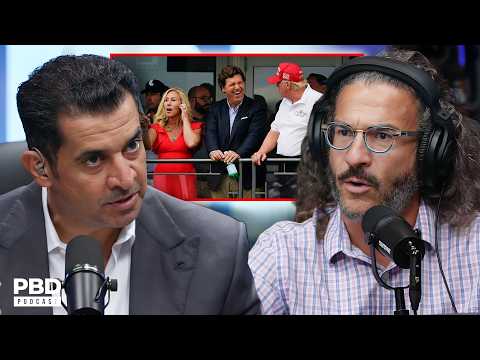
“Nut Jobs & Troublemakers” - Trump GOES OFF On Tucker, Candace & Megyn Kelly
Audio Summary
AI Summary
The video discusses a lengthy tweet from the President, which has sparked considerable online reaction. The tweet criticizes several media personalities and commentators, including Tucker Carlson, Megyn Kelly, Candace Owens, and Alex Jones, accusing them of being low-IQ, stupid, and troublemakers who seek publicity. The President asserts that these individuals are not aligned with the MAGA movement, which he claims overwhelmingly supports him. He labels them as "losers" who have been unsuccessful in their careers, citing Tucker Carlson's inability to finish college and his firing from Fox News, Megyn Kelly's past questioning of him, Candace Owens' controversial remarks about the First Lady of France, and Alex Jones' bankrupt status due to his false claims about the Sandy Hook shooting. The President contrasts these individuals with the MAGA movement, which he defines by its focus on winning, strength, and preventing Iran from obtaining nuclear weapons.
The discussion then shifts to analyzing the reasons behind these public figures' criticism of the President, with one speaker suggesting it stems from a disagreement over the Israel-Iran situation and the President's stance on it. Another point of contention is the President's praise for Mark Levin, which is seen as contradictory by some. A particularly striking comment from the President, that Brigitte Macron is "far more beautiful" than Candace Owens, is highlighted as a point that caused some listeners to disengage. The idea of the party "splintering" is raised in relation to these public disagreements.
The role of Charlie Kirk in unifying the right is discussed, with one speaker believing his absence has allowed more extreme voices to emerge. The importance of discerning who to listen to is emphasized, with a call for listeners to be critical of their media consumption and to favor voices that have remained consistent in their support. Glenn Beck and Dana Lash are mentioned as examples of individuals whose opinions are valued. Mark Levin is also cited, noting that Trump trusts him.
The conversation delves into the nature of criticism, distinguishing between constructive and destructive. The President's tweet is characterized as having no constructive criticism. The idea that Charlie Kirk might have advised the President against posting such a tweet is debated. The tweet itself is described as a "diatribe" and contradictory, citing the President's simultaneous claims that CNN is "fake news" while also stating it gave him "100% approval." One speaker proposes interpreting CNN's statement as sabotage rather than truth, intended to mislead the President about his support.
The discussion questions the credibility of figures like Tucker Carlson and Candace Owens, with one speaker noting Candace Owens has "gone off the rails on certain issues." The potential for alliances being built for future political aspirations, such as 2028, is also suggested.
A significant portion of the dialogue revolves around the President's decision-making process, particularly in military matters. The President's lack of military background is contrasted with historical figures like Eisenhower. The analogy of a business leader dealing with different types of advisors is used: those who are never satisfied, those who offer balanced criticism, and those who are overly supportive ("ass-kissers"). The speaker advises against trying to win over those who will never be convinced and suggests limiting engagement with overly critical or overly flattering advisors.
The conversation then turns to the specific context of Iran and the IRGC, with one speaker sharing personal experience growing up in Iran and expressing a desire for its freedom. The speaker questions whether Charlie Kirk ever advocated for a war with Iran, suggesting he did not. The President's decision-making as commander-in-chief is analyzed, with a focus on his reliance on military advisors and intelligence. The scenario of a meeting with generals and advisors, including Bibi Netanyahu, is visualized, where the President asks about the feasibility and timeline of an operation. The speaker highlights the potential for miscalculation when an advisor provides an optimistic assessment (e.g., "80% chance of success") that proves inaccurate.
A key point made is the difference in mindset between a country with a strong sense of self-preservation, like Venezuela (described as a Catholic country with a belief in afterlife), and a group like the IRGC, which might view martyrdom as a source of pride. This difference, it is argued, makes a conventional military approach potentially ineffective.
The speaker expresses a personal perspective on leadership in times of conflict, suggesting that a leader might need to temporarily set aside personal beliefs and act as a "warrior" if they believe their people are threatened.
The commentary on Alex Jones is that his voice is needed, despite his past criticisms of Trump. Tucker Carlson, Candace Owens, and Megyn Kelly are seen as aligned, with Tucker Carlson being the primary influence on the other two.
The video concludes with a discussion of the President's communication style, specifically his use of tweets. The advice given to the President is to implement a "blackout" on tweets until the conflict is over, acknowledging that this may not align with his usual business style. The long-term consequences of actions, rather than short-term market reactions, are emphasized as the true measure of success.
Finally, there is a promotional segment for merchandise, including a limited-edition hat celebrating 250 years of American history. The limited availability and desirability of these items are highlighted, with a call to action to visit the website.