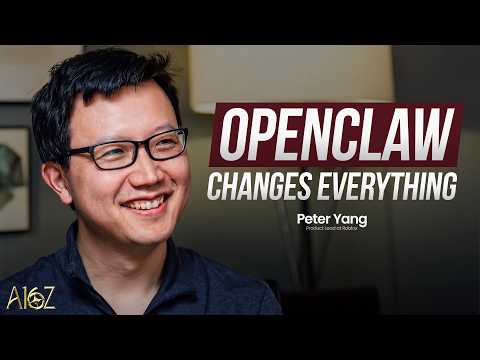
OpenClaw, Claude Code, and the Future of Software | Peter Yang on The a16z Show
AI Summary
Peter Yang and the interviewer discussed the evolving landscape of work and technology, particularly focusing on the rise of coding agents and their potential impact on various industries and the nature of companies.
Peter shared his personal experience with "Zoe," his OpenClaw agent. He described Zoe as a highly personalized AI assistant, primarily accessed through voice commands on Telegram. While OpenClaw can perform tasks like pulling analytics, updating Google Docs, and building small web projects, Peter mostly uses it for voice conversations and even occasional "pep talks" that offer deep, personalized insights based on its memory. He noted that the interface on Telegram makes it feel more personal and human-like than other language models, despite its "janky" nature and tendency to forget things without reminders. He also successfully set up a phone call with Zoe, highlighting its ability to execute even complex, unconventional requests, albeit with latency issues. Peter admitted to being "super transparent" with Zoe, giving it read access to his email and calendar and write access to certain documents, though not his entire drive.
A significant point of discussion was Peter's "hot take" that "apps will die" and "coding will eat all knowledge work." He clarified that this wasn't fully thought out but observed that since integrating apps like Mercury and MCP with his OpenClaw, he uses those individual apps less. He believes task-oriented apps will be the first to see reduced usage, as it becomes easier to instruct an agent to complete tasks. However, entertainment-focused apps might survive longer. While OpenClaw has reduced his reliance on certain apps, his overall smartphone usage hasn't decreased due to his Twitter addiction. He also acknowledged the challenge of context switching with a single agent, as apps traditionally provide clear divisions of intent. To mitigate this, he uses multiple Telegram channels with Zoe for different purposes, such as casual voice replies, collaborative project work, and public demos.
The conversation then shifted to the broader implications of coding agents. Peter believes that OpenClaw's architecture and primitives will eventually be productized by companies like OpenAI, integrating similar capabilities into platforms like ChatGPT to make them more human-like and capable of task execution. He expressed frustration with ChatGPT's tendency to end conversations with "if you want I can also do X and Y," finding it annoying and preferring Claude for general conversation, while still using Codex for actual coding. He noted the different characteristics of Claude and Codex: Claude is chattier and makes more assumptions, suitable for synchronous experiences, while Codex is more accurate but slower, breaking the "flow state." Both, however, exhibit a "slot machine" effect with variable rewards and response times, creating a casino-like feeling.
Regarding the impact on companies, Peter shared his view that larger companies tend to become less desirable workplaces due to the need for extensive alignment. He hopes that future companies will remain smaller, with founders leveraging agents to assist smaller teams. For example, a two or three-person product team could replace a ten-person team with the help of agents. This approach, he argued, makes alignment easier and removes emotional biases from negotiations, leading to a more objective and productive work environment. He suggested that AI could significantly improve the "NPS of work," reducing the emotional burden of human-to-human interactions and allowing people to focus on creative tasks.
Peter also highlighted that many Product Managers (PMs) are now "vibe coding" in their free time, and he believes that unemployment might even offer more opportunities for innovation by providing time to build and learn with these new tools. He acknowledged the importance of traditional PM skills like understanding user problems but stressed the need for PMs to also build and prototype themselves.
Addressing the pace of work in the AI era, Peter suggested that while AI tools enable rapid exploration in multiple directions, it's crucial to slow down and define direction. He believes traditional annual planning processes are becoming obsolete. He agreed with the idea of combining fast and slow approaches: rapid iteration to reach a local maximum of an idea with agents, followed by a period of slowing down for deeper reflection and to discover the next "hill" or market fit.
The discussion also touched upon "business in a box" platforms, with Peter mentioning "Postyet" as an example of what's possible, even if still in early stages. He expressed excitement about these platforms enabling more individuals to build bootstrap businesses, potentially creating opportunities for $100,000 TAM products that could significantly impact individual lives, even if not venture-backable. He hopes his own children will build such businesses in high school, potentially skipping college and corporate life.
Finally, the conversation delved into the challenges for consumer products in the agent-driven future, particularly regarding retention and brand equity when agents interact directly with APIs. Peter suggested that the shift to direct monetization, consumption-based revenue (like tokens), and real inference costs in the AI era might simplify business models. He also envisioned products offering both an API interface for agents and a human-centric interface for direct user interaction, allowing for both transactional tasks and emotional engagement. He concluded by emphasizing that the entire agent stack, including identity, payments, and marketing, is emerging, rendering much of the old playbook obsolete. Despite initial skepticism, he now believes agents are truly coming. He hopes this shift will make human work more enjoyable, although he doesn't foresee a massive loss of jobs, but rather a change in the economic structure towards smaller companies and dramatically increased productivity, allowing humans to focus on tasks that require creativity and emotional intelligence.