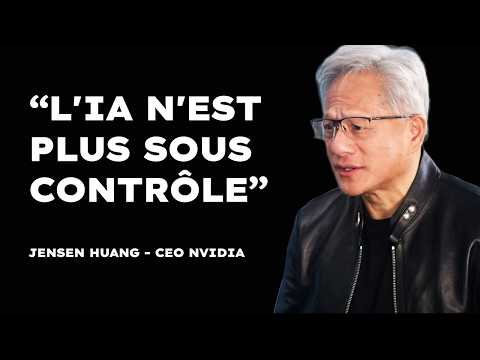
AGI : Le CEO de NVIDIA est inquiet de la super intelligence artificielle
Audio Summary
AI Summary
Jensen Huang, CEO of Nvidia, a Taiwanese-American entrepreneur and electrical engineer, has become a pivotal figure in the world of artificial intelligence. Nvidia, initially known for graphics cards, has transformed into a cornerstone of the AI revolution, designing GPU accelerator chips and the accompanying software infrastructure that power advanced AI models. This strategic shift has dramatically increased Nvidia's market capitalization, making it the most capitalized public company globally in the first quarter of 2026, surpassing giants like Apple, Microsoft, and Alphabet.
In a March 2026 podcast with Lex Friedman, Huang discussed general AI and its future impact on the job market. He believes that AI can already create a tech company with a billion-dollar capitalization, marking a stage of general AI. Such a company might not be sustainable in the long term, akin to many short-lived ventures during the dot-com bubble. He envisions an AI agent creating a viral web service or app that gains millions of users temporarily before fading away, similar to simple automated systems from the internet bubble era. Huang notes that in China, people are already training AI agents to find work, perform tasks, and earn money, suggesting the emergence of social phenomena like ultra-cute digital influencers or Tamagotchi-like social apps that achieve instant, fleeting success. However, he emphasizes that the probability of 100,000 AI agents creating a company like Nvidia is zero.
Huang addresses widespread fears about job loss due to AI by highlighting a crucial distinction: the purpose of one's job, the tasks performed, and the tools used are related but not identical. He cites his 33-34 years in the industry, during which his tools constantly evolved. As an example, he brings up radiology, a profession once predicted to be obsolete due to superhuman computer vision. While computer vision did indeed become superhuman around 2019-2020 and is now integrated into all radiology tools, the number of radiologists has actually increased, leading to a shortage. This is because the radiologist's goal is to diagnose diseases, help patients, and collaborate with doctors. With AI, radiologists can analyze scans faster, process more cases, make better diagnoses, provide quicker treatment, and see more patients, ultimately benefiting hospitals and increasing the demand for their services.
Similarly, Huang predicts that the number of software engineers at Nvidia will increase, not decrease. Their job isn't merely to write code but to solve problems, work in teams, diagnose issues, evaluate results, find new problems, innovate, and make connections—aspects that AI cannot replace. He suggests that the definition of "programming" is expanding. Today, programming involves describing specifications and potentially defining software architecture. The number of people capable of instructing a computer on what to build could grow from 30 million to a billion. In the future, every artisan, such as a carpenter or a plumber, will also be a programmer, leveraging AI to enhance their value and creativity. Accountants will become financial analysts and advisors.
Huang explains that the art of programming will involve deciding where to position oneself on a spectrum of coding precision. One can choose to be highly precise for specific outcomes or more exploratory, leaving intentional ambiguities to iterate with AI and push creative boundaries. This positioning on the coding spectrum is the future of programming.
Acknowledging the stress induced by technological change, Huang recommends breaking down the problem. He distinguishes between what one can control and what one cannot, focusing on concrete actions within controllable domains. He advises that anyone hiring today would choose a candidate proficient in AI over one who isn't, regardless of the field—be it accounting, marketing, supply chain, customer service, sales, business development, or legal. His simple advice is for every student and teacher to embrace AI. All graduating students should have a mastery of AI, and professionals in every field, from electricians to farmers and pharmacists, should explore how AI can transform their work and elevate their value, becoming agents of change in their industries.
Finally, Huang emphasizes being realistic: technology will displace and eliminate tasks through automation. If a job is reducible to a single task, it is highly exposed. However, if a job has a broader objective encompassing multiple tasks, learning to use AI to automate those tasks becomes essential.