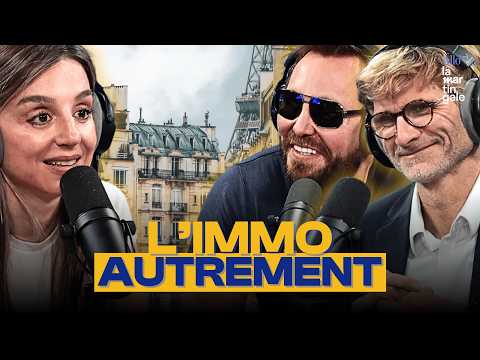
Immobilier, la meilleure alternative à la Bourse ? - Allo La Martingale #53
AI Summary
The podcast discusses the current state of the real estate market in France, focusing on investment opportunities within the context of economic uncertainty and the rise of artificial intelligence. The conversation features two guests, Thierry Vignal, founder of ATOM, a company specializing in transforming Parisian "chambres de bonne" (small studio apartments) into high-end living spaces, and Vincent Lamot, Deputy Director General of Real Estate Fund Management at Perial Asset Management.
The overall sentiment is that while the current economic environment, marked by inflation, rising interest rates, and geopolitical tensions, creates discomfort and fear, it also presents significant investment opportunities, particularly in real estate. This is framed by the idea that "the more discomfort there is, the more it's time to buy."
**Current Market Conditions and Inflation:**
The European stock markets are experiencing increased volatility due to residual effects from the energy crisis and concerns about growth forecasts being revised downwards due to persistent inflation. The Banque de France is working to control inflation, and news of potential interest rate hikes is causing investor anxiety. Conflicts in Eastern Europe and geopolitical uncertainties are directly impacting energy and industrial sectors. Even comments from figures like Trump about trade relations and economic policies add to the uncertainty, with potential for a return to protectionist policies.
**Real Estate as a Safe Haven:**
In a world where AI is becoming increasingly powerful, real estate is identified as a sector that is difficult to impact and offers long-term visibility. The logic presented is that when interest rates rise (due to inflation, often driven by oil prices), real estate prices tend to fall. This mechanical relationship is likened to Swiss watchmaking. While this can feel like a "nuclear winter" for the market, it creates entry points for savvy investors.
**SCPIs (Sociétés Civiles de Placement Immobilier) - Real Estate Investment Trusts:**
Vincent Lamot explains that despite past difficulties with certain SCPIs (particularly those heavily invested in offices during a period of declining demand), the current market offers opportunities. He clarifies that there are no "bad" SCPIs, but rather historical ones that invested during a low-interest-rate environment, leading to a decrease in asset value when rates rose. However, he emphasizes that the real estate itself hasn't necessarily lost value if it hasn't been sold, resulting in an "unrealized loss."
He notes that the real estate market is cyclical. While office real estate is undergoing a transformation to meet new tenant needs (smaller spaces, flexibility, coworking), other sectors like retail and commercial spaces are also evolving. Lamot highlights that SCPIs that have significantly reduced their asset values can still deliver returns if rents remain stable. He also addresses the issue of liquidity, explaining that Perial has implemented a "suspension of variability" mechanism for some SCPIs, creating a secondary market for buying and selling shares, similar to the stock market, to provide liquidity.
Lamot introduces two SCPIs from Perial:
1. **Perial Opportunité Europe:** A 30-year-old SCPI with over 6.10% yield, diversified internationally.
2. **Perial Opportunité de Territoire:** A newer, 100% French SCPI with a 7.5% yield, focusing on regional acquisitions and supporting local businesses (retail, hospitality, shopping centers). This SCPI aims to regionalize acquisitions and provide financial vitality to local areas.
He stresses that investors should look at the quality of assets and the fund manager when choosing an SCPI. Diversification across different SCPIs and asset classes is also crucial.
**Thierry Vignal's "ATOM" Concept:**
Thierry Vignal's venture, ATOM, focuses on transforming Parisian "chambres de bonne" (9m² legal minimum) into high-end micro-studios. He points out that 85% of the 120,000 "chambres de bonne" in Paris are abandoned, representing significant abandoned real estate in a city facing a housing crisis. His concept addresses the challenge of making these tiny spaces functional and attractive.
Vignal highlights that the current market crisis, while negative for most, is positive for him because it allows him to acquire these technical, overlooked assets at very low prices. He explains that the high yield (around 7% net) compensates for the "discomfort" of purchasing such specialized properties. He notes that institutional investors are more receptive to these opportunities than individual investors, who are often deterred by the perceived risk and technicality. He uses the analogy of Warren Buffett buying "at the sound of the cannons" – when everyone else is fleeing.
ATOM's model is attractive to institutional investors seeking diversification away from traditional office and retail spaces, offering good yields and leveraging Paris's strong rental demand. Vignal emphasizes that the high returns are a reward for investing in technically challenging assets in a difficult market.
**Comparing Direct Real Estate vs. SCPIs:**
The discussion contrasts direct real estate investment (like Vignal's "chambres de bonne") with SCPIs. Vignal argues that direct real estate offers more leverage, particularly for individuals with borrowing capacity, as banks can finance the purchase, and the tenant repays the loan. He also highlights the tangible nature of direct real estate, offering a sense of security and emotional connection.
Lamot counters that SCPIs offer a passive investment, free from the direct management headaches of direct real estate (construction issues, tenant problems, etc.). He also points out that SCPIs are becoming more accessible and modern, with some offering monthly dividends and investment programs starting at €50, allowing younger investors to build wealth gradually.
**Fiscality:**
For Vignal's "chambres de bonne," the LMNP (Loueur Meublé Non Professionnel) status is recommended for its tax advantages, allowing for amortization. SCI (Société Civile Immobilière) with corporate tax is another option. For SCPIs, the taxation is similar to owning a direct apartment if the assets are in France. Investing in SCPIs with foreign assets (e.g., in Germany) can offer significant tax advantages due to lower property taxes in those countries, although this is subject to international tax agreements and potential regulatory changes.
**The Impact of AI:**
Thierry Vignal expresses a strong belief that the emergence of advanced AI (AGI/ASI) will be far more disruptive than political events like Trump's statements. He posits that AI will fundamentally change many professions, including white-collar jobs like accounting, law, and even medicine. However, he believes that physical assets, or "atoms" (as opposed to "bits" or virtual assets), such as real estate, will be largely resistant to AI's disruption. This is because AI cannot easily replicate the creation or management of physical spaces, making professions that involve tangible assets, like real estate agents specializing in niche markets or tradespeople, relatively safe.
**Investment Strategy and Risk:**
Both guests agree that investing during times of discomfort and fear is often the most profitable strategy. Vignal advocates for going where others are not, looking for "massacred" sectors or assets with depressed valuations, citing his past investment in Greek banks as an example. He relies on valuation indicators like the CAPE ratio to identify undervalued sectors.
Lamot, while acknowledging the importance of diversification, suggests that for a 10-year horizon, a mix of equities (potentially in high-growth sectors like aeronautics/SpaceX, if one had the capital) and tangible assets like real estate would be prudent. He also highlights the potential of the tourism sector due to increasing leisure time and nomadism.
**Conclusion:**
The overarching message is that while the current economic climate is challenging and creates significant discomfort, it is precisely this discomfort that signals opportune moments for strategic investment in real estate. Whether through direct ownership of unique properties like transformed "chambres de bonne" or through diversified SCPI investments, the long-term resilience and tangibility of real estate, especially in contrast to the potential disruption of AI, make it a compelling asset class. Investors are encouraged to look beyond fear and identify undervalued opportunities, emphasizing the importance of due diligence, diversification, and understanding one's own risk tolerance and financial capacity.