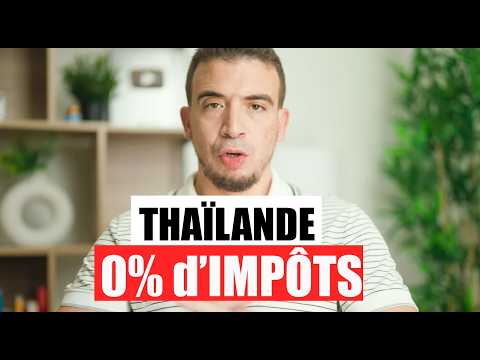
Alerte Fiscale Thaïlande : Ce que le fisc thaïlandais ne vous dit pas.
AI Summary
In this video Sabri, a ten‑year expatriate living in Bangkok, explains how you can legally keep your international income tax‑free in Thailand in 2026. He begins by debunking the headline that Thailand has become a “tax nightmare.” The country has not turned into a fiscal black hole; rather, the rules have simply shifted, and the only way to achieve a 0 % effective tax rate now is to adopt a disciplined, financially intelligent structure.
**The fundamental legal change**
The cornerstone of the new strategy is Article 41 of the Thai Revenue Code, which was overhauled in the 2024‑2025 decrees. For decades expatriates relied on a “one‑year delay” loophole: if foreign earnings were earned in year N and only brought into a Thai bank account after 1 January N + 1, the money was exempt from Thai tax. That provision vanished on 1 January 2024. Today, any foreign‑source income that a tax resident brings into Thailand is potentially taxable, regardless of when it was earned.
**Residency matters**
Thai tax residency hinges on physical presence: more than 180 days in a calendar year makes you a resident. Digital nomads who split their time between Bangkok, Bali, Europe or Dubai and stay under the 180‑day threshold remain non‑residents and are not subject to Thai tax on worldwide income. For those who have chosen Thailand as their main home, the challenge is to manage “repatriation of funds” with surgical precision.
**Territorial taxation – the core shield**
Thailand follows a territorial tax system: only income generated on Thai soil is taxable. Local business profits—restaurants, massage salons, real‑estate agencies—are subject to corporate tax, but earnings from consulting, coaching, copywriting, crypto trading, SaaS platforms, or any service delivered to clients abroad are classified as foreign‑source income and are ignored by Thai authorities as long as the money stays outside the country.
**Distinguishing stock from flow**
Sabri stresses the difference between accumulated capital (the “stock”) and annual earnings (the “flow”). Money you already owned before becoming a Thai tax resident is considered capital, not income, and therefore is not taxable when transferred. The tax authority only taxes the flow—profits earned in the current year. Proof is vital: you must be able to show bank statements proving that any transferred amount originates from pre‑existing savings. Without documentation, the tax office will assume the money is current‑year income and impose tax.
**Three pillars of a zero‑percent strategy**
1. **Selective repatriation (bank segregation)** – Keep the bulk of your offshore profits in foreign accounts (e.g., a Dubai, New Mexico or Hong Kong entity). Transfer only the portion needed for your Thai living expenses. For example, if an offshore company earns €500 000, you might move just €40 000 to a Thai bank for rent, food and health costs. The rest remains offshore, untouched by Thai tax. Using international cards (Revolut, Wise) or offshore bank cards further reduces traceable local transactions, lowering the visible “flow” even more.
2. **Double‑taxation treaties** – Thailand has signed tax‑information agreements with over 60 countries. These treaties prevent you from being taxed twice on the same income. If you receive dividends from a French company and French withholding tax has already been deducted, Thailand will usually grant a tax credit that neutralises any Thai liability. A competent accountant can structure the paperwork so that foreign taxes fully offset any Thai assessment, resulting in a net‑zero tax bill.
3. **Visa choice as a fiscal lever** – The type of visa you hold influences how easily you can prove foreign‑source income. The Destination Thailand Visa (DTV), a five‑year permit aimed at digital entrepreneurs and freelancers, makes it straightforward to demonstrate that your earnings originate abroad, facilitating bank relationships and reinforcing your non‑resident‑for‑tax‑purposes status. However, a DTV does not automatically grant a Thai bank account; many holders rely on online wallets such as True Money, which allow QR‑code payments and limit cash withdrawals, thereby reducing taxable inflows.
The Long‑Term Resident (LTR) visa, often linked to the Board of Investment (BOI) premium categories, offers an even stronger fiscal shield. Under strict conditions, LTR holders can enjoy total exemption on foreign‑source income, even when that money is deposited in Thai accounts. This visa is more costly and paperwork‑intensive but provides a “golden ticket” for high‑earning entrepreneurs who want a ten‑year peace of mind.
**Geographic arbitrage in practice**
Sabri illustrates the impact with two concrete scenarios.
*Scenario 1 – Digital‑marketing agency (€200 000 profit)*
- **Dubai**: Corporate tax of 9 % applies above a €95 000 exemption, costing roughly €9 450. Adding a free‑zone licence (€7 000), mandatory audit fees (€3 000) and high living expenses (≈€40 000 for a Marina apartment) pushes total out‑of‑pocket costs well beyond €60 000.
- **Bangkok (DTV)**: The entrepreneur leaves €160 000 offshore, moves only €40 000 to Thailand. After standard personal allowances, the effective Thai tax on that €40 000 falls below 5‑10 %. The remaining €160 000 never touches Thai soil, escaping any Thai tax. The net saving exceeds €30 000 annually, while the lifestyle in Bangkok can be comfortably upscale.
*Scenario 2 – E‑commerce expert (€250 000 profit)*
- **High‑tax European base**: After corporate, social‑security and income taxes, the individual retains about €120 000, limiting capacity to invest and build wealth.
- **Bangkok with optimized structure**: The offshore entity (U.S. LLC, UAE, Hong Kong) keeps €200 000 offshore, repatriates only €50 000. That sum comfortably funds a high‑standard condo, domestic help, fine dining and regional travel. With proper segregation, personal deductions and proof that the €50 000 is pre‑existing capital, Thai tax liability is nearly zero. The untouched €200 000 continues to be invested abroad (ETFs, overseas property) without any Thai fiscal friction. Over five years, the entrepreneur amasses an additional €400 000 in investable assets compared with staying in Europe, while enjoying superior healthcare and safety.
These examples underscore that the decisive factor is not hiding money but structuring cash flows so that only a minimal, well‑documented portion enters the Thai tax net.
**Compliance and transparency**
Sabri warns that Thailand now participates fully in the global Common Reporting Standard (CRS) and automatic exchange of financial information. Both Thai and foreign tax authorities will eventually know about any offshore accounts you hold. Therefore, attempting to conceal assets is futile and risky. The only sustainable path is to be “square” from day one: register correctly, keep meticulous records, and respect reporting obligations.
**Call to action**
For viewers planning to move to Thailand within the next 12‑18 months, Sabri offers a free consultation with his team to audit their current situation and design a personalized tax‑optimisation plan. He also provides a downloadable guide on Thai taxation, with links in the video description. He invites questions in the comments and promises future videos on related expatriate topics.
**Bottom line**
Paying 0 % tax in Thailand in 2026 is no longer a matter of luck, clever loopholes, or “hiding under the rug.” It is a disciplined financial architecture built on three pillars: selective repatriation of only what you need, leveraging double‑taxation treaties, and choosing the visa that best supports your fiscal profile. By respecting Thailand’s territorial tax system, proving the origin of transferred funds, and maintaining transparent reporting, expatriates and digital entrepreneurs can legally keep their foreign earnings tax‑free, enjoy a high quality of life, and grow wealth far more efficiently than they could in many high‑tax jurisdictions.