Busting Nutrition Myths with Dr. Jessica Knurick
Audio Summary
AI Summary
Here is a summary of the provided transcript:
* **The Pervasiveness of Food Fads:** Nutrition is highly susceptible to fads because everyone eats multiple times a day, making it a constant focus. Social media amplifies this by promoting sensational and scary claims to attract attention and clicks, often leading to misinformation.
* **America's Health Trends:** While life expectancy and the combatting of infectious diseases have improved, lifestyle-related chronic diseases like type 2 diabetes and cardiovascular disease are significantly higher. This is linked to diet, physical activity, stress, and sleep.
* **The Role of Medical Advancements vs. Lifestyle:** Medical technology helps people live longer with chronic conditions, but it doesn't address the underlying lifestyle causes. There's a societal inclination towards "quick fixes," like weight loss drugs, rather than adopting healthier behaviors.
* **GLP-1 Drugs and Weight Loss:** These drugs, initially for diabetes, suppress appetite and help people eat less, addressing a key factor in weight management. While not inherently improving diet quality, they can shift mindsets towards healthier eating. However, long-term human data is limited, though animal models are used to infer safety. The effectiveness of these drugs in rewiring the brain for sustained healthy habits after cessation is still a question.
* **The "Physicist's Diet":** The fundamental principle of weight loss remains consuming fewer calories than burned. GLP-1 drugs effectively achieve this, but the societal desire for a "magic solution" often bypasses the need for consistent effort in lifestyle changes.
* **Challenges in Adopting Healthy Behaviors:** Despite extensive data on preventing chronic diseases, adoption of healthful eating and lifestyle habits is difficult. This is partly due to the effort required and systemic issues where societal structures may not support healthy choices.
* **Ultra-Processed Foods (UPFs):** The term "ultra-processed food" lacks a regulatory definition but is scientifically categorized by the NOVA classification. UPFs contain ingredients or processing methods not accessible in a home kitchen. This broad category includes both nutrient-dense foods (e.g., some yogurts with preservatives) and hyper-palatable, low-fiber foods (e.g., chips) high in fat, salt, and sugar. Demonizing all UPFs is seen as a "moral argument" rather than a nuanced nutritional one. The focus should be on nutrient quality (higher protein, fiber; lower added sugar). The prevalence of UPFs is due to a food environment relying on prepackaged, shelf-stable items.
* **Protein Fad:** Current data suggests most Americans consume adequate protein. The emphasis on high protein, especially from red meat, is largely a fad, partly driven by social media movements like the "carnivore movement." While certain demographics (older adults, those recovering from injury, underinformed vegetarians) may benefit from more protein, excessive intake for the average person primarily leads to overconsumption of calories.
* **Dietary Guidelines and Their Visual Representation:** Dietary guidelines are updated every five years by a committee of scientists. The visual representation has evolved from the original Food Pyramid (early 1990s) to MyPlate (2011), which was intuitive with half the plate for fruits and vegetables. The latest guidelines (2026) introduced a confusing "reverse pyramid" that visually emphasizes animal proteins, seemingly promoting them more than plant-based options, despite the actual guidelines maintaining recommendations to limit saturated fat to less than 10% of total calories.
* **Conflicts of Interest in Dietary Guidelines:** Many individuals involved in the current dietary guidelines committee have conflicts of interest with the beef or dairy industries. While the scientific reports are generally unbiased, lobbying efforts can influence the final guidelines, often watering down language (e.g., "eat less saturated fat" instead of "eat less meat") or creating visual representations that contradict the scientific recommendations, leading to confusion.
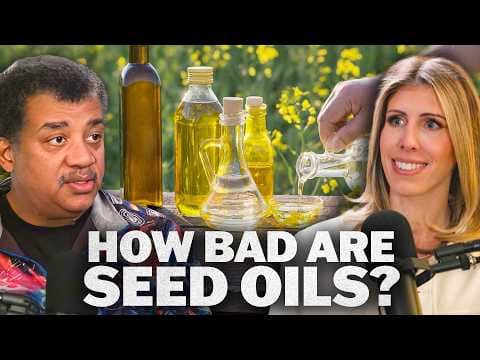
* **"Villainized" Foods: Seed Oils:** Seed oils (e.g., sunflower, canola, sesame) are polyunsaturated fatty acids, which global nutrition science data consistently shows are heart-healthy when consumed in place of saturated fats. Misinformation often arises from taking a mechanistic pathway (e.g., linoleic acid converting to inflammatory arachidonic acid) and extrapolating it to human outcomes, despite the conversion being negligible in the human body. The motivation for this misdirection is often linked to an anti-science movement and the fact that cheap seed oils are widely used in low-nutrient ultra-processed foods, leading to "guilt by association."
* **Food Dyes, Salt, and Raw Foods:**
* **Food Dyes:** Synthetic food dyes (e.g., Red 40, Yellow 5) are deemed safe by regulatory bodies globally, contrary to social media narratives claiming they are banned in other countries.
* **Salt:** "Salt is salt"; pink Himalayan salt and iodized sodium chloride have the same physiological effects. The fortification of salt with iodine has been a successful public health intervention.
* **Raw Foods (e.g., Raw Milk):** The "natural is better" fallacy drives the raw food movement. Pasteurization, which involves simply heating milk to kill pathogens without meaningfully changing nutritional content, is a crucial public health intervention. Advocating raw milk accepts a higher risk of known pathogens for unproven benefits.
* **Combating Misinformation:** People are often confused by conflicting information, even from those with credentials. Scientists need to engage more in public spaces, like social media, to explain scientific consensus. A single study, especially if it confirms a pre-existing bias, does not refute scientific consensus, which is built on a vast body of research. A "guided discovery" approach is more effective than simply telling people they are wrong. While government websites *should* be reliable, recent instances of changing guidelines necessitate looking at global scientific consensus and reputable medical organizations.
* **The Core of Healthy Eating:** Despite constant changes in discourse, the fundamental principles of nutrition science remain largely unchanged: center the diet on plants (fruits, vegetables, whole grains), get a variety of protein from plant and animal sources, prioritize whole nutrient-dense foods, and limit low-nutrient ultra-processed foods. Sensational claims are often a tactic to sell products.