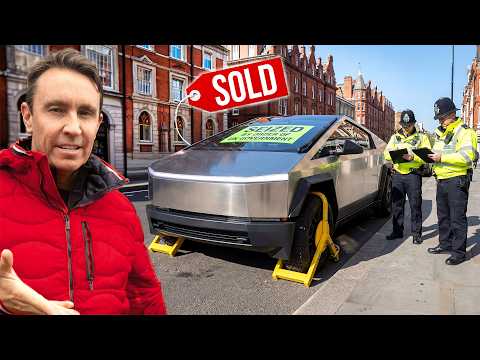
I BOUGHT AN ILLEGAL CYBERTRUCK IN THE UK
Audio Summary
AI Summary
This video documents an attempt to purchase and road-legalize a Tesla Cybertruck in the UK, a vehicle currently banned there. The project began over two years ago, anticipating the difficulties involved. The goal was to secure a Cybertruck, specifically the rare Foundation Edition Cyberbeast, and navigate the complex legal requirements to make it drivable on UK roads, potentially turning it into a business opportunity.
The Cybertrucks are only sold in the US, making acquisition challenging. The narrator sought the limited-edition Foundation Cyberbeast, a high-performance model with 850 horsepower and 1,400 Nm of torque, capable of 0-60 mph in 2.6 seconds. Only 666 units of this version were produced, making it exceptionally rare. Tesla dealerships confirmed they were sold out. After extensive searching, a seller was found, but the price was $50,000 above the list price, bringing the total to $170,000 (approximately £150,000 after currency exchange). The narrator decided to proceed, believing the car’s uniqueness and the potential to be the first in the UK could justify the cost and possibly lead to a profit.
The initial hurdle was shipping the vehicle from the US to the UK. Weeks after the purchase, the car was stuck at a Florida port because shipping companies required specific paperwork for electric vehicles in case of battery fires, which was unavailable for the Cybertruck. The narrator speculated that Tesla might be intentionally hindering exports to prioritize its domestic market. To obtain the necessary documentation, a fabricated story about filming a "Hollywood movie" requiring the Cybertruck in the UK was used in an email to Tesla, which successfully yielded the required paperwork after six days.
However, further delays led to the car's battery dying at the port, incurring additional costs for charging services. Five months after the initial purchase, the Cybertruck was finally on a boat to England. Upon its arrival in the UK, significant taxes and duties were incurred: 20% VAT and an additional 10% import duty, totaling approximately £45,000. Combined with the purchase price and other transport costs, the total investment reached about £200,000. At this point, the market value of the car in the US had already depreciated, making it a "very bad business decision."
The next major challenge was making the Cybertruck road legal in the UK. This required an Individual Vehicle Approval (IVA) certificate, as no Certificate of Conformity (CFC) existed for the Cybertruck in Europe. The IVA process involves modifications to comply with UK regulations. Initial known modifications included separating brake and indicator lights (which were combined and red on the US model, needing amber and distinct functions in the UK), adding side repeaters, and potentially width marker lights for vehicles over 2.1 meters wide.
A significant, unforeseen obstacle arose due to the Cybertruck's 48-volt electrical system. Most car accessories and replacement parts operate on 12-volt or 24-volt systems, making it impossible to find compatible bulbs or components for the required modifications. This meant custom solutions would be needed, greatly increasing complexity and cost. However, a stroke of luck was discovered: the tow bar socket had a separate 12-volt system, which could potentially power the additional lights needed for IVA.
The team also discovered that the car's width, excluding mirrors, was just under 2.1 meters, meaning width marker lights on the roof were not required, simplifying one aspect of the modification. The main electronic challenge remained: separating the 48-volt brake and indicator lights, which required complex electronic rewiring and coding to avoid system errors. The team successfully managed to change the rear indicators to orange by cutting apart the rear lights and fitting custom LED boards.
Regarding the Cybertruck's sharp stainless steel edges, a point of public concern, the team decided to present the car for IVA testing without modifications, hoping that not all edges would require alteration based on specific protrusion rules. The initial IVA test provided a clearer list of necessary edge modifications, confirming that many areas were not an issue due to their minimal protrusion.
However, after the initial IVA test, an unprecedented request came from the DVSA (Driver and Vehicle Standards Agency) for paperwork confirming the Cybertruck’s "steer-by-wire" system met UK requirements. This technology, where there is no mechanical link between the steering wheel and the wheels, is new, and while certified in the US and present in other UK-legal vehicles like the Lexus RZ 450e, the DVSA demanded specific documentation from Tesla. Tesla, known for its difficult communication channels, ignored repeated requests for this paperwork, creating a major setback.
Further complicating matters, news spread about a black Cybertruck being seized and impounded in Manchester for not being road legal, leading to increased scrutiny and negative press. This made IVA testers hesitant to approve any Cybertruck, despite the narrator's car having all necessary safety documents. The government and police were actively targeting Cybertrucks, even those on foreign plates, closing loopholes.
After over a year, the required steer-by-wire documentation from Tesla was finally obtained. However, when submitted, the DVSA still refused to approve it, demanding to speak directly with Tesla about their testing processes. This was a frustrating development, as previous experiences with other manufacturers showed that provided paperwork was usually accepted. The narrator expressed bewilderment at the government's stance, suggesting it was not about safety but a higher-level decision to keep the Cybertruck off UK roads.
As of April 2026, the Cybertruck remains a very expensive garden ornament, unable to be legally driven in the UK. The narrator recounts the emotional and financial toll of the two-year endeavor, including missed opportunities for content creation and the car's depreciation. Yanni, another individual who imported a Cybertruck, also faced similar issues, having to move his car out of the UK after a limited period on Albanian plates. The video concludes with an appeal for help from anyone with expertise in mechanically adapting the steering system or navigating the bureaucratic hurdles to finally get the Cybertruck road legal.