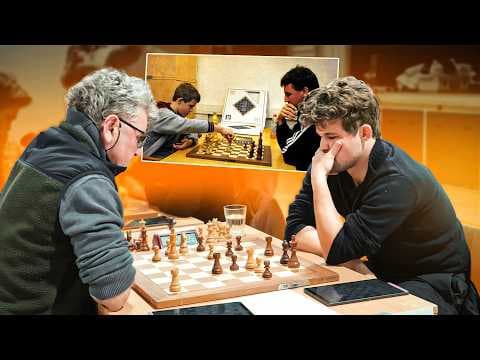
Magnus CARLSEN affronte son PREMIER COACH 20 ANS plus tard !!
AI Summary
This video recounts a chess match between Magnus Carlsen, the current world number one, and his first coach, Simon Astein, a grandmaster rated 2573. The game took place 20 years after Carlsen was first coached by Astein, in a tournament in Oslo. The central question of the match was whether Carlsen could defeat his former mentor.
The game began with D4, knight F6, C4, E6, and after knight F3, D5, a Queen's Gambit Declined position was established. Following knight C3, Carlsen played the somewhat rare knight B D7, surprising Astein, who spent eight minutes considering his response. Astein then played C takes D5, leaving him with 1 hour 22 minutes on the clock compared to Carlsen's 1 hour 28 minutes. After E takes D5, the Carlsbad pawn structure, common in the Queen's Gambit, emerged.
Astein continued by developing his bishop to F4. Carlsen responded with knight B6, followed by queen C2 from Astein. Carlsen then played knight H5, a seemingly risky move ("knight on the rim is dim") but with a precise goal: to capture Astein's bishop on F4 and gain the bishop pair, which is powerful in open positions. Astein sought to preserve his bishop, moving it to E5, but Carlsen continued his attack with F6. The bishop retreated to G3.
Astein's move bishop G3 was interesting, as he noted that the computer considered it an error, but he disagreed. His idea was clear: he was willing to surrender the bishop pair if Carlsen took it, but in return, he would open the H-file for his rook. Carlsen understood this and did not immediately capture the bishop, instead playing C6 to solidify his pawn chain. Astein played E3, Carlsen developed his bishop to E7, and Astein mirrored with bishop D3, attacking the H7 pawn twice, which Carlsen defended with G6.
Astein then played the surprising A3. This "waiting move" seemed to violate opening principles, as Astein had already controlled the center and developed pieces, and conventional wisdom would suggest castling to secure the king. However, Astein, being a grandmaster and Carlsen's former coach, had a deeper strategy. He was delaying castling to keep both kingside and queenside castling options open, thereby preventing Carlsen from knowing where to direct his attack. Carlsen, on the other hand, knew he had to castle kingside due to the pressure on the queenside and the open lines. He played bishop E7 to develop his pieces.
Astein continued his waiting strategy with knight D2, another seemingly surprising move. After Carlsen castled kingside, putting his king in safety, Carlsen had 57 minutes against Astein's 1 hour 03 minutes. Astein continued with knight B3, aiming for the C5 outpost to attack the B7 pawn. Carlsen played knight D7 to control C5 and prevent Astein's knight from occupying it. The position remained unclear, with the evaluation bar fluctuating between white and black advantage.
Astein persisted in his plan, playing knight A4, determined to place a knight on C5. Carlsen finally decided to capture Astein's bishop on G3 with knight takes G3, followed by H takes G3. Astein then posed a significant threat: if Carlsen made a move like A6, Astein could play bishop takes G6, followed by H takes G6, and queen takes G6, resulting in checkmate. Carlsen, being the world number one, recognized this and played bishop F7 to defend the G6 pawn and avoid the checkmate trap.
Astein then played G4, pushing pawns on the kingside, clearly signaling an attack on Carlsen's king. With the H-file open and the bishop and queen targeting Carlsen's king, this was a logical attacking strategy. Carlsen, understanding Astein's plan, realized that Astein would now castle queenside for king safety. Carlsen responded by launching a pawn storm on the queenside with A5, preparing an attack on Astein's king. Astein played knight B C5, attacking the B7 pawn, which Carlsen defended with rook B8. Astein then played bishop E2.
At this critical juncture, Carlsen played knight takes C5. The computer's evaluation bar shifted significantly in Astein's favor, indicating that this was an inaccuracy. After queen takes C5, a strong square opened up for Astein's pieces. Astein gained more space on the queenside, and with the pawn on C5, it would be difficult for Carlsen to push his pawns on the queenside due to the threat of en passant captures. After bishop E6 and queenside castling, Astein's king was safe, and Carlsen's queenside attack was effectively blocked. Astein, Carlsen's coach, now held an advantage.
However, Carlsen, being the world number one, adapted his strategy. He abandoned his queenside plans and initiated a kingside attack with F5, aiming to open the F-file for his rook on F8 and target the F2 pawn. Carlsen had 24 minutes left, while Astein had 31 minutes. Astein played a clever indirect defense with bishop D3. It seemed that the G4 pawn was undefended and could be captured by Carlsen. But as before, if Carlsen took the G4 pawn, Astein would play bishop takes G6 (a brilliant move), H takes G6, and queen takes G6, leading to checkmate. Carlsen avoided this trap and played queen C7 to activate his queen.
Astein continued his aggressive kingside pawn push with F4, but Carlsen remained calm, playing rook B E8, highlighting the drawback of F4: the E3 pawn became a backward pawn on a semi-open file, and Carlsen began to position his rook to potentially target it later. Astein, in an aggressive mood, played the surprising rook H6, intending to double rooks on the H-file to capture on H7 and potentially checkmate Carlsen. Carlsen defended the H7 pawn with rook F7. Astein played rook D H1 to double rooks, and Carlsen played bishop F8 to chase away Astein's rook. After rook H4, Carlsen played queen E7 to centralize his queen.
At this point, the game was critical, with the evaluation bar showing a slight advantage for Carlsen but remaining balanced. Carlsen had spent a significant amount of time on queen E7, leaving him with only 7 minutes on the clock compared to Astein's 17 minutes. This created a scenario where Carlsen could potentially lose to his former coach.
Astein chose to block on the kingside with G5. However, Carlsen, mastering the principles of chess, knew that when attacked on the wing, one must react in the center. Carlsen unleashed the exceptional D4, sacrificing a pawn. His idea was simple: if Astein captured the D4 pawn, Carlsen's bishop's diagonal and the central files would open, while Astein's pieces were scattered on the edge of the board. Carlsen demonstrated his deep strategic understanding of the position.
Astein, with 14 minutes on the clock, spent 11 minutes contemplating D4, leaving him with only 3 minutes when he finally played E takes D4. At this point, both players were in severe time trouble. Carlsen, with 5 minutes, played queen D7 to attack the D4 pawn. Astein continued his kingside aggression with G4. Carlsen captured the D4 pawn, and then F5, with G takes F5. Astein played rook D1, trying to bring pieces to the center as it had opened up. Carlsen played queen E3 check, Astein moved his king to B1, and Carlsen played rook D8, increasing pressure on the D-file.
Astein's rook H1 was an admission of weakness, as he was retreating his pieces from the kingside attack to defend the center, effectively abandoning his kingside offensive. He acknowledged that Carlsen's central attack was more dangerous. Carlsen played rook F7, increasing pressure on the D3 bishop. Astein played rook D E1 to attack the queen on E3. This seemed surprising as the D3 bishop was attacked three times and defended only once. Astein's idea was that after queen takes D3, the E6 bishop would be en prise. However, entering an endgame against Carlsen, a specialist in endgames, was a risky proposition. Carlsen seized the opportunity, playing queen takes C2, followed by king takes C2, entering an endgame that was heavily in his favor.
The black pieces were much more active, the white king was in danger, and the bishop was much stronger than the knight, which was on the edge of the board. The pawn structure, with pawns on both wings, favored the long-range bishop over the short-range knight, as the bishop could easily switch between wings. Carlsen played rook D4 to attack the weakness on F4. After king B3, Carlsen captured the F4 pawn, gaining a pawn. Astein played G6, aiming to open lines for a counterattack on Carlsen's king. But Carlsen cleverly played H6, keeping the lines closed and his king safe.
Astein played rook F6, Carlsen checked with rook D3, and Astein moved his knight to C3. Carlsen checked with rook A4, the pawn was not capturable due to the king being in check. Astein moved his king to C2. Carlsen played rook D7, retreating slightly to defend. Astein played rook H5, attacking the F5 pawn twice, which was defended only once. Carlsen played rook F2 check, Astein moved his king to C1, and Carlsen captured the C5 pawn with bishop takes C5. Astein recaptured the F5 pawn. Carlsen played bishop E3 check, and after rook takes F5, rook takes F5, Carlsen played king G7. The G6 pawn, which Carlsen had preserved with H6 instead of H takes G6, became a passed pawn, although isolated and fragile. This pawn eventually fell after knight takes A4. Carlsen then played king takes G6, leaving him with a strong H-pawn that could advance to promotion.
Astein, recognizing Carlsen's superior skill, did not even need to verify the world number one's capabilities. After rook F3 and bishop D4, he resigned. The H-pawn was unstoppable, and Astein's knight on A4 was completely passive. Carlsen thus confirmed that the student had indeed surpassed the master, even 20 years later.