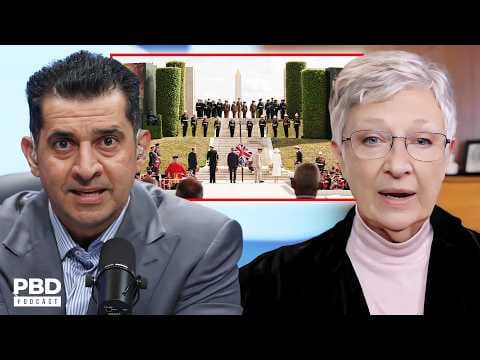
"It's Called THE GREAT GAME" - Imperial Expert TORCHES Britain's 200-Year War On America
Audio Summary
AI Summary
The discussion revolves around who wields power in global politics, questioning if it's the Royal Family, bankers, or specific wealthy entities like the Rothschilds. The Rothschilds' historical manipulation of war bonds for profit is cited as an example of wealth creation before regulation. The conversation then shifts to the "Brits" and their alleged power in assassination attempts, attributing it to a corporate-like structure where various entities play roles.
A recently published book, "Queen Elizabeth and Her Presidents, the Hidden Hand Behind History," is referenced, claiming Queen Elizabeth received extensive daily intelligence briefings and was deeply involved in national security matters, including the "Five Eyes" operation. The author describes the monarchy's use of "soft power" to influence presidents.
Beyond royalty, the financial power embedded in the City of London is highlighted as a significant force. The City of London, particularly Lloyd's of London, is implicated in setting oil prices through Brent crude speculation, using instability, like the Strait of Hormuz choke point, to create a "terror premium" or tax. This speculative pricing, originating in London, contributes significantly to oil costs in the United States, independent of physical production.
The intelligence side, MI6 and MI5, is also mentioned as legendary, historically intertwined with the CIA. Furthermore, the media's role in shaping the political environment through "soft power" and psychological warfare is emphasized. The British elite are described as masters of psychological manipulation, shaping narratives to divert movements like MAGA from their stated goals, which are seen as countering a modern-day British empire or "globalist system."
The current US administration's actions are described as an extraordinary effort to break the power of this imperial system, reminiscent of President William McKinley's challenge to global reach. The speaker urges people to observe cabinet meetings and executive orders to understand the historic nature of these efforts, rather than being distracted by divisive social media narratives.
The method of control isn't direct orders but creating a system where people conform to avoid losing money or jobs, akin to Stockholm Syndrome. This "playbook" involves keeping people in a world of perceptions, reacting to narratives generated by institutions like the mainstream media, which are controlled by a "global financier elite." This elite runs media and entertainment to shape how people think, creating "shadows on the wall" to which people react. The true fight, according to the speaker, is between imperialism and the right of nations to develop for their own betterment, not for a global elite.
The Russians are cited as understanding this dynamic, attributing the ongoing Ukraine war specifically to the British, not primarily the US. This strategy, named "the Great Game" in the 19th century, aims to keep nations constantly fighting, allowing imperial powers to maintain control. Historical examples include the post-WWI redrawing of Middle Eastern borders to ensure perpetual conflict and the overthrow of leaders like Mossadegh in Iran who threatened British oil interests. The speaker concludes by urging a shift from simplistic binaries (e.g., communism vs. capitalism) to understand the underlying struggle between imperialism and national self-determination.