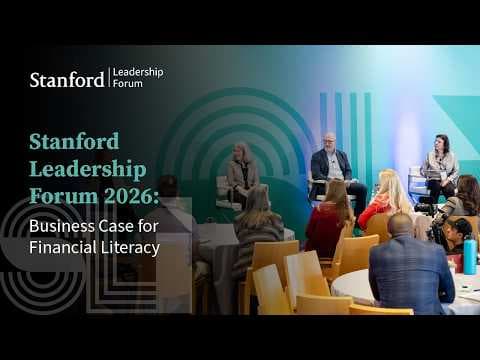
Stanford Leadership Forum 2026: Business Case for Financial Literacy
Audio Summary
AI Summary
The session, "The Business Case for Financial Literacy: From Classroom to Capital Markets," highlights the critical importance of financial literacy, not merely as an educational issue, but as a fundamental economic one that drives market functionality and overall economic well-being. The moderator, Dr. Lardi, a professor of personal finance at Stanford, notes the immense popularity of her new course, which consistently has a long waiting list, underscoring the high demand for such education. She emphasizes that financial literacy is a "must-have," not a "nice-to-have."
Tim Ranzetta, founder of Next Gen Personal Finance, shares his journey, inspired by his volunteer teaching experience, to create a nonprofit dedicated to ensuring every American student receives a personal finance class. He presents a compelling business case: research indicates a lifetime benefit of approximately $100,000 per student from a personal finance class. With 3.5 to 4 million high school graduates annually in the US, this translates to a societal benefit of around $400 billion. The costs, he argues, are negligible, as many nonprofits provide free, high-quality curriculum and teacher training. Eleven states have already made personal finance a graduation requirement, often upskilling existing teachers who are eager to learn alongside their students.
Jerry Walsh, former president of the FINRA Investor Education Foundation, corroborates this with data from the National Financial Capability Study. This study reveals that individuals with higher financial knowledge are more likely to manage their finances effectively, meet their daily needs, and plan for the future, regardless of income. They also experience less financial stress, even when controlling for income, which has significant implications for workplace productivity, especially for lower-wage workers. Workplace financial wellness programs, she suggests, can complement high school education, with data consistently showing better financial outcomes for those exposed to financial education.
Natalia Guzva from the World Economic Forum adds further numerical context. She estimates that individuals make 35,000 decisions daily, most with financial implications, yet only one in three people globally are financially literate. The compounding effect of these daily decisions, she states, can be significant. At the enterprise level, financial stress costs US employers an estimated $5 billion per week in lost productivity. Societally, financial literacy is crucial for all, not just the underprivileged. She notes that even high-net-worth individuals struggle with discussing money and inheritance. With an estimated $83 trillion in wealth transfer from baby boomers to Gen X and millennials, much of it inherited by women, financial literacy becomes vital for capital allocation and risk management, impacting society broadly.
Natalia further explains why global institutions, including the World Economic Forum, view financial literacy as a pillar of economic resilience. The World Economic Forum has established a Global Council on Financial Education, co-chaired by Dr. Lardi and including Jerry Walsh, which is engaging central bankers to discuss the importance of financial literacy in the transmission of monetary policy. Globally, financial literacy is seen as an enabler of economic prosperity, helping to turn savers into investors and increase market competitiveness, particularly in regions like the European Union.
Tim addresses the question of mandating financial education in schools, preferring the term "guarantee." He points to a natural experiment: 30 states now require a standalone personal finance course, up from 8 states just five years ago, covering 76% of students. This contrasts with 20 states where it is not required. Data shows that low-income and urban communities are less likely to receive this education, while rural districts are three times more likely. He highlights the danger of students relying on platforms like TikTok for financial advice, where "get-rich-quick" schemes are prevalent, without a foundational understanding to discern good advice from bad. Regarding capital markets, personal finance classes teach investing strategies, emphasizing accessibility to markets (commission-free trading, fractional shares, low minimum investments). Access without education, however, leads to mixed results. Greater participation by young people in markets, driven by education, is seen as imperative.
Jerry expresses both worry and hope regarding young investors. The National Financial Capability Study, which has tracked investor behavior since 2009, shows a significant increase in participation from underrepresented groups (women, people of color, lower-income individuals, and younger people) up until 2021, with some decline in 2023-2025 due to economic conditions, but still higher than 2015 levels. She is concerned that some who left the market are 18-34 year olds, people of color, and men. A major concern is the reliance on social media influencers for investment information, particularly among younger, male, and minority investors. While they may consult more sources, the quality of these sources is questionable. Jerry stresses the importance of tools like FINRA's BrokerCheck, a free service allowing individuals to verify the registration and disciplinary history of financial professionals. She notes a "risk paradox" among young investors: while few express a willingness to take substantial risk, nearly two-thirds of 18-34 year olds believe they *need* to take outside risk to achieve financial goals, which is deeply concerning.
Natalia discusses how technology is reshaping global financial participation. She likens its impact to Uber and Lyft, fundamentally changing how people interact with the financial system. Technology offers access and execution via mobile apps, and influences attention and education through influencers on platforms like TikTok and YouTube. Trust in traditional institutions is falling, while trust in technology, including AI chatbots and robo-advisors, is rising. She uses cryptocurrency as an example: it is visible, familiar, and accessible, driving engagement. Surveys show non-investors perceive crypto as easier to access and understand than stocks, bonds, and ETFs. While technology presents risks, it also offers opportunities to engage young investors and make financial concepts more familiar and accessible at scale.
Tim adds that the rise of online sports gambling, now legal in 40 states, further blurs the line between investing and gambling. A disturbing statistic indicates 25% of young people view gambling as a form of investing, with 95% of online gamblers reportedly losing all their money. This highlights the urgent need for curriculum providers to clarify the distinction for young people.
Regarding barriers to universal access to financial education, Tim identifies inertia (status quo bias) and the local control of education systems as primary challenges. Despite these, 80-85% of people believe personal finance should be required. His organization created a 501c4 to lobby state legislatures, leading to 20 states passing laws requiring financial education. This issue is non-partisan, with widespread agreement, often driven by regret over past financial decisions and hope for future generations. The economic cost of lacking financial literacy, he reiterates, is $100,000 per person in lifetime benefits, much of it from improved credit scores and reduced borrowing costs. He notes that high school students are now discussing Roth IRAs and actively investing, demonstrating the impact of effective education.
Jerry elaborates on the economic consequences, particularly the link between financial literacy and market outcomes, focusing on fraud. The mission of the FINRA Investor Education Foundation is to help people build financial stability to participate in capital markets safely. While market democratization has increased participation, fraudsters also leverage technology. A FINRA study found that 50% of investors, and 67% of 18-34 year olds, could not identify red flags in a scenario offering a guaranteed 25% return with no risk. This lack of "fraud literacy" has massive economic impacts, with billions lost to fraud, particularly elder fraud, and increasingly targeting younger individuals. FINRA has implemented rules, such as requiring trusted contact information, to help protect investors. Fraud is escalating, draining vast sums from the economy, and is significantly underreported.
The panel discusses the trend of decreasing age for investing and the rise of early life investing (e.g., 529 plans), further emphasizing the importance of early financial literacy.
Natalia concludes with optimism, noting that 70% of Gen Z are confident in their financial goals, and 30% began learning about investing before entering the workforce, twice as many as millennials. She emphasizes that many of their financial goals are medium to long-term, not purely speculative. Her closing thought is to "destigmatize the conversation around money," as it's a topic often avoided but universally necessary. She encourages everyone to become ambassadors for financial literacy in their communities and workplaces.
Tim highlights the ripple effect of financial education: students learn, inspiring parents to invest, and teachers improve their own financial lives. He encourages Californians to advocate for earlier implementation of personal finance courses and those in states without mandates to speak to their representatives.
Jerry echoes Natalia and Tim, offering hope that financial knowledge gaps are closing, especially among young women. She notes that while millennials often started investing through 401ks, Gen Z often began with cryptocurrency in taxable accounts, showing that some high-risk ventures can still lead to market participation. Her call to action is for everyone, including students, to contribute to financial literacy efforts, whether by funding research, supporting workplace wellness programs, or discussing money in their communities. "We need money," she states, to support the rigorous research, programs, and global initiatives.
Dr. Lardi closes by presenting a compelling statistic: people spend an average of six hours per week at work dealing with personal finance issues. Financial education, she argues, is an investment for firms and society, as it equips young people to be productive contributors to the economy, leading to a high return on investment. She shares her personal experience chairing Italy's financial education committee, which successfully mandated financial literacy from elementary school, and the profound impact teaching personal finance has had on her students' lives, transforming them into financial advisors for their families.