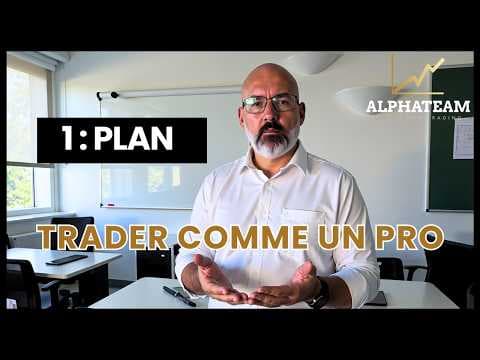
Apprendre le Trading comme un Pro — Leçon 1/4 : Le Plan
AI Summary
Gabriel, a coach for Alpha Team, shares insights from years of experience guiding traders and investors in the crypto market. He highlights that markets are highly competitive, with informed and well-resourced individuals often profiting from the inexperience of small investors. A professional approach to markets is crucial, differing significantly from mere conviction or belief in a company's story. This professional method provides a probable advantage, justifying the risk of capital and allowing for measurement of potential gains, rather than relying on intuition or perceived genius.
Alpha Team offers a free introductory training program called "Discover Pro Trading." This program aims to eradicate bad habits and teach professional trading techniques not typically found on YouTube or taught by influencers. These are methods applied by profitable traders, hedge funds, and large-scale investors. The training consists of four short, simple videos, condensing Gabriel’s experience for an audience with limited attention spans, like those accustomed to short-form content. The goal is to identify motivated individuals who wish to join Alpha Team and become professional traders. The videos are free, with no referral links, and are delivered via email, allowing quick assessment of their value.
Gabriel stresses that markets are unforgiving; without correcting errors and modifying approaches, traders will continue to achieve unstable or poor results. He asserts that undertaking the work outlined in this training can save years in achieving financial goals, acknowledging that not everyone has the discipline to succeed in trading. The program focuses on building a plan, mastering one's mindset, and securing one's financial future, emphasizing that a solid mindset and plan are indispensable.
Trading without a plan is akin to suicide because markets are unpredictable and chaotic. While some patterns repeat, most events are unique, influenced by new participants, macroeconomic conditions, and other factors. Just as one cannot predict every detail of the ocean's waves, one cannot perfectly predict market movements. Without a clear plan of action, consistent, profitable gains are impossible, as results become dependent on fluctuating personal factors like mood or sleep. Many traders constantly switch strategies, leading to random outcomes. They often get lost in "noise," collecting opinions and strategies from various sources, leading to mental overload and exhaustion. A structured plan provides clear direction and is essential for long-term success.
The training will guide participants in creating a plan. This plan begins with personal objectives, which serve as a reminder of one's purpose for trading. While ambitious goals like yacht ownership are tempting, a more immediate, realistic goal is to achieve sustainable profitability. Extreme financial aspirations can be a strong motivator but also a significant obstacle, leading to excessive risk-taking and premature capital depletion. It's crucial to allow time for success to unfold and to prioritize financial independence over grandiose dreams.
An equally important, non-financial objective is to focus on improving one's method. Like a basketball player practicing 3-pointers repeatedly, a trader must consistently refine their approach until it becomes automatic. This involves identifying and correcting a primary error in one's trading history. Common mistakes include over-trading, revenge trading, failing to cut losses, prediction, or inability to accept losses. Identifying and committing to correcting one major error can transform a losing trader into a winning one. This correction is paramount, more so than any material dream. It builds confidence in oneself as an "operator" who executes strategies precisely.
The plan must include a precisely defined strategy, detailing entry and exit criteria. This includes knowing when to enter, where to place a stop-loss (when one is wrong and how much one will lose), and target profit levels. This clarity is crucial for achieving stable results.
Risk control is another vital component. Protecting capital is not a tedious task but an opportunity to stay in the game, gain experience, and identify what works and what doesn't. It ensures that a trader has "infinite cartridges" to seize future opportunities, even if a current trade goes poorly. Without risk control, rapid capital depletion makes it impossible to become competent. Gabriel challenges listeners to identify what would guarantee a win today; if they don't know, there's no reason to risk large sums.
The exercise for participants is to identify their biggest error, noting it in their plan. Examples include wanting to be part of every market move or failing to take losses. Learning to accept losses is fundamental, much like learning to fall in judo. Losses are a normal part of trading; the key is how one recovers. Many traders avoid realizing losses, hoping the market will turn, only to face larger losses or career termination. To achieve financial goals, one must be able to repeatedly engage the market and accumulate gains.
Knowledge alone is insufficient; execution of the plan is what transforms trading. A trader must become an executor, pressing buttons according to a predefined plan, which justifies risking money in a business model. If one is still unsure of their biggest error, they should reflect on why they haven't yet achieved their objectives.
Regarding strategy, Gabriel refrains from providing a ready-made one. He explains that strategies can be simple and fall into two main types: trend-following or range-bound. Trend strategies involve buying dips in an uptrend or selling rips in a downtrend. Range strategies involve buying low and selling high within a defined range. The specific indicators or conditions added are secondary. The key is to recognize the market context and align one's strategy with it. Traders should identify whether they prefer trend or range markets and step aside when the market doesn't suit their preferred style. There are many assets to trade, offering diverse market conditions.
Once a trader identifies their preferred market type and setup, they should revisit their best strategies, whether from past experience, YouTube, or community resources like Alpha Team's strategy sessions. The problem often isn't knowing what a good trade looks like, but rather taking bad trades or lacking patience. A chosen strategy should be simple, with clear entry points (why enter, what indicators/price action confirm), stop-loss levels (where to exit if wrong), profit targets (when to take profits), and invalidation points (when the trade idea is definitively wrong). Precision is key; avoid broad entry criteria driven by a desire to be constantly active.
Cultivating a winning mindset is crucial and will be covered in later videos. It requires mental clarity, reducing self-doubt and self-sabotage. A clear plan helps alleviate anxiety by providing a framework for action, even when market outcomes are uncertain. This clarity reduces mental burden, stress, and fatigue, allowing traders to perform at their best. Success in trading doesn't require participating in every market movement, but rather winning more often than losing, and building capital over time. This approach fosters personal pride, as one becomes a disciplined professional, doing the work others avoid. Gabriel emphasizes that quick riches are a myth; professional trading requires effort and discipline.
The presentation concludes by encouraging participants to start drafting their plan immediately, even if it's imperfect. Alpha Team helps refine these plans, but clear rules are the first step. The next video will explain how to transform this plan into a probable advantage.