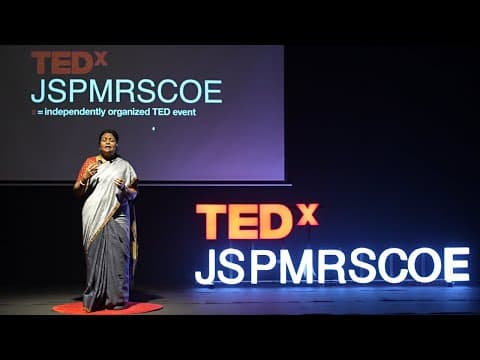
A Beautiful Paradox: When Life Rewrites the script | Resident Commissioner Vimala R | TEDxJSPMRSCOE
Audio Summary
AI Summary
The speaker recounts their personal journey, highlighting a life filled with unexpected turns and paradoxes that ultimately led to success and fulfillment. They begin by describing their initial struggles with competitive exams, specifically the UPSC Civil Services exam, where they failed twice despite reaching the interview stage. This led to feelings of inadequacy and self-doubt. Subsequently, they attempted the Maharashtra Public Service Commission (MPSC) exam, feeling particularly insecure about their lack of proficiency in Marathi, a language that counted towards the final ranking. Despite intensive study, they achieved their highest marks in Marathi and passed the MPSC exam, becoming a Deputy Collector.
Following this success, the speaker returned to preparing for the UPSC exam with renewed confidence. However, just one day before the exam, they were involved in a scooter accident, resulting in a hospital stay and profound disappointment. Feeling that life was unfair, they almost gave up. Fifteen years later, however, life unexpectedly led them into the Indian Administrative Service (IAS), fulfilling a dream they had long buried without actively pursuing it.
This personal experience forms the basis for the speaker's central message: that setbacks and unexpected detours are not necessarily rejections but rather life's way of repositioning individuals. Using the analogy of a river changing its course when blocked, the speaker emphasizes that life’s challenges often lead to new directions and ultimately to the desired destination.
The speaker then delves into the concept of paradox, drawing parallels from the Bhagavad Gita. They discuss the paradox of Arjuna, a great warrior, being paralyzed by doubt on the battlefield, and Krishna’s guidance to focus on duty (Nishkam Karma) rather than the outcome of actions. This, they explain, is a crucial lesson for students facing exams: preparation and sincere effort are key, and letting go of the outcome allows for clarity and focus to emerge.
The narrative shifts to the story of Lord Rama, illustrating another paradox. Rama’s exile to the forest, which appeared to be a punishment and a loss of his kingdom, ultimately led to his transformation into "Maryada Purushottam" (the supreme human being) and his significant alliances, shaping his legend. His brother Bharat, by refusing the throne and ruling as a servant in Rama's name, turned apparent loss into a legacy. The speaker suggests that these "forests" in our lives are not punishments but preparations.
The speaker stresses that life does not adhere to a fixed academic timeline. Individuals may take longer to find their path, change directions, or discover their true calling after perceived failures. This evolution, they argue, is not a weakness. They use the example of the bamboo tree, which strengthens its roots underground for years before rising tall.
A significant portion of the talk is dedicated to the inspiring stories of women from self-help groups in Maharashtra, facilitated by the Maharashtra State Rural Livelihood Mission (MSRLM). These women, often having faced extreme hardship, domestic abuse, and rejection from banks, demonstrated remarkable resilience and transformed their lives and communities. One woman, rejected 17 times by a bank, now runs a successful agricultural unit employing 40 women. Another, starting with an income of ₹800, became a community resource person and empowered over 100 women. These stories highlight that when one path is blocked, individuals can forge their own. The women's ability to overcome adversity, find their inner strength, and create enterprises, educate their children, and transform villages is presented as a testament to the human spirit, achieved through dedication and action rather than philosophical discourse.
The speaker then addresses the students directly, reminding them of the resources and support systems available to them – health, education, internet, books, institutions, mentors, and loving parents. They encourage open communication with parents, emphasizing their unwavering support. The core message remains: life is precious, and no exam defines one's worth. If one door closes, another can be knocked on, or one's own path can be built.
The COVID-19 pandemic is also brought up as a profound paradox. While the virus brought the world to its knees, it also revealed humanity's strength, the dedication of scientists, doctors, nurses, and essential workers. In moments of helplessness, the value of touch and love became apparent, demonstrating the resilience of the human spirit.
Finally, the speaker touches upon the paradox of valuing foreign goods over indigenous culture. They observe the global success of Indian exports like turmeric and yoga, yet highlight a hesitation among people to embrace their own heritage, such as Khadi and handloom. The speaker argues that buying Khadi is not just economical but psychological, representing dignity of labor, self-reliance, and national history. The women of MSRLM, by creating and selling their crafts, are not just selling products but preserving cultural continuity.
The speaker concludes by reiterating that their own journey, from failed attempts and accidents to unexpected postings, were not detours but disguised destinations that prepared them. The Marathi they feared became a strength, the exam they doubted led to their career, and the lost dream returned. The un-planned life, they suggest, is often the one that prepares us best. Rejection can be redirection, and perceived weakness can become strength. The final message is one of faith, devotion, and patience, encouraging individuals to focus on excellence in action, embrace contradictions as learning opportunities, and recognize that life's greatest lessons often come from unexpected places, transforming destiny.