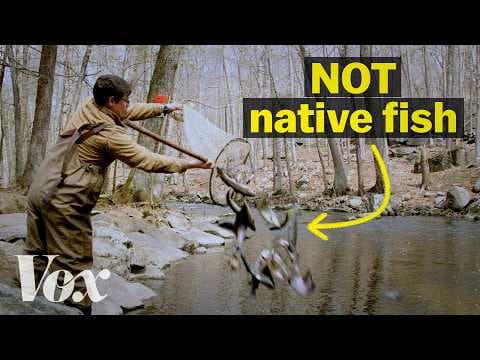
Why are states unleashing millions of these fish?
Audio Summary
AI Summary
This video explores the practice of fish stocking, where non-native fish are intentionally released into rivers and lakes, often for recreational fishing. Andrew, a state official, is shown releasing fish into a river, a practice that has been common since the late 1800s. The primary reason for this is that many ecosystems lack a thriving native fish population, necessitating the introduction of fish for people to enjoy the sport of fishing. These stocked fish are bred in hatcheries with the specific goal of being caught.
The practice raises significant questions about its reasonableness and ecological impact. The speaker traveled to Connecticut to observe fish stocking firsthand and understand its prevalence. A key finding is that fishing is crucial for conservation funding in Connecticut and nationally. Annually, around 170,000 people participate in fishing in Connecticut, and their fishing license fees directly fund conservation efforts, stocking programs, and fish habitat improvements. Nationally, fishing licenses and taxes on fishing equipment generate over $1 billion in conservation revenue. Ironically, this recreational fishing is supported by manually restocking waters because native fish populations are insufficient.
Non-native fish, such as rainbow trout (from the West Coast of the US) and brown trout (from Europe, Asia, and Northern Africa), are bred in hatcheries. The US has been stocking fish for over a century, a practice that began in the late 1800s when native fish populations declined due to dam construction and water pollution. The federal government used "fish cars"—trains full of live fish—and horses or mules to transport them across the country. At that time, the concept of "invasive species" was not recognized.
Today, while the understanding of the negative impacts of non-native species is much greater, fish stocking continues, albeit using modern methods like trucks and planes. Human activities, such as warming stream temperatures (detrimental to cold-loving fish like trout and salmon) and dams (a major habitat problem, especially for migratory species), continue to disturb natural ecosystems. The Mianus River in Connecticut, for example, has several dams affecting its native fish population.
Connecticut's fish stocking program is not random; it has evolved since the 1870s to include monitoring and adaptive management processes to prevent negative effects. However, even with careful approaches, problems can arise. Non-native stocked fish, raised in hatcheries, can become aggressive and outcompete native species for food, potentially displacing them. Another concern is hybridization, where non-native fish breed with native fish, leading to a loss of genetic traits essential for the native species' survival and potentially their decline. There are also welfare concerns about breeding fish in hatcheries solely to be caught.
Beyond ecological impacts, fish stocking highlights a broader issue: how public institutions are structured to protect wildlife amid climate and biodiversity crises. States often prioritize non-native fish because fishing revenue is a significant source of funding. This creates an incentive to favor game species and stocked fish, potentially at the expense of native species and broader ecosystem health. The resources used for hatchery operations could be better spent on other conservation efforts. This creates a paradox: to fund conservation, states engage in practices that can harm the very ecosystems they aim to protect.
The solution lies in evolving how conservation is funded and defined, through diversified funding streams. Examples include Oregon's lodging tax increase to support state wildlife action plans and the proposed "backpack tax" on outdoor equipment, similar to fishing taxes. While states face a dilemma between satisfying constituents who want to fish and those who want to conserve nature, some argue that engaging people in fishing can build environmental and conservation ethics, ultimately providing a net good. The ultimate goal is to restore native systems and their fish populations, which would benefit everyone.