claude code changed everything for builders
Audio Summary
AI Summary
The video chronicles a developer's journey of building an application, likely a chat app, using Xcode and AI assistance, specifically referencing "Claude code" and "Codex." The process begins with the developer navigating their development environment, struggling initially with launching the app and connecting Xcode to the AI tools. They explore YouTube for guidance on connecting Xcode to "Claude code," encountering various tutorials. A recurring issue involves the developer's Mac attempting to take over their headphones, disrupting their workflow, which they express frustration about.
The developer then delves into Xcode, acknowledging it as an IDE. They attempt to activate Codex, which is initially not installed, leading to a slogan change to "Learn baby learn so we can earn baby." The process involves running commands in the terminal, generating shell scripts, and dealing with environment activation. The developer expresses a strong belief in manifestation and achieving goals through sheer will, stating, "If I want it, if I believe I can have it, then that's my reality."
A significant portion of the video focuses on the interaction with AI assistants to guide the development process. The developer asks the AI to run the app in a simulator, encountering errors related to installation and permissions. They repeatedly grant permissions to commands, emphasizing the AI's ability to handle tasks without explicit knowledge from the developer. The developer also touches upon the cost of AI services, noting that both Codex and "clogs" (likely referring to Claude) have associated fees.
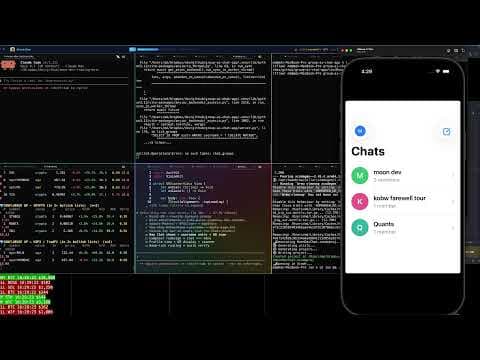
The developer then seeks guidance on how to launch the app in Xcode and see it in the simulator. They receive instructions to run the iOS target. An error arises: "a build-only device cannot be used to run this target. No support to iOS devices are available." The solution involves selecting a specific simulator, such as an iPhone 17 Pro, rather than a general "Any iOS device." This leads to the app building successfully, and the developer expresses awe at the capabilities available.
The chat interface is then revisited with a request for a complete redesign, aiming for an Apple-esque, sleek, flat, and beautiful aesthetic, with specific instructions to avoid the color purple and ensure proper sizing for various iPhone models (17, 16, 15). The developer contrasts the current rapid iteration with past experiences that took weeks. They also discuss the concept of minimum viable products (MVPs) and the costs associated with different AI models, comparing Opus at $5 with Mini Max at $0.92, opting for the cheaper option for testing.
Authentication is a key development point. The developer considers phone number authentication but pivots to an Apple-only login for an iOS-only MVP, citing its simplicity, native integration with Face ID, and zero infrastructure cost compared to phone authentication which involves third-party services like Twilio. The trade-off of Apple-only login is potential vendor lock-in for future Android or web versions. The process involves Apple returning a stable user identifier, the backend verifying a JWT against Apple's JWKS, and then upserting a user row.
Further UI refinements are requested, including removing the AI button from the left side of the chat input, making the message field extend to the left, and placing two buttons on the right: a send button and a circular AI button that invites the AI to the conversation. The "new chat" button at the top right is to be replaced with a feature to directly message a specific user by their username. The concept of "rooms" is deemed unnecessary, as rooms are to be created automatically when users chat. Each chat should have a three-dot menu in the top right to copy a link to the chat.
The developer expresses amazement at the complexity and potential cost of these feature requests, estimating them to be thousands of dollars, and reflects on the front-end development possibilities and the challenges of user acquisition. They also note that the current UI is not utilizing the screen space effectively and suggests removing the "chats" header. The idea of a profile page accessible by clicking a username is introduced, allowing users to upload an image, change their username, and log out. A QR code is to be generated immediately upon opening the app, linked to the user's profile, allowing others to scan it to initiate a chat directly. This QR code functionality is also to be present on each chat page.
The developer then requests two distinct passes for development: one for username selection and another for Apple sign-in, connecting the username to the Apple ID. The process of wiping the database is mentioned, which the developer finds "sketchy." The video concludes with the developer reflecting on the iterative process of app development, the current design being "poopy," and the long-standing desire to build apps without prior coding knowledge. They announce a stream the following day on their website, Moondive.com, for further development and Q&A. The video ends with a brief, humorous interaction about their mouse trying to connect to another computer.