Adobe has a big problem
Audio Summary
AI Summary
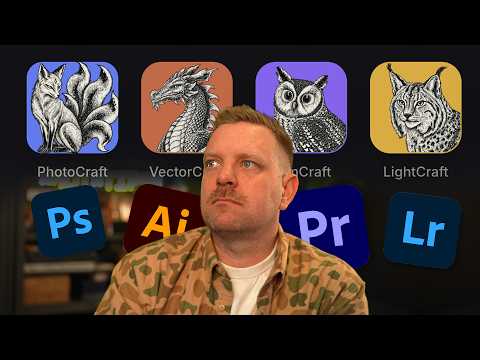
Adobe is facing a significant challenge from a new company that has "clean room ported" the entire Adobe Creative Suite, including Photoshop, Illustrator, Premiere, Lightroom, and InDesign. This development is particularly surprising given the difficulty in replicating Adobe's complex software.
The speaker, a Photoshop user for 25 years who has tried numerous alternatives without satisfaction, was initially skeptical. However, after installing and testing the new suite, he was "shocked" by its quality and speed. The application opens faster than Photoshop and handles complex Photoshop files, including those with multiple stacked effects, blend modes, and masks, with remarkable accuracy. One specific test involved a custom halftone effect with eight stacked layers of patterns, gradient maps, levels, and black and white variants, all of which rendered perfectly. The only minor discrepancy noted was in the texture of a drop shadow.
The speed of development is also astounding; a look at GitHub commits suggests that a significant portion (70-80%) of the Adobe suite was recreated in just two weeks. This rapid progress highlights a new era in software development, potentially driven by AI-assisted coding.
The concept of "clean room design" is crucial here. It's a legal method of reverse engineering where one team analyzes an existing product's functionality and creates a detailed specification, while a separate, isolated team then implements the new software based solely on that specification, without ever seeing the original code. This process aims to avoid copyright infringement. The new suite boasts thousands of tests against existing Photoshop and Illustrator files, indicating a thorough development process.
The user interface of the new suite is familiar, which is a major advantage. Many existing alternatives fail because they don't replicate the industry-standard UI and file compatibility. The new suite supports Photoshop files, including text and filters, which GIMP, for example, struggles with, often breaking smart objects and text. The UI itself is built in Rust, a detail that was appreciated by the hosts.
While the new suite is impressive, it's not perfect. Some minor UI interactions, like collapsing effects panels or creating masks by holding Control and clicking between layers, are not yet implemented. Dragging and dropping an image opens it in a new file instead of placing it in the current one. Additionally, large Photoshop documents with multiple artboards caused the application to crash, indicating that this feature is not yet fully supported. However, given the rapid development, these issues are expected to be addressed.
This development comes amidst a broader industry discussion about "vibe coding" and the rapid creation of software, particularly in the context of AI. Four months prior, a blog post questioned the lack of "vibecoded Photoshops" that were truly professional-grade. The emergence of this new suite suggests a significant shift in what's possible in a short timeframe.
The conversation also touched on Figma's recent controversy regarding its AI tools and "Marketplace and Plugin" (MCP) policies. Figma has adopted a "lockdown approach" to AI tools, restricting third-party AI harnesses from integrating with its MCP without strict approval. This stance has drawn criticism from the developer community, who argue it limits innovation and control over the ecosystem. The speaker noted a parallel with API restrictions from major players like Amazon, Reddit, and Twitter, who want to control how their platforms are used rather than serving as mere utilities.
The hosts questioned whether the future of creative software lies in simply replicating existing tools or in developing entirely new paradigms. They believe that a true replacement for Photoshop won't be a free or slightly better clone but rather a "generational shift" in how design is done, similar to how Figma revolutionized web design by introducing multiplayer collaboration and browser-based accessibility.
The "moat" for future creative software, according to the speakers, lies in two key areas:
1. **Exceptional UI/UX:** This includes meticulous attention to detail in interactions like clicking, dragging, and pasting. Figma's success was partly attributed to its superior multiplayer interaction and cross-platform accessibility.
2. **Caring about the project:** Developers need to move beyond simply "slopping together" a basic version and genuinely invest in refining the software, addressing subtle bugs, and improving the user experience over time. This involves actively seeking and responding to user feedback and meticulously fixing "paper cuts" – small, annoying bugs that accumulate and detract from usability. The hosts emphasized the importance of tools like Sentry.io for automatically capturing and reporting bugs, providing developers with the necessary information to address issues effectively.
The ideal creative suite would not just copy existing features but actively innovate and improve the user experience. DaVinci Resolve was cited as an example of a video editing application that consistently delivers useful updates and a better experience than its competitors, demonstrating a commitment to continuous improvement.
In summary, the new Adobe suite alternative represents a significant technological leap, showcasing the power of rapid development, potentially with AI assistance. While it has some rough edges, its current capabilities are highly impressive. The broader discussion highlights the tension between replicating existing successful software and innovating new paradigms, as well as the importance of open ecosystems versus proprietary control in the age of AI. The ultimate winners in the next generation of creative tools will likely be those who prioritize both innovative UI/UX and a deep, ongoing commitment to user satisfaction and product refinement.