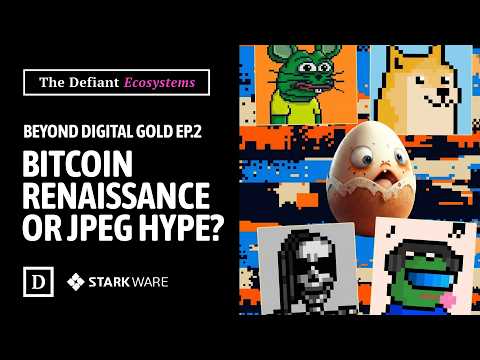
The Bitcoin Renaissance Legacy : Beyond Digital Gold Ep. 2
AI Summary
In 2023, Bitcoin underwent what many observers describe as a renaissance, a period defined by the sudden emergence of NFTs, meme coins, and various tokens on the world’s oldest blockchain. This era brought back the intensity of the historic block size wars, characterized by spiking transaction fees and a renewed sense of experimental energy. However, as quickly as this hype cycle arrived, it appeared to fade, with volumes cooling and prices correcting. This raises a fundamental question: was the Bitcoin renaissance merely a flash in the pan, or did it establish something more lasting? To understand the current wave of innovation, it is essential to explore the technical and cultural shifts that occurred during this pivotal time.
For years following the block size wars of 2017, Bitcoin appeared to ossify, focusing almost exclusively on its role as a payment system or store of value. Developers who wished to build complex applications or financial systems felt compelled to move to Ethereum, which offered the programmable features Bitcoin lacked. Errol Binary, a prominent developer and founder of BRC 2.0, notes that while the original dream was to build on Bitcoin, early attempts like colored coins failed to gain significant traction. This led a generation of builders to seek opportunities on other chains. However, the landscape began to shift in late 2022 as developers realized that Bitcoin’s existing infrastructure could be repurposed for much more than simple transfers.
The primary technical enabler of this shift was Taproot, a Bitcoin upgrade activated in November 2021. At the time, most participants saw it as an incremental improvement focused on transaction efficiency, privacy for multi-signature setups, and data encoding. In hindsight, Taproot was a transformative change because it significantly expanded Bitcoin's "expressive surface area." This expansion allowed developers to leverage the blockchain in ways previously unimagined. In early 2023, Casey Rodarmor launched Ordinals, a protocol that utilized this new surface area to number every individual Satoshi, or "Sat," making them unique. This enabled "inscriptions," allowing arbitrary data like text, images, and code to be stored directly on-chain.
Researcher Isabel Foxen Duke explains that Ordinals reframed Bitcoin from a simple payments layer into a robust data availability layer. Unlike Ethereum NFTs, which often rely on external storage, Ordinals are entirely native to the Bitcoin blockchain. This shift turned Bitcoin into a decentralized database, a development Rodarmor initially thought might only appeal to a niche audience. Instead, it sparked a massive wave of activity, leading to the creation of BRC-20 tokens by an anonymous developer known as Domo. BRC-20 used simple JSON inscriptions to deploy and transfer fungible tokens, effectively turning Bitcoin into a memecoin battleground. Within months, the market cap for these tokens approached one billion dollars.
The rise of BRC-20 was a populist movement; it allowed anyone, regardless of their coding expertise, to launch a token on Layer 1. This accessibility caused transaction queues to swell and fees to climb to levels that challenged the network's traditional users. At one point, more than half of all Bitcoin transactions were related to inscriptions. This surge triggered an immediate and vocal backlash from "Bitcoin maximalists," who argued that such activity was merely "spam" that perverted Bitcoin’s purpose as hard money. The community faced a significant cultural fracture between those who embraced Bitcoin as a data layer and those who insisted it remain strictly a ledger for payments.
By 2024, the limitations of the BRC-20 experiment became clear. The protocol was straining Bitcoin’s accounting system, specifically the Unspent Transaction Output (UTXO) set, making it cumbersome at scale. In response, Rodarmor introduced "Runes," a protocol designed to work natively with the UTXO model rather than around it. Runes launched during the 2024 halving, and while they initially triggered another frenzy, the market soon cooled. Isabel Foxen Duke notes that a broader crypto market correction in March 2024 saw Bitcoin-native assets take a significant hit, with many protocols struggling to recover.
Despite the cooling of the initial hype, the technical and ideological legacy of the renaissance persists. The movement galvanized the broader crypto ecosystem to rethink Bitcoin’s potential, attracting developers who had previously abandoned the chain for Ethereum. This period of intense experimentation paved the way for current innovations in Layer 2 solutions, BitVM research, and native staking experiments. Errol Binary emphasizes that Bitcoin is ultimately "ungovernable," and because the miners and users found value in these new protocols, the trend cannot be stopped. The renaissance proved that Bitcoin’s rules could be reinterpreted without the need for controversial hard forks or permission from a central authority. Ultimately, the 2023 hype cycle was not the final destination but the ignition for a new era of infrastructure and programmability on Bitcoin. Once the door to innovation was opened, it became clear that it could never be fully closed again.