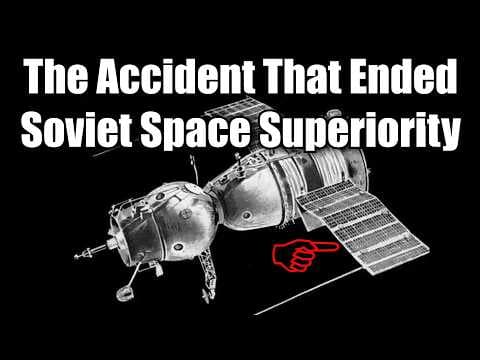
The Mission That Lost The Space Race, and Killed Its Pilot - Soyuz-1
Audio Summary
AI Summary
The Soviet space program experienced its first fatal in-flight disaster on April 24, 1967, with the crash of Soyuz 1, marking a significant setback in the space race against the US. Early Soviet successes like Sputnik and Vostok were attributed to their powerful R-7 rocket. The US progressed from Mercury to Gemini, a two-person spacecraft capable of rendezvous and docking, essential for lunar missions and space stations. The Soviet response, Voskhod, was an evolution of Vostok, enabling a three-person crew and Alexei Leonov's historic spacewalk. However, Voskhod did not advance Soviet spacecraft capabilities significantly.
The development of Soyuz, intended for lunar missions and later for low Earth orbit, began in 1962. Delays and the distraction of the Voskhod program may have impacted Soyuz's timeline. The program suffered another blow in 1966 with the death of its chief designer, Sergei Karelyev, succeeded by Vassily Mishin, who reportedly struggled to inspire the team as Karelyev had.
The first planned Soyuz flight in late 1966 aimed for a groundbreaking rendezvous, docking, and crew transfer between two spacecraft, requiring a spacewalk due to the lack of a docking tunnel. The uncrewed first launch on November 28, 1966, encountered significant problems. The spacecraft failed to maintain attitude, depleting its attitude control propellant and becoming uncontrollable. The planned second launch for docking tests was therefore scrubbed and the first spacecraft was designated Cosmos 133. Attempts to regain control revealed further issues, including a flawed thruster modification that required control cable swaps, which were not performed due to a factory manager's refusal without a clear explanation. The spacecraft attempted a de-orbit but was too high and fast, believed to have self-destructed to avoid landing in China, with no debris ever found.
Despite these setbacks, the test flight provided data to fix deficiencies. A second spacecraft was ready for a solo test flight on December 14, 1967. During engine ignition, one booster engine failed to light, scrubbing the launch. As ground crews prepared to work on the rocket, the launch escape system activated, safely carrying the Soyuz spacecraft away just before the booster exploded. The escape system was triggered by a faulty attitude gyro that had remained active and indicated a severe attitude misalignment. The rapid separation severed coolant lines, leading to a fire and the subsequent explosion of the propellant-laden booster, damaging the launch pad.
A third test launch on February 7, 1967, was initially successful, reaching orbit and performing an orbit adjustment. However, by the fourth orbit, issues arose with commands for a spin-stabilized, sun-pointing attitude, and unexpectedly high fuel consumption. Yuri Gagarin, training for Soyuz, pointed out that a pilot could have resolved many of these issues in person. Communication was limited when the spacecraft was out of Soviet range. The mission was cut short, and on February 9, the Soyuz entered an uncontrolled ballistic re-entry due to control system problems, subjecting the crew and spacecraft to high G-forces. The spacecraft landed on an ice sheet and sank before recovery teams could reach it. After recovery, a 30-centimeter hole in the heat shield was discovered, which would have been fatal even with pressure suits due to plasma penetration.
Despite three failed test flights, engineers, cosmonauts, and managers deemed it time for crewed flights, partly due to pressure to launch something significant for the Soviet Union's 50th birthday. The plan was for a rendezvous, docking, and transfer mission in April 1967. Vladimir Komarov was selected as commander for the first flight, making him the first cosmonaut to fly twice. He was highly qualified but initially excluded due to height, weight, and medical issues. His backup was Yuri Gagarin, whose selection raised eyebrows due to his propaganda value and the risk of his involvement in a dangerous mission. The crew for the second Soyuz, intended for docking, would be Valery Bykovsky, Aleksey Elisiv, and Evgeny Kronov.
Training for the mission began in February and concluded in March. Komarov and Gagarin trained in simulators for docking, while Elisiv and Khrunov practiced EVAs. Despite some engineers' concerns about the spacecraft's readiness, voiced through numerous documented issues, dissenters were overruled.
On April 23, preparations were complete. Komarov and Gagarin traveled to the launch site. The mission did not require Komarov to wear a spacesuit as the orbital module served as an airlock. Conspiracy theories about Gagarin attempting to stop the launch are unfounded; he accompanied Komarov to the spacecraft to offer well wishes. The launch itself proceeded smoothly, as the R-7 launch vehicle was a proven system.
However, once in orbit, Soyuz 1's flaws became apparent. A primary issue was one solar panel failing to deploy, possibly snagged on insulation. Komarov, unable to fix it from inside, could only attempt to dislodge it through vibration. With only one panel, the mission's power supply was insufficient, rendering the joint mission pointless and leading to the cancellation of the Soyuz 2 flight. Stories of the Soyuz 2 crew insisting on launching to fix the panel are considered apocryphal, as Soyuz 1 was the only spacecraft equipped for rendezvous.
The single solar panel severely limited power, requiring the spacecraft to be oriented for maximum sunlight. The 45k sun-star sensor, crucial for panel orientation and re-entry burn alignment, was also problematic. Without this sensor, automated orientation was impossible, and Komarov had to attempt it manually. The altered center of mass due to the undeployed panel complicated manual control, causing cross-coupling between pitch and roll axes and making spin stabilization unreliable. Komarov reported significantly increased propellant usage.
Other attitude control sensors included the horizon sensor, which determined "down" relative to Earth, and the new ionic sensor, which measured motion through the upper atmosphere. A visual orientation system using a periscope was also available. A planned orbit change maneuver using the ionic sensor and rendezvous propulsion system was successful, but attempts to return to sun-pointing using the ionic sensor were problematic, possibly due to excessive thruster use overwhelming the sensors.
By the sixth orbit, a decision was made to bring the spacecraft home on the 17th orbit, as power was projected to run out by the 20th. Power conservation measures led to a colder cabin. Komarov reported feeling excellent and took photographs. On the day of de-orbit, Yuri Gagarin managed communications. With limited battery life, Komarov had few chances for a correct de-orbit burn.
On the 15th orbit, a test of the ionic sensor for orientation showed it could hold attitude for engine firing. However, during the planned de-orbit burn over Africa on the 17th orbit, the engine failed to ignite. Data indicated the ionic sensor lost orientation as the spacecraft crossed the equator at night, likely due to a region of low ion density. Without proper guidance, the engine fire plan deactivated. Komarov had to resort to alternative methods. The Vostok's backup optical system was impossible due to nighttime. A manual orientation on the sunlit side, followed by gyroscopic stabilization, was the remaining option.
On the 18th orbit, Komarov attempted this manual alignment but manually cancelled the engine burn, believing the attitude had drifted too far. He had one more chance. He repeated the manual alignment on the sunlit side, and the nighttime attitude hold was engaged. This time, the engine fired successfully over the Atlantic for 146 seconds. Ballistics experts confirmed he was heading for a landing site, though an air condition warning indicated greater attitude drift than expected, triggering the backup ballistic trajectory.
Before re-entry, Komarov confirmed correct orientation and armed the separation system. His last words were thanks and confirmation of module separation. After re-entry, a helicopter observed the spacecraft descending rapidly under an undeployed parachute, impacting hard. The capsule was engulfed in flames, fueled by hydrogen peroxide, melting its structure. Firefighting efforts were insufficient, and the capsule collapsed. Komarov was officially killed on impact, his body unrecognizable.
The cause of the disaster was the main parachute failing to deploy. The parachute container lid jettisoned, and the drogue chute deployed, slowing the capsule. However, the main parachute package remained stuck in the container, its walls squeezed inwards by atmospheric pressure at altitude, gripping the parachute tightly. This was exacerbated by the pressurized cabin. The reserve chute deployed but became tangled with the still-attached drogue chute from the main system, failing to deploy properly. The heat shield also failed to separate, preventing the landing rockets from arming, and contributing to the fire.
The reserve parachute container was shorter and possibly more structurally resistant, and deployed at a lower altitude with less pressure differential. The earlier successful parachute tests likely involved capsules at lower altitudes, unpressurized, or with holes that prevented pressurization. A later claim suggested incorrect heat shield application allowed resin to enter the parachute container, increasing friction, though factory workers disputed this.
Sensationalist claims of Komarov's last words, screaming insults, are unsubstantiated. Radio communications after re-entry were impossible as the antennas were part of the undeployed main parachute lines. The VHF system's reception equipment was specialized. The last logged transmissions were from space.
The disaster could have been worse. If the solar panel had deployed, Soyuz 2 might have encountered the same parachute failure. A year later, Soyuz 2 flew uncrewed, followed by Soyuz 3, which also failed to achieve its docking mission. Soyuz 4 and 5 finally achieved crew transfer in 1969, though Soyuz 5 nearly ended in disaster. By the time Soyuz 6 launched, the US had landed on the Moon. While the N1 rocket's failure is often cited, the Alexei Leonov spacewalk marked the last time the Soviet program genuinely led. Despite its tragic beginnings, Soyuz has been a successful crew vehicle for nearly 60 years, influencing other spacecraft designs.