Michael Phelps' New Chapter
Audio Summary
AI Summary
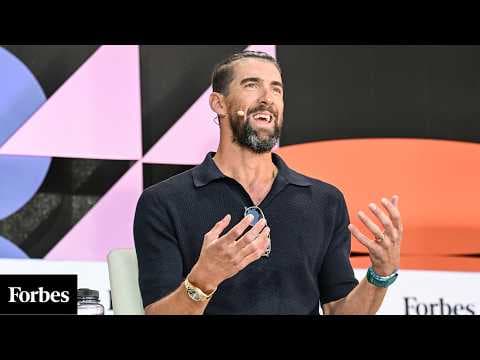
The speaker, Michael Phelps, a highly decorated Olympic swimmer with 28 medals, including 23 gold, was featured on the cover of Forbes magazine, a rare honor for a swimmer. He was invited to speak at the Under 30 Summit, recalling a past incident ten years prior at a similar event in Boston. What was planned as a fun run for a few hundred people on the Charles River unexpectedly drew 2,000 to 3,000 attendees, turning into a chaotic event likened to a celebrity-led run club. The speaker, who doesn't typically run, found it wild. A local TV station had announced the run, leading to 7,000 people showing up. The speaker humorously noted that he, an Olympic athlete, quickly outpaced his companions during the run.
The discussion then shifted to the discipline required to achieve success, especially when winning margins were as small as hundredths of a second. Phelps explained that his approach was to constantly ask himself what he could do every day to improve, even marginally. He noted that the combined winning margins for six or seven of his Olympic medals were less than half a second. This meant being prepared under immense pressure, as he had a chance to win an Olympic gold medal only every four years. His preparation was relentless, focusing on improvement even on days he didn't feel like it. He emphasized that in swimming, taking one day off requires two days to recover to the previous level of fitness. His unique success, including winning 23 Olympic gold medals and eight in Beijing, stemmed from swimming six straight years without missing a single day, including Sundays and holidays, because he "wanted and expected different results."
Phelps detailed his focus on minute aspects of his swimming, such as stroke kicks, streamlines, turns, and finishes. He believed that under pressure, he would revert to these ingrained habits. Throughout his 20-year career, he viewed each race as a test, relying on a "backpack filled with tools" gained from consistent practice. He stressed the importance of daily effort, knowing that someone else was always willing to do the small things to get better, and he wanted to be that person.
When asked if his approach was a solved system or constantly evolving, Phelps stated it was always evolving because he, as a human, was always changing. He highlighted the 20-year partnership with his coach, which began when he was 11. Their relationship had to adapt as he grew older and found his voice. He expressed profound gratitude for his coach, believing no one else could have coached him as effectively. He also mentioned having the same trainer for 15 years, who focused on dry-land training and recovery methods like cold tubs, Graston technique, and cupping. He emphasized building a trusted team around him that helped him be his best self, even though he was the one in the water.
Reflecting on his life after retiring from swimming at 31, having achieved the pinnacle of his sport, Phelps discussed channeling his energy. He explained that he "retired twice" and then naturally transitioned into mental health advocacy. His own mental health journey began when he "didn't want to be alive anymore." He sought help and learned that others shared similar struggles, prompting him to speak openly about it to reduce the stigma around mental health. He highlighted the stagnant suicide rate, which deeply saddens him, and stressed the importance of asking for help, especially for male athletes who are often expected to be strong and macho. He believes mental and physical health are intertwined and must be cared for together to be one's best self.
Phelps acknowledged that his openness about his mental health struggles has made him a role model, demonstrating that vulnerability has nothing to do with weakness. He revealed that he compartmentalized his feelings during his career, which contributed to his success but ultimately led to issues. However, during his comeback from 2014 to 2016, leading up to the Rio Olympics, he actively focused on his mental well-being, attending therapy and meetings. This shift made him feel like "a kid again," excited to train and compete. Although physically demanding to compete against younger athletes at 30, he found joy in loving what he was doing again. He expressed contentment with what he knows now, stating he wouldn't change his past struggles as they allowed him to see himself as a human being with feelings and emotions, not just "the Energizer Bunny."
He drew parallels between his physical and mental training, emphasizing the importance of routines. As an athlete, his life was meticulously scheduled for 20 years. He now applies this to his mental well-being, seeking routines that work, especially with four young children.
Describing his mental process on the starting block, Phelps stated that he couldn't afford to have many thoughts, as it would distract him from the present moment. Dwelling on past mistakes or insufficient preparation would pull him out of the intense focus required. He found he raced with the most intensity when fully present and prepared. Races were tests, showing him areas for improvement to achieve goals that others deemed impossible.
When asked if he knew he would win big races, he said "yes" for most Olympic Games, citing 2004 and even 2008, despite a broken wrist six months prior. He felt confident because he could read his competitors better than they could read themselves, observing their practice habits and facial expressions. His confidence stemmed from his unparalleled work ethic, asserting that "nobody outworked me on the planet."
Phelps offered advice for company founders, emphasizing the importance of focusing on small, consistent steps. He likened it to building a puzzle, where many small pieces contribute to the larger goal. Greatness, he explained, is "a bunch of small things done well that stacked on top of each other." His own goals and dreams outweighed any physical pain, driving him to do what others weren't willing to do.
On achieving goals and then setting new ones, Phelps described an obsession with numbers and pushing himself beyond his own beliefs. His coach instilled in him at age 11 the importance of removing "can't" from his vocabulary, believing that saying you can't do something prevents you from doing it.
Regarding reading people, especially in a competitive setting like poker (which he plays, having recently placed 11th in a charity event where his wife made the final table), Phelps looks for "grit," drive, and the willingness to do the "dirty work." He values goal-driven individuals and good team players, reiterating that his success was not solitary but built with a trusted team that remained with him throughout his career. He highlighted his decision to move to Arizona to follow his coach, who was at ASU, prioritizing the team dynamic over personal convenience. He also praised the Phoenix/Scottsdale area for its climate and positive impact on his mental health.
Finally, offering advice to the conference attendees, many of whom are around 25, he shared the message "be you," a sentiment from a bracelet a friend's daughter made him. He urged people to be their authentic selves and not be afraid to show it, recognizing that everyone is special in their own way. He emphasized that while he was a swimmer, he was also a human being with feelings and emotions.
The session concluded with Phelps receiving the first-ever Forbes Under 30 Role Model award, recognizing his extraordinary achievements and his honesty and openness in helping others, particularly through his mental health advocacy. The presenter praised his vulnerability as what makes him truly special.