Paul Jorion - L'Iran veut la destruction d'Israël et réciproquement
AI Summary
This summary covers a video presentation dated March 10, 2026, regarding the ongoing conflict in the Middle East. The speaker provides a deep analysis of the war involving Israel and the United States on one side, and Iran and its regional neighbors on the other.
The speaker begins by outlining the current military landscape. Iran, unable to strike the United States directly due to geographical distance and weaponry limitations, has turned its attention to neighboring countries that host American military bases. While Iran can target Israel, the speaker notes that Israel remains heavily protected by a sophisticated defense dome, which has intercepted most Iranian missiles thus far. Consequently, Iran has shifted its strategy toward countries like Saudi Arabia, Kuwait, Qatar, the United Arab Emirates, and Dubai. These nations are viewed by Iran as "de facto accomplices" because they provide the infrastructure for American military operations.
A significant portion of the analysis focuses on the extreme vulnerability of these neighboring Gulf states. The speaker highlights that these are desert regions with very little natural water or agriculture. Their survival depends almost entirely on massive desalination plants and food imports arriving by ship or plane. The speaker points out that these desalination facilities are "vital points" that are easily destroyed by aerial bombardment. Furthermore, the Strait of Hormuz—the narrow passage through which essential supplies must travel—is only about 30 kilometers wide, similar to the English Channel between Calais and Dover. The speaker notes that this waterway is easily blocked by mines or coastal fire, a tactic already demonstrated by the Houthis in Yemen, who are allies of Iran.
To explain the underlying logic of this escalating violence, the speaker introduces the theories of Dominique Temple, an author known for his work on the concept of "reciprocity." The speaker argues that Temple’s work provides the "key" to understanding the current crisis. The analysis distinguishes between three types of interaction: positive reciprocity, negative reciprocity, and the total absence of reciprocity.
Positive reciprocity is described as the "turn the other cheek" philosophy associated with Jesus Christ—a willingness to pause, call a ceasefire, and engage in dialogue. Negative reciprocity is the traditional "eye for an eye" or "tit-for-tat" logic of the Law of Talion. The speaker suggests that while negative reciprocity involves revenge, it actually allows for wars to eventually end without the total destruction of either side, as both parties eventually feel "avenged" enough to stop.
However, the speaker asserts that the current conflict between Iran and Israel has moved beyond these frameworks into a state of "non-reciprocity." In this state, both sides have dehumanized the other to the point of viewing them as "vermin," "dogs," or "animals" that must be exterminated. The speaker references the rhetoric of a "free Palestine from the river to the sea" and the Iranian call for the destruction of Israel. Conversely, the speaker notes that Israel, with the backing of the United States, appears committed to the total annihilation of the Iranian regime. Because both parties consider the other unworthy of existence, the speaker believes the war cannot end until one side is completely destroyed.
The speaker then describes the dire situation on the ground in early March 2026. In Tehran, the atmosphere is apocalyptic. Due to the explosion of major oil reserves, the city is covered in thick soot and smoke, making it impossible for residents to breathe and turning day into night. Despite these conditions and massive internal protests, the Iranian government continues to project a "business as usual" image, recently appointing the son of the former leader, Khamenei, to succeed his father.
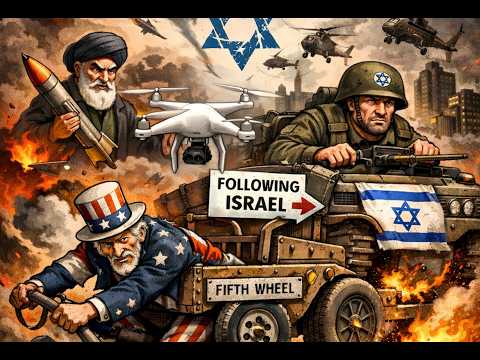
Turning to the American role, the speaker is highly critical of the U.S. government under Donald Trump’s second administration. He describes the American response as a "cacophony" and characterizes the cabinet as having an exceptionally low "intellectual quotient." He specifically mentions Marco Rubio, the Secretary of State, and argues that the U.S. has essentially followed Israel's lead since 1948. The speaker suggests that the U.S. is "stuck" in a cycle where it simply reacts to the decisions made by Benjamin Netanyahu, who is focused on the destruction of Iran.
The speaker concludes by reflecting on the "collateral victims" of this existential struggle. Countries like the United Arab Emirates and Dubai, which once styled themselves as terrestrial paradises, are now facing severe shortages of drinking water and food. The global economy is also reeling; while high oil prices may benefit Russia, they are devastating for China, which relies heavily on oil passing through the Strait of Hormuz. Ultimately, the speaker remains pessimistic, viewing this as the "worst possible kind of war" because it is driven by a mutual desire for total elimination rather than a negotiable political grievance. According to the transcript, there is no sign of a ceasefire because neither side is willing to recognize the humanity of the other.