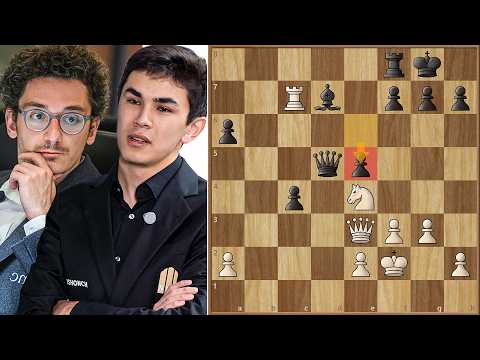
"Vacation Mode" || Fabiano Caruana vs Javokhir Sindarov || FIDE Candidates Tournament 2026 R11
AI Summary
Welcome to round 11 of this year's FIDE Candidates tournament, featuring a highly anticipated game between Fabiano Caruana and the leader, Javokhir Sindarov. Sindarov currently leads by a two-point margin over Anish Giri and three points over Caruana. For Fabiano, qualifying for the World Chess Championship match is becoming increasingly difficult, but a win in this game would certainly boost his chances and motivate Anish Giri.
The game opened with Knight to F3, followed by Pawn to D5 and Pawn to C4, leading into the Catalan. After several theoretical moves, including Pawn to E6, G3, Knight F6, Bishop to G2, Bishop to E7, Castles, Castles, and Pawn to D4, the D pawn was captured, and Knight to E5 was played. This sequence represents the most classical line of the Catalan. Knight to C6, usually met by knight captures on C6, was instead met by Bishop captures, B captures, and Knight captures on C6, attacking both the queen and bishop. Queen E8 followed, and then Knight captures on E7 check, leading to Queen captures. This entire sequence is well-established theory, with many games featuring this exact setup. Queen A4 and Queen to C2 are strong moves in this line.
Bishop to E3, a rare move, was played by Fabiano. This move has been seen in games by Nihal Sarin and Nicolas Theodoru, a game that Caruana and Sindarov would follow. Knight to D5 was played, putting pressure on the bishop, and Queen to C1 was played, indicating readiness to recapture with the queen and the C4 pawn. Rook to B8 was played, threatening to capture on B2 if the queen moved. Knight to C3 followed, with Fabiano offering a pawn. Both players had nearly full time on the clock at this point, despite being on move 13.
After Knight captures, Queen captures, and Rook captures on B2, Fabiano played Rook A to B1, diverging from the game between Istdor and Pavle Eljanov, which featured Rook F to B1. From move 15, the game became completely new. However, Javokhir was still familiar with the line, playing Rook captures on B1, followed by Rook captures on B1, and Pawn to A6. Fabiano later stated in an interview that he played F3 at this point but was already unsure of the position. Javokhir also confirmed being out of theory around this time, yet both players still had ample time on the clock.
Javokhir played Bishop to D7, aiming to re-route the bishop to C6 to control the diagonal. King to F2, Bishop to C6, and Pawn to D5 followed, with Fabiano playing actively to create chances. The queen on E7 was undefended, preventing captures. Fabiano then played Rook to B7, leading to a complex position. Javokhir found Queen to D6, and Knight to E4 attacked the queen. Queen captures on D5 followed, then Rook captures on C7.
Javokhir considered playing Rook to C7, which he believed was the safest option, leading to a rook trade and potentially a draw, which would suit his goals as he wasn't in a better position. He also considered H6 without Rook to C8 but realized it would lead to trouble after Rook to C5, attacking the queen. Queen to B7 or Queen D1 were considered, with Queen D1 being the better idea. This would lead to Knight F6 check. If G captures, you must recapture; otherwise, King to H8 leads to Rook to H5, and there's no defense, as Rook captures on H6 would end the game with the knight covering key squares. Even capturing the knight on H wouldn't help, as Rook H5 and Queen captures would lead to checkmate. This intricate line highlights the depth of calculation.
Instead, Javokhir played Pawn to E5, which negated the effectiveness of Rook to C5. Fabiano played Queen C5, and Javokhir responded with Bishop to E6. Queen captures, Bishop captures, and Knight to C3 attacked the bishop. Bishop returned to E6, and then Rook to C5 was played, a move Javokhir stated he missed. He played F6, and Rook to C6 followed, creating problems. King to F7, and Fabiano captured the A6 pawn, equalizing material and gaining an outside passed pawn, which posed a significant threat.
Rook to B8, Rook to A7 check, King to G6, and Rook to E7 put pressure on the bishop. Rook B6 defended, and Fabiano played Pawn to G4 (Pawn to H4 or H5 would have been more precise). Both players were now under the one-hour mark. Javokhir responded with Pawn to H5. After captures, King H6 kept the pawn. Javokhir's idea was that at some point, he might sacrifice the light-squared bishop to stop the white king from advancing the passed C pawn, then capture weak pawns, potentially even being down a piece, but still securing a draw.
King E1, Bishop to F5, Rook to C7 going after the pawn, Bishop back to E6, and King to D2. Rook to D6 with check, King to C2, and Rook to D7 offering a rook trade, which Fabiano declined with Rook to C6. Bishop to F7 and Pawn to A4, with Fabiano advancing the passed pawn. Rook to A7, King to B2, King captures on H5, and King to A3. Rook to B7, and Knight to B5 was played.
King G5, and Rook to C5. Another possibility was King to B4, a funny line that could lead to a draw for black. After King to F4, Rook to C7, and rook trades, King to E3, Pawn to A5, King to D2, and Knight to B5, black could win. If A6, both would queen, but white queens faster. However, after C1 queen, there's only one check, and the A2 square is covered by the bishop. After the check, King captures on E2, and black is up material and completely winning. This would be a problem for Fabiano.
So, Fabiano played Rook to C5. King to F4, and Pawn to A5, advancing the passed A pawn. King E3, Pawn to A6, and Rook to B6, putting pressure on the pawn. A7, Rook A6 check, King to B4, and Bishop to E8. Rook to C7 put pressure on the G7 pawn. King captures on E2 was played. Knight to C3 check, King captures on F3, and Rook captures on G7, followed by Pawn to E4 and Rook to E7, targeting Javokhir's bishop.
There were still ways to blunder the game, for instance, Bishop to H5 would lead to King to B5 and a win for white, as moving the rook would allow Knight A4 and the pawn would queen. However, Javokhir played correctly with Pawn to F5. Rook captures on E8, Rook captures on A7, and Rook to F8. Javokhir was now down a piece, but his pawns were incredibly strong. Rook H7, Rook captures on F5 with check, King to G2, and Knight captures on E4. King captures on H2. With zero pawns for white, this position is a draw, as a rook versus a rook and knight is a draw.
Knight to F6 was played, still hoping for a mistake. However, Javokhir played Rook to C7, and Rook to C5 offered a rook trade. After captures, King captures, and even Pawn to C3, it seemed Fabiano might lose. But Fabiano played Knight to G4 check, and in this position on move 58, Fabiano Caruana and Javokhir Sindarov agreed to a draw. Knight G4 check was the only move that drew. After King G3, Knight E3, and King F3, Knight C2, the king would follow, defending the pawn. This would lead to a draw by insufficient material.
All games in round 11 ended in a draw, leaving the standings unchanged. Javokhir Sindarov maintains a two-point lead over Anish Giri. While a draw is still possible for Fabiano to tie with Javokhir, it would require Javokhir to lose three games and Fabiano to win three, which is highly unlikely, estimated at less than 1% chance. Fabiano stated he aimed for a solid, risk-free game, pushing for a long time, and indeed the game lasted for five and a half to six hours. Javokhir's incredibly solid play and perfect calculation, even in difficult positions, ensured the draw. The likelihood of a World Chess Championship match between Javokhir Sindarov and Guaraju is increasing.