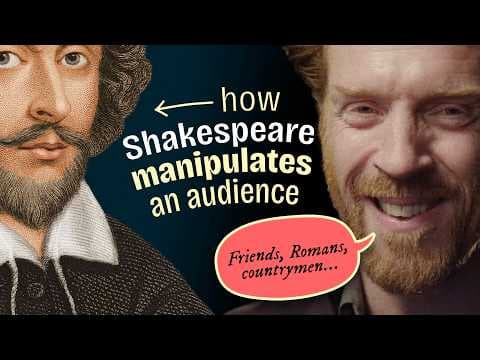
How Shakespeare Manipulates An Audience
AI Summary
Mark Antony delivers a eulogy for Julius Caesar, who was assassinated by senators including Brutus, who feared Caesar's ambition would destroy the Roman Republic. Antony, initially playing along with the conspirators to save himself, agrees to speak at Caesar's funeral after Brutus has justified the assassination to the Roman crowd. Brutus, appealing to the crowd's reason and trust in his honor, convinces them that Caesar had to die for the sake of free Roman citizens, leading the crowd to cheer him and condemn Caesar.
Antony then steps up to a hostile crowd. He begins by using stressed syllables and addressing them as "friends" rather than "Romans," aiming for an emotional connection. He states his intention to "bury Caesar, not to praise him," which is a rhetorical deception as he fully intends to praise Caesar and condemn the conspirators without appearing to do so. He starts by saying, "The evil that men do lives after them; the good is often interred with their bones," subtly prompting the audience to consider the good Caesar did, associating "good" with Caesar's corpse and "evil" with the living conspirators.
Antony then addresses Brutus's assertion that Caesar was ambitious, stating, "The noble Brutus hath told you Caesar was ambitious. If it were so, it was a grievous fault, and grievously hath Caesar answered it." He uses indirect speech ("Brutus is saying that Caesar was ambitious") and the conditional "If it were so" to introduce doubt about Brutus's claim. He repeatedly refers to Brutus and the other conspirators as "honorable men," but the delivery of this phrase, particularly by Lewis, implies growing sarcasm and contempt.
He reminds the audience that Caesar was his "friend, faithful and just," subtly linking friendship with good rulership. Antony then provides counter-examples to Brutus's claim of ambition. He mentions Caesar bringing captives home, whose ransoms filled Rome's public coffers, and Caesar weeping when the poor cried, suggesting these actions were not ambitious. He uses rhetorical questions to engage the audience, asking, "Did this in Caesar seem ambitious?" and "Ambition should be made of sterner stuff."
Antony further challenges the idea of Caesar's ambition by recalling that Caesar thrice refused a kingly crown. While refusing a crown might be a smart move for an ambitious autocrat in a republic, Antony knows the crowd will interpret it as the opposite of ambition. As he repeats the refrain, "Yet Brutus says he was ambitious, and sure, he is an honorable man," his sarcasm becomes evident, infused with genuine rage, which also serves as a rhetorical tactic to elicit anger in the audience.
He then makes a risky move, telling the audience, "You all did love him once, not without cause. What cause withhold you then to mourn for him?" He subtly redirects some of their anger and frustration towards themselves, making them feel guilty for cheering Caesar's murder. Antony elevates his language, stating, "Oh judgment, thou art fled to brutish beasts, and men have lost their reason," implying the audience acted like beasts. This challenge is softened by his earned trust with the audience, his use of rhetorical questions, and addressing an abstract concept rather than directly scolding them. Lewis's performance conveys this anger as grief, which elicits pity rather than defensiveness.
Antony skillfully places himself below, with, and above the audience, evoking sympathy for himself, for Caesar, and for the audience's own thoughtless response. He concludes by declaring, "My heart is in the coffin there with Caesar, and I must pause till it come back to me," allowing the audience to process his words and arrive at their own verdict, which, by this point, is no longer a surprise.