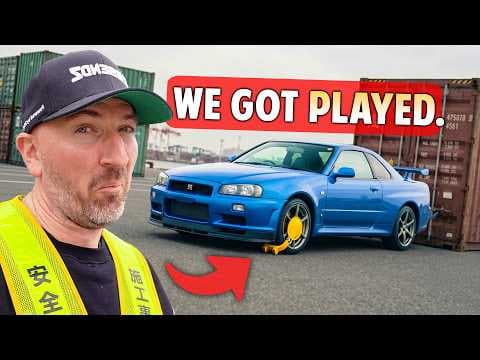
The Japan Car Market Scam Nobody Talks About
Audio Summary
AI Summary
The speaker explores whether buying JDM cars in Japan and importing them to North America is still a "cheat code" or a myth. The journey begins in Osaka, described as a grittier, more "DTE" (Down to Earth) city compared to Tokyo, making it an ideal location to establish a DTE headquarters.
The first stop involves meeting with "Pixel Man's" brother, who owns several impressive cars. The conversation touches on the R34 GTR, which the owner, at 49, prefers over the R35, stating R35s are for older individuals and R34s offer a more engaging manual driving experience. The speaker agrees, emphasizing the joy of driving manual regardless of age.
Next, the group discusses the process of importing cars from Japan to the US with Horit, their Uber driver who also owns several cars. Horit explains that cars can be shipped via "RORO" (roll-on/roll-off) boats, which is an open ship, or in more expensive containers. RORO is generally used for cars that aren't ultra-expensive or pristine. He also advises on negotiating politely in Japan, avoiding aggressive American negotiation tactics.
They then visit a car enthusiast's garage, where a covered car is revealed to be a highly customized, widebody FD RX7 with a NASCAR-inspired livery. The car features a gutted interior, carbon door cards, and a rotary engine that previously blew its apex seals due to detonation from a big turbo, producing around 450-470 horsepower. The owner, who is 49, plans to rebuild it for time attack racing by the time he's 55, after which he might consider selling it. The speaker jokingly offers 20,000 yen, then 10,000 yen, highlighting the owner's passion for cars beyond monetary value.
Another car at the garage is a Nissan 180, which the speaker connects to a humorous family anecdote about his parents' divorce over a 240. They then discover a clean S13 Silvia, which the owner might be willing to sell. The S13, an SR20 turbo, has 110,000 km on the chassis and 40,000 km on the engine. It has some minor issues like power steering noise and a noisy clutch throw-out bearing, and the AC is not working, all of which are noted as "discounts." The owner has had the car for about 18-20 years and built it to pay homage to the R34 M-spec, using R34 wheels and a GTR shifter. The speaker considers it a potential project car for Adam LZ or himself.
A truly special car is then unveiled: a first-generation 1986 Toyota Soarer, a one-owner vehicle with only 46,000 km. This "time capsule" car is in immaculate condition, retaining factory plastic on the door panels and a distinct "smell of Japan." It showcases advanced 1980s technology, including an electronic display with a digital tachometer and speed alarm, power windows, cruise control, and touch-button HVAC controls. The speaker marvels at Toyota's innovation, which pushed luxury brands like Mercedes to develop models like the W140 S-Class. The Soarer features unique details like seatbelt reminders and large fender-mounted mirrors. It's powered by a six-cylinder engine and is for sale.
Later, the group learns about a previous engine blow-up experience from the R34 GTR owner, where a connecting rod snapped. This incident led him to route the wastegate out the side of the car, a practical modification based on failure rather than aesthetics.
The group then visits another enthusiast's home, whose great-grandfather built the house. Inside, a Toyota Carina with a non-stock engine is revealed to have a VTEC engine. In the back, a 13B rotary engine is being disassembled, intended as a backup for a new engine the owner is building, a testament to his "heavy foot."
Finally, the group heads to Global Auto, a dealership specializing in JDM legends. Before arriving, they enjoy a meal of 7-Eleven Japanese food, including fried chicken, yakisoba, tamago sando, and donuts, praising its affordability and quality compared to Western fast food.
At Global Auto, a vast collection of iconic JDM cars like Skylines (R32, R33, R34 GTRs), Evos, STIs, and Supras are displayed outdoors, despite being valuable inventory. The speaker is particularly interested in finding an R33 GTR for a secret project. They discuss the differences between R32, R33, and R34 GTR tail lights as a key identifier.
They inspect a white R33 GTR that isn't "super clean," which is desirable for their project as it will be cut up and rebuilt. The market price for an R33 GTR ranges from 50,000 to 80,000 USD, but they hope to find one for around 30,000 USD given their plans for a full rebuild and rebody. They learn that R33 prices have significantly increased due to the American 25-year import rule and the devalued yen, making them as expensive as R32s. The dealership owner has several R33 GTR options, including a red one and the white one, both with some damage or rust, but still running.
The owner then takes them to a second location, revealing even more special cars, including his personal R33 400R, one of only 50 ever made and valued at approximately $3.5 million. Adjacent to it is an R34 Nismo Z-Tune, number two of only 20 ever produced, estimated to be worth around $5 million. These cars are not for sale. The speaker notes the R34 Nismo Z-Tune's carbon fiber components and factory ceramic brakes. The overall market for these rare GTRs is heavily driven by American demand, with prices skyrocketing from under $20,000 historically to millions today.
The conclusion is that the idea of Japan being a "cheap" source for JDM cars is largely a myth now. The increased demand from North America (due to 15-year and 25-year import rules) and the lower yen have driven prices up significantly. Once shipping, taxes, duties, broker fees, and other hidden costs are factored in, importing a car is no longer cheap. The speaker advises that it's often more cost-effective to find an already imported car.