The painful death of Github
Audio Summary
AI Summary
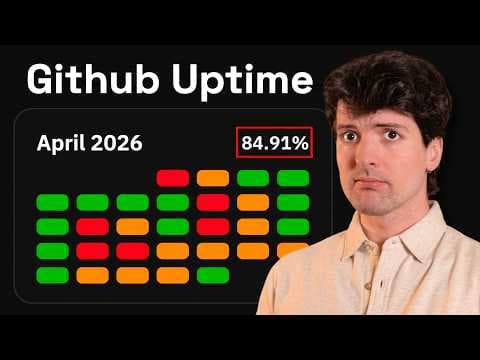
GitHub, a tool that has been foundational to my career, friendships, and projects for 15 years, is experiencing a severe decline that I can no longer ignore. The platform, which I once viewed as an indispensable pillar of the open-source community, is exhibiting a disturbing erosion of trust due to persistent and egregious outages, a lack of leadership, and a dysfunctional internal structure. This situation has become deeply frustrating and personal, leading me to question its future viability.
Just yesterday, I was completely unable to access pull requests on T3 Code, one of our major open-source projects, due to a non-functional API. This wasn't an isolated incident but one of many severe outages in recent weeks. A particularly alarming incident involved GitHub successfully reverting previously merged pull requests, leading to a "split-brain" problem where deployed code no longer matched the repository history. Such an event is catastrophic, making debugging nearly impossible and undermining the core function of a version control system. This level of unreliability is unprecedented and unacceptable.
The response from GitHub's leadership has been equally disappointing. Kyle, the COO, issued a statement regarding the merge queue regression that I found to be an "absolute slop reply." His message downplayed the severity of the incident, using phrases like "regression in merge Q behavior" and "making earlier changes appear reverted." He also tried to minimize the impact by stating that only 2,840 pull requests out of 4 million merged on April 23rd were affected, roughly 0.07%. This attempt to frame the issue as minor by extending the measurement window to an entire day, despite the outage lasting only a few hours, is disingenuous. The absence of a genuine apology, replaced by a focus on downplaying, is pathetic and indicative of a deeper problem. If I were CEO, I would fire him for such a response.
This crisis extends beyond mere technical glitches and poor communication; it points to fundamental leadership failures. GitHub currently lacks a CEO, with its operations reporting to a Microsoft Executive Vice President who oversees Core AI, Azure, and Co-pilot, among other things. This individual, whose background includes a CEO role at Lace Work and a board membership at Atlassian, appears to lack the direct experience and dedicated focus required to lead GitHub effectively. The absence of a dedicated CEO means there's no single leader accountable for failures, leading to a culture where individuals like the COO or CTO might fear owning up to mistakes for fear of being fired. This creates a vacuum of responsibility, hindering any meaningful path forward.
Furthermore, GitHub's internal organizational structure is deeply flawed. There's a significant "wall" between the product and engineering teams, with no overlap in reporting chains or processes. In a company whose primary users are developers, this separation is "f***ing nonsense." Product and engineering should ideally be integrated, especially when the product itself is an engineering product. This hard separation could potentially work if there were a strong leader at the top to synchronize efforts, but without a CEO, this structure is a recipe for disaster, leading to a "dead company."
The reliability issues can be categorized into four tiers, and GitHub is failing across all of them. The first tier, "does it work the way it did before?", has seen GitHub falter with performance regressions and broken UI elements, though these alone weren't enough to drive users away. The second tier, "does it work right now?", has become a major concern, with frequent outages rendering the platform unusable for hours. My personal experience during VidCon 2022, where a GitHub webhook outage prevented critical deployments, marked the beginning of my trust erosion. I had to manually deploy using the Vercel CLI because GitHub's basic POST request functionality was broken for two hours.
The third and most alarming tier is, "did the work I did yesterday persist?". The recent incident of merged pull requests being unmerged crosses a critical line. This means that a database migration or a new feature, once deployed via a webhook, could simply vanish from GitHub's history, leading to an irreconcilable difference between production and the source of truth. This "unfathomable" situation makes the merge button, a core component of Git, untrustworthy.
The fourth tier, "can others steal my work and harm my users?", has also been breached. A recent remote code execution (RCE) bug allowed a cloud researcher to gain access to millions of repositories. While GitHub deployed a fix rapidly, such a severe security vulnerability further erodes trust. Compounding this, GitHub's ownership of npm has led to a critical failure in protecting open-source maintainers. Tanner Lindsley, creator of Tanstack, has been trying for months, even years, to reclaim the "tanstack" package name on npm from a malicious actor who squatted on it and demanded $10,000. GitHub and npm ignored his reports, resulting in a seemingly legitimate "tanstack" package being compromised with a post-install script that steals environment variables. This demonstrates that GitHub is not only failing to support open-source maintainers but actively harming them through incompetence and neglect.
Mitchell, GitHub user 1299 and creator of Vagrant, Terraform, and Ghosty, shares similar sentiments and is moving Ghosty off GitHub. His emotional blog post details his 18-year relationship with the platform, where he spent "over half his life" using it daily. GitHub was his "dream job" and a place of immense personal and professional fulfillment. However, he now states that GitHub is "failing me every single day" with constant outages impacting his work. He keeps a journal, and "almost every single day has an X" marking an outage. He concludes, "This is no longer a place for serious work if it just blocks you out for hours per day every day. It's not a fun place for me to be anymore." He plans to keep a read-only mirror on GitHub but will transition Ghosty to other providers, predicated on "real results and improvements, not more words and promises."
I echo Mitchell's sentiment. GitHub was my "original YouTube," the platform where I built my career and learned from the open-source community. Watching it die, feeling "fear and frustration," and wondering "what's going to break this time" is deeply disheartening. This is not an overreaction; every maintainer of real software I know is severely impacted. My channel's purpose is to fight for open-source maintainers, and I would be failing my moral code if I didn't speak out.
Microsoft's stewardship of GitHub, initially a net positive with the removal of private repository paywalls, has clearly deteriorated. There is no longer any trust to repair; the foundation has been destroyed. I sincerely hope to be proven wrong, but until then, I will be rigorously evaluating alternatives. This situation is beyond unacceptable; things need to change drastically, and I see no indication of that happening. I can no longer trust or recommend GitHub.