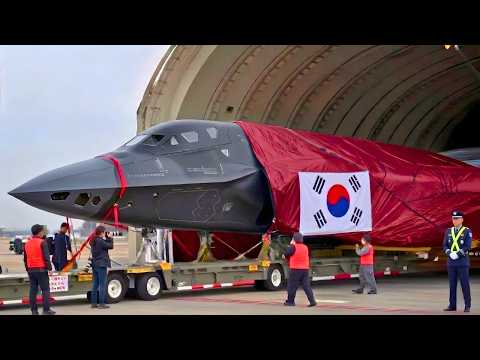
La Corée du Sud a peut-être créé le meilleur avion de chasse que personne n'attendait
Audio Summary
AI Summary
In just 33 minutes, the KF-21 Boramae shifted the aerial balance of the Pacific. On July 19, 2022, a South Korean fighter jet took off for the first time from Sachon Air Base, marking a historic moment. For two decades, Western experts had dismissed the possibility of a country without a fighter jet tradition designing a 5th-generation aircraft, asserting that South Korea would always rely on Washington for its jets. They were proven wrong. This narrative explores how a nation of 52 million people secretly developed one of the world's most formidable fighters and why this machine concerns both Beijing and Pyongyang.
South Korea faces a unique border situation, with a demarcation line to the north guarded by over a million North Korean soldiers, thousands of tanks, and since 2022, an officially acknowledged nuclear program. Seoul is merely 40 km from this border, meaning initial aerial strikes could reach the city in under 3 minutes in the event of a conflict. This context underscores that the KF-21 is not just an industrial project but a matter of national survival. For decades, Seoul's strategy was simple: buy American F-16s, F-15s, and F-35s. While powerful, these jets came with conditions, as Washington dictated their usage, targets, and weaponry. For a country that could face war overnight, this dependence posed a strategic risk that the South Korean government ultimately decided to eliminate.
The KF-21 Boramae, meaning "young hawk" in Korean, represents the pinnacle of Korean national engineering. This twin-engine jet, resembling something from a sci-fi film, is very real and dangerous. Its inaugural 33-minute flight sent shockwaves globally. The Koreans rapidly produced six flying prototypes, with one achieving supersonic speeds just six months after its first takeoff—an unprecedented pace in modern military aviation. Buyers immediately took notice, with Poland, Peru, and the Philippines expressing concrete interest. South Korea plans to have 40 jets in service by 2028 and a full fleet of 120 by 2032. Designers are also considering a naval version, the KF-21N, for potential South Korean aircraft carriers, a project actively discussed since 2020. A Korean stealth fighter on a Korean aircraft carrier in the Pacific would have been laughable a decade ago, but today, it prompts serious consideration among regional players.
The KF-21's story began in 1992 with the T-50, a more modest supersonic training aircraft. South Korea had never before designed a complex military aircraft from scratch. The T-50 was a commercial success, sold to several Southeast Asian countries, serving as a dress rehearsal for Korean engineers who were already looking ahead. In 2001, the government officially launched the KFX (Korean Fighter Experimental) program, aiming to design a combat fighter capable of rivaling top American and Russian machines from nearly nothing. The international reaction was unanimous disbelief. Analysts pointed out that even nations like Italy or Spain, with decades of military aeronautical industry experience, had never managed to independently design a top-tier fighter. South Korea aimed to do it in 20 years.
For almost a decade, the program existed mostly on paper, plagued by insufficient budgets, hesitant partners, and growing calls to simply purchase F-35s from Washington. The project seemed doomed until November 2010, when North Korea shelled Yeonpyeong Island, killing two soldiers and two civilians. This was the first direct attack on South Korean territory since the Korean War. Within weeks, the political debate in Seoul shifted from "Can we afford to build our own jets?" to "Can we afford not to?" Funding followed, and Indonesia joined as a partner, pledging to cover 20% of costs in exchange for technology transfer. Turkey showed interest but later withdrew to develop its own program, the KAAN. Lockheed Martin was a technological partner, but the Americans refused to share sensitive stealth secrets, paradoxically forcing the Koreans to develop everything themselves. The partnership with Indonesia remains fragile, with Jakarta accumulating significant payment delays, potentially leaving Seoul to absorb a much larger share of the costs.
The air force opted for a twin-engine stealth fighter, prioritizing power, safety, and a range suited to the peninsula's geography, where every kilometer matters. When the first prototype was unveiled in April 2021, skeptics were silenced. It was no longer a drawing but a real aircraft, assembled by Korean hands in a Korean factory. A nation that had never built a fighter had crossed a line many deemed insurmountable.
The KF-21 is powered by two General Electric F414 engines, also used in the American Super Hornet and Swedish Gripen. This strategic choice of a proven engine avoided a common pitfall of new engine development, which often causes delays and budget overruns. With these engines, the KF-21 achieves Mach 1.8 and has a combat radius exceeding 1000 km, nearly double that of an F-16. This is due to its approximately 6400 kg internal fuel capacity, compared to the F-16's 3200 kg. This allows the KF-21 to patrol, intercept, fight, and return to base without refueling, where its predecessor would have had to turn back.
Its armament is equally impressive, with 10 hardpoints under the wings and fuselage. For long-distance missions, it uses the European Meteor missile, considered by many experts superior to the American AMRAAM in terms of range and jamming resistance. For close combat, it carries the IRIS-T, and for deep strikes, the Korean Skydragon cruise missile, capable of over 500 km, allowing targets to be neutralized without entering enemy airspace.
The most remarkable, and often overlooked, aspect is its electronics. When the U.S. refused to share sensitive technologies like AESA radar, infrared sensors, and electronic warfare systems, the Koreans developed them all themselves, against widespread expectations of failure. The Korean AESA radar tracks dozens of targets simultaneously, and its jamming resistance surprised Western observers during initial tests. The passive infrared system allows pilots to hunt in total silence without emitting radar signals that could betray their position.
Comparing the KF-21 to the Rafale F5, which has been in service since 2001 and seen thousands of hours of real combat, the KF-21 has an obvious disadvantage: it has no combat experience. In the military world, the difference between a combat-tested jet and a laboratory-tested jet can be decisive. However, the KF-21 boasts a native modernity that the Rafale cannot claim. Designed from the outset to integrate AI combat management and an open architecture for rapid updates, it avoids the constraints of a 1980s design. This is like renovating an old house versus building a new one; both can be excellent, but one starts with fewer limitations. Designers have also left space for a future internal weapons bay, with a transition to full 5th-generation stealth planned, not hypothetical.
Currently, the KF-21 occupies a strategic middle ground: more stealthy than an F-16, more heavily armed than an F-35, and cheaper than both. This positioning makes it commercially formidable. To understand why the KF-21 concerns regional strategists, one must look at the Pacific's skies. Over the past five years, China has commissioned the J-20 stealth heavy fighter in 2017, designed for long-range dominance over the Pacific. Concurrently, it's developing the FC-31, a lighter stealth fighter for export and aircraft carriers. Since 2023, prototypes of what appear to be 6th-generation fighters have been sighted over the deserts of Sichuan. China is not just building an air force; it's building an armada.
Facing this reality, South Korea cannot afford to wait. Seoul is 1200 km from Shanghai, meaning a J-20 taking off from a Chinese coastal base could reach Korean airspace in under 40 minutes. North Korea, despite its aging but numerous air force (over 800 aircraft, some less than 100 km from Seoul), adds to the threat. In this context, every minute gained in reaction time is a matter of life or death. The KF-21, with its radar capable of detecting targets 320 km away, provides the Korean air force an alert window that its current F-16s cannot offer.
The true revolution of the KF-21 is not military but commercial, making it globally significant. For decades, the global fighter market was a duopoly: American or Russian. American jets like the F-16 and F-35 are excellent but come with heavy political strings, dictating who can buy them, what weapons can be integrated, and how they can be used. Russian jets were a credible alternative until February 2022, when the invasion of Ukraine made buying Russian politically impossible for most nations and logistically nightmarish for existing customers. The KF-21 arrives perfectly positioned to fill this commercial void.
A KF-21 costs approximately $65 million, half the price of an F-35, yet offers comparable performance for most real-world missions. For countries like Malaysia, the Philippines, or Morocco, seeking to modernize their fleets without political dependence on Washington or compromise with Moscow, this proposition simply didn't exist five years ago. Unlike American jets, the KF-21 is sold without usage conditions. Want to integrate European missiles? No problem. Locally manufactured laser-guided bombs? The Boramae can carry them. This universal compatibility is a commercial advantage that neither Lockheed Martin nor Boeing can replicate, as their jets are built around an American weapons ecosystem from which they also derive revenue. South Korea sells the plane; the weapons are the buyer's choice.
India observes this situation with particular interest. New Delhi has always sought to diversify its military suppliers, operating French Rafales, Russian SU-30s, and American jets simultaneously. The KF-21 represents precisely the type of industrial partnership India seeks: real technology transfer, partial localized production, and a competitive price. If India signs on, the KF-21 program's long-term viability becomes almost certain, and others would likely follow.
What is not openly stated but understood in defense circles is that the KF-21 also poses a direct threat to the Rafale export program. Dassault has built part of its business model on emerging markets like India, Egypt, Indonesia, and the UAE. In each of these markets, a cheaper, politically neutral, and technologically credible KF-21 is a serious competitor. Paris is aware of this and has been watching Seoul very closely since 2022.
South Korea's achievement with the KF-21 extends far beyond the military. In less than 20 years, a country without a combat fighter tradition has built a complete military aeronautical industry, including design offices, wind tunnels, assembly lines, electronic systems, and missiles. This is not merely an aircraft; it's a national industrial transformation whose effects will be felt for the next 50 years. The program directly created over 6,000 highly skilled jobs in South Korea and indirectly supported tens of thousands more in the supply chain. Korean universities have reoriented entire engineering programs to meet project needs. Companies that once manufactured electronic components for civilian industries learned to produce certified parts for military aviation. This is precisely the kind of ripple effect a major national program can generate, and few countries have the discipline to see it through.
The timeline for the coming years is clear. Block 1, air-to-air combat only, will be delivered to the first South Korean air force units starting in 2026. Block 2, which will add ground-strike capabilities, precision-guided bombs, and an improved electronic warfare system, is planned for 2028-2030. Beyond that, Block 3, whose details remain classified, should integrate initial capabilities for formation flight with autonomous winged drones, allowing a human pilot to command multiple combat drones from the Boramae's cockpit. This is no longer science fiction; it is the official program. The naval version, the KF-21N, is progressing in parallel. South Korea officially launched a feasibility study for a light aircraft carrier in 2024. If this project materializes, and political signals indicate strong will, the KF-21N would be the natural embarked fighter for this future fleet. A Korean aircraft carrier patrolling the South China Sea with Boramae jets on deck would completely redraw the naval geopolitics of the Western Pacific.
There is a universal lesson in this story that countries like Australia, Canada, Turkey, and Poland have well understood. In a world where supply chains can be cut overnight by sanctions, conflict, or unilateral political decisions, a country that cannot build its own weapons is vulnerable. South Korea grasped this after the Yeonpyeong bombing in 2010. Other countries understood it after February 2022. The KF-21 is the convincing Korean response to this vulnerability.
What is remarkable is the speed at which this lesson is spreading. Poland, traumatized by the war in Ukraine on its border, is accelerating its own defense industry while purchasing Korean equipment. The Philippines, facing Chinese pressure in the South China Sea, views the KF-21 as a credible and politically neutral solution. Indonesia, despite financial difficulties with the program, has not withdrawn, proving that the strategic value of the partnership outweighs short-term budgetary tensions.
The Boramae is not perfect. Its stealth is limited by the absence of an internal bay. Its operational experience is nil. Its international maintenance and spare parts network is still embryonic compared to Lockheed Martin or Dassault. These are real weaknesses that competitors will exploit in commercial negotiations. However, in the history of military aviation, no program is born perfect. The F-16 was too light upon release. The Rafale took 20 years to find its first export customers. The F-35 experienced years of embarrassing technical failures. What matters is the trajectory, and the KF-21's trajectory is, for now, impressive.
As of early 2026, the KF-21 Boramae is a flying, performing aircraft that is starting to fill order books. It represents a country that refused to accept dependence and emerged with one of the planet's most dynamic defense industries. A question now arises in capitals worldwide: If South Korea achieved this in 20 years, who is next? North Korea continues to test ballistic missiles. China continues to expand its fleet. And over the Pacific, a young Korean hawk now patrols the skies, where no one expected it.